
All right, so you guys know by now that I’m all over the place on this website.
Future warfare developments, science fiction, books, and reviews of products and cool stuff. Today I’m doing a review of an add-on automotive turn signal kit that I ordered from the beast for 129.99.
As you may know, I recently unloaded the Jeep project from hell, an antique 1955 Willys CJ-5 that was a lot of fun, but it ended up giving me endless grief. ‘Nuff said. I replaced it with a brand-new Mahindra Roxor, a fairly faithful WW2 Jeep clone. I ditched the antique hassle for the same vehicle without the old-stuff headaches.
The vehicle I bought was an HD Base model. By base, Mahindra means very, very basic. Zero creature comforts, but an astounding off-road machine. I had to add protection from the elements equipment, such as a windshield with wipers, a cloth top, and a hitch. This has slowed delivery a bit as the shop must install my add-ons. But that’s OK, because it’s given me time to think about what else the vehicle needs.
All right. The Roxor is legal to drive on the road where I live, with some restrictions. I discussed this with the county sheriff and highway patrol and covered my bases. The Roxor is good as long as I don’t operate it on the interstate or limited-access highways (think freeways). They also advised me not to race it or operate it while drunk. This strikes me as reasonable, sound advice.
But the Roxor I ordered, the base, doesn’t have turn signals installed, and you need those if you are going to share the road with traffic, even over limited distances, to reach the riding trails.
The dealer lady advised me she be happy to sell me an awesome recommended turn-signal kit for between 600-700 dollars.
Guys, this is a bit steep. So, I decided to see what Amazon had as an alternative. There were many kits, from very stripped-down models for about sixty bucks, all the way up to the 600-700 dollar range that I was quoted at the dealership.
Yes, I am sure that the 600 dollar kit is amazing. No, I don’t want to spend that kind of money. But what I also didn’t want to do was to buy a kit and be pissed off because it was shoddy- this would defeat my purpose- saving money. I’ve learned that you don’t want to buy just anything from Amazon because they sell junk and quality products together. Let the buyer beware.
So, after a lot of thought and searching, I settled upon the Kemimoto turn signal kit. It had a good balance of 4 and 5 star reviews, about 70 percent, and from the pictures and descriptions it seemed to be what I needed. I ordered it, fingers crossed. Two days later, it showed up. I unboxed it, curious as to what I would find.
I was impressed. Everything was neatly packaged and labeled, and the instructions weren’t pure garbage.
I decided to test the unit in my basement to do a dry run before installation. I grabbed a spare 12v lawnmower battery to simulate an automotive power source and started hooking things up.
Guys, it was childishly easy. Seriously, if you know that red is “power,” and black is “ground,” you can make this work. Everything, including the very loud add-on horn, worked as advertised without any tinkering, thought, or real effort. I have a fair bit of experience with automotive wiring harnesses. Usually, you really have to think to make things like the turn signals and horn work.
This is not the case with the Kemimoto kit. It really is a case of sticking the red wire on hot, and the black on ground, and everything works the first time. I’ll install this kit the next day when my vehicle is delivered. The biggest obstacle will be routing the wires along the chassis and locating the lights, which has nothing to do with the function of this kit, which is flawless.
One area I do think is a little dumb. The wires for the interior indicator lights use a standard marker light. Yeah, you can do this, but if you place a standard marker light on your dash, you’ll blind yourself! Of course, you won’t forget to turn off your signal with the standard old-school non-self-operating hot rod turn signal control, but those marker lights on your dash would be a bit much.
I ordered these to replace the marker lights, and I’ll use the spare marker lights elsewhere.
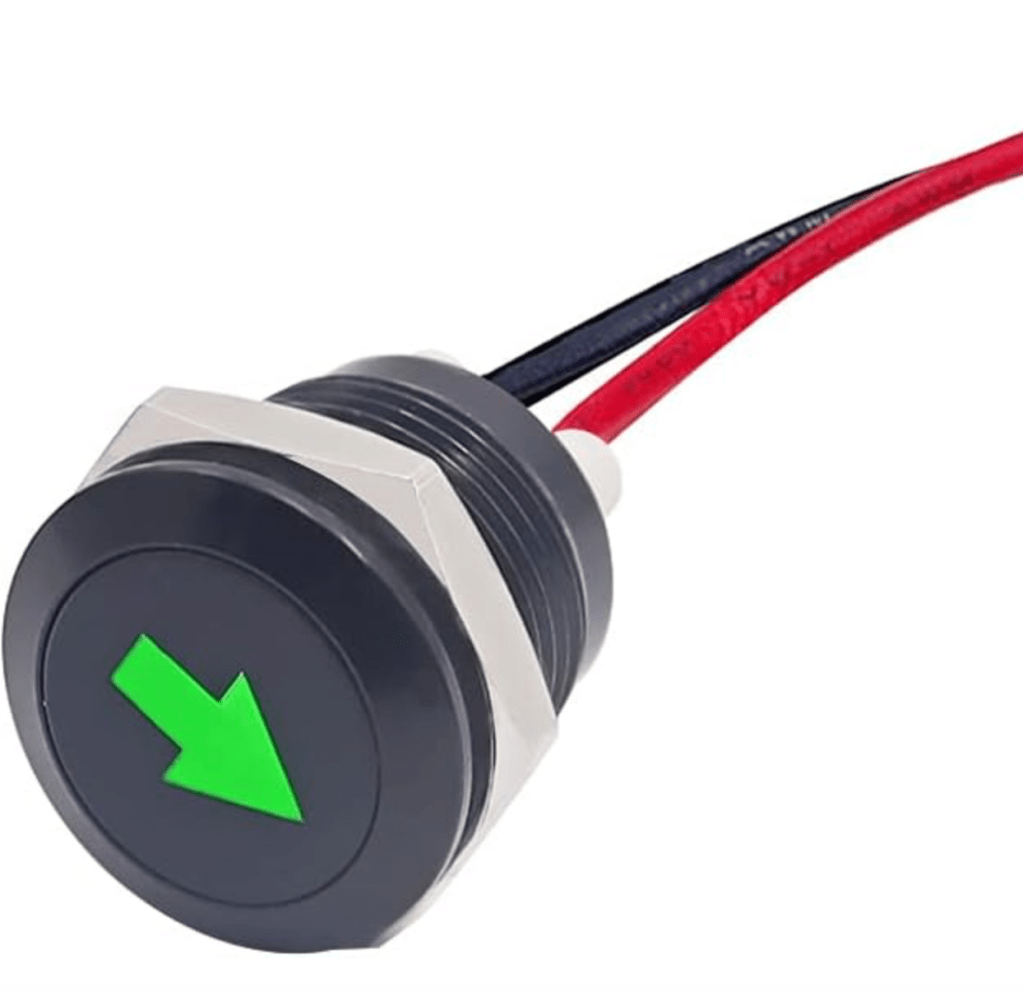
A much better look, IMO. When doing such mods to a vehicle, you should always strive for a “factory” look. The green arrows give you that.
Besides that, I can’t find much fault with this kit. I also disassembled the JC Whitney-style turn signal control assembly just to see the quality control on the internals. Everything was soldered in tight, and the hot-rod style unit worked as advertised. It did differ from the old 1950’s and 60’s units in that there is a plunger switch on the turn signal lever which controls the horn, and the body of the assembly doesn’t have the old “jewels” that light up when the turn signals are flashing.
But that’s OK. I know those old units are dead reliable, if clunky, and I was gratified to see that whoever made this loom used one.
For the money, this harness cannot be beat. Period.
Here is the mock-up I made. You can see all the components in the harness, and how they function. This took me about ten minutes to figure out, right out of the box! Very nice, very easy.
So. This will absolutely work on my Roxor, but it has all kinds of applications. Crappy cars whose turn signals died. ATVs. Antiques with no turn signals. The list goes on.
Five stars!
 The Interstellar Valley