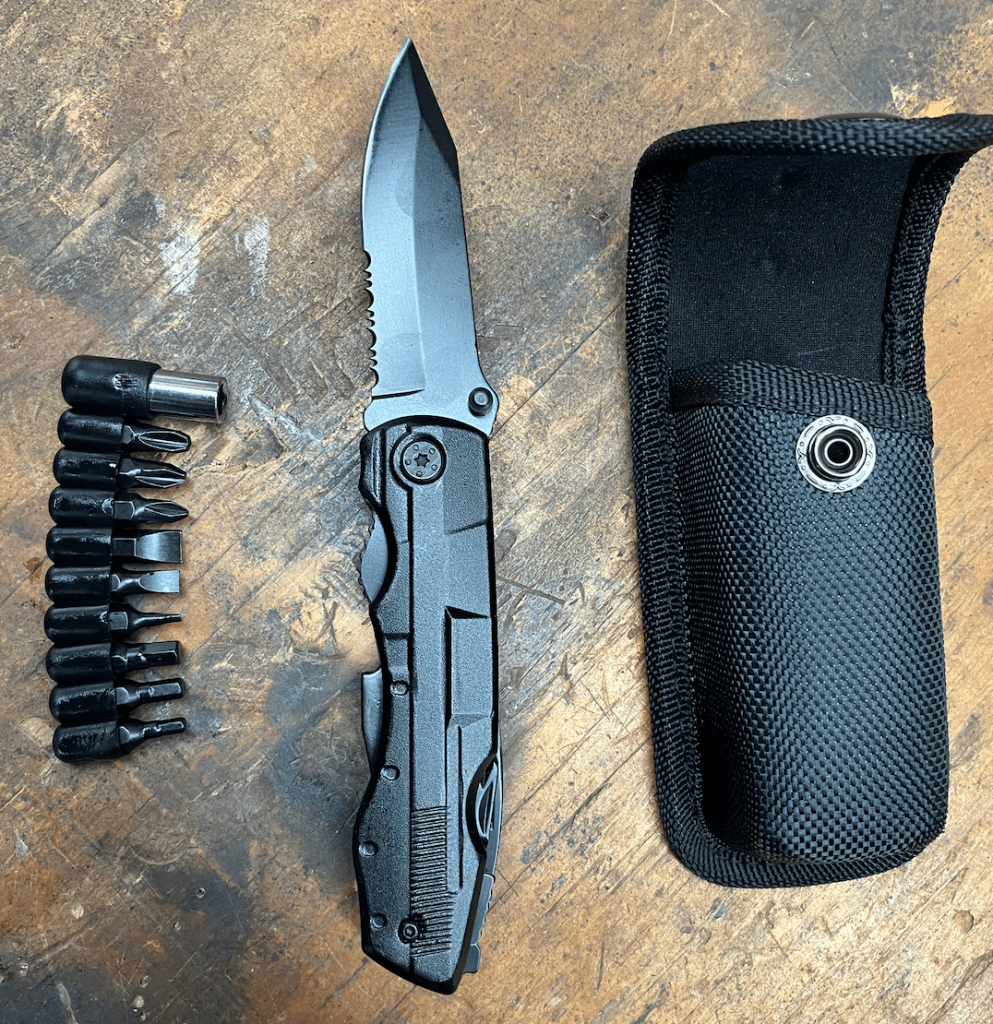
Today is another gear day. This is because Walmart changed their style of inexpensive multitool; I was dissatisfied with their latest twelve-dollar offer. They used to sell pretty good, serviceable multitools for four dollars less. No more.
I try to seed all our vehicles and likely places of use with inexpensive multitools. Nothing is so darn frustrating than doing something somewhere, and you need just one stupid tool. Something like a Phillips screwdriver or maybe a pair of pliers.
I’m a big believer in keeping tools around in multiples. For example, I must have twenty 9/16 combination wrenches in my garage. This is born of experience; on many occasions, I’ve been on the job, and I couldn’t find a wrench, or the wrench was in an inconvenient location, or I needed multiples of the same size wrench. You get it. After near half-a-century of life, I’ve had enough of that type of crap.
Therefore, I was searching for a new type of inexpensive multi-tool. I needed four or five of them to achieve saturation.
Many look down on inexpensive tools with some degree of justification. It’s true. Some are total junk. I don’t buy junk. I may try one of them; but if it fails, never again. If a cheap tool works well, I’ll buy it again. A good example is the Harbor Freight Pittsburgh line of ratcheting wrenches; for the money, they cannot be beat. They are strong, they don’t slip, and the price is right. This is one example of many.
So, when I found this handy-looking little multi-tool on Amazon US, I decided to try one. I ordered exactly one. I’ll blow thirteen dollars to try something out, but I won’t invest much money in garbage.
The website description looked promising, and I liked that this multi-tool was essentially in pocket-knife format. Unlike many multitools, it wasn’t the usual fold-out, butterfly knife configuration, and it had a locking blade. What I didn’t like was that it had no pocket clip, a definite preferred feature. With the dumb-gadget-looking strip of apex bits, it looked like using the adequate provided sheath was required.
I shrugged, thought, “Hey, thirteen bucks,” and decided to try it. A few days later, here’s what I saw when I opened the box. Also, here’s what I’ve experienced after using it for small chores over the past week.
First, let’s establish immediately that this is NOT a hardcore, beat-the-shit-out-of-it titanium hell beast meant for the end of the world. It is a thirteen-dollar multitool, probably made in the millions somewhere in the Chinese Gulag archipelago. You have to take this into account. To a certain extent, you get what you pay for, although I’ve bought plenty of name-brand stuff that purely sucked. You have to respect this tool’s limitations.
But, once you consider that, there is plenty to like about this little tool at its price point. This is, after all, why I’m doing a writeup of this little guy. Over the past week, I’ve found myself reaching for it repeatedly, and on every occasion, it has worked well. So, with that in mind, let’s talk about what this tool can do.
Did I mention that the biggest draw for me with this tool was the pocket-knife-like large, one-handed opening stud and blade locking feature? Observe.

This is really nice- it gives true pocket-knife convenience to this multitool and has a locking blade, which is a big deal. The blade can be deployed in a second with a flick of the wrist, cutting open envelopes and bailing twine just fine. I think the blade is cheap stainless, but I could be wrong. I don’t really care. I don’t plan on using this thing to pry, and I probably won’t get in a knife fight with it against barbarian hordes, so whatever. Seriously. It cuts. This is what it should do. While I’m not a huge fan of serrations, they have their uses, and you can do a lot with a three-inch blade. After a trip to the whetstone, I’d imagine that this little knife could field-dress a deer just fine. I guess this could also be a defense tool for those bloody-minded readers out there. By the way, with some experimentation, you can orient the tool in the sheath so that when drawn, your thumb automatically rests on the opening stud.
As a pocket knife, I checked the box. With a little fiddling on the blade, the lock works, and so does the knife. But what about the rest? A major detraction was the lack of a pocket clip; I’d have to use the stupid sheath to carry this thing around. Well, this turned out to be a non-issue. Observe.

The relatively tough little sheath, a standard cheap multi-tool style, has a nifty little side compartment for the strip of Apex bits. I quickly found out that when worn, it was easy to access. It didn’t interfere with the by-feel resheathing of the tool at all. Also, the little strip of Apex bits is a force multiplier; it gives you tremendous options for all those annoying fasteners you come across in a house, on the job, or on a vehicle. I didn’t appreciate this at first, but I do now. This is a very intelligent feature. Observe.

See the square Phillips bit? While you can use this as a Phillips screwdriver, and the can opener has a slot-style screwdriver head, the real power is in the square shape of this screwdriver, which acts as a drive for the Apex socket. This shaft also locks- very important if you must press down on a stubborn fastener. I’ll show you how this works. See below.
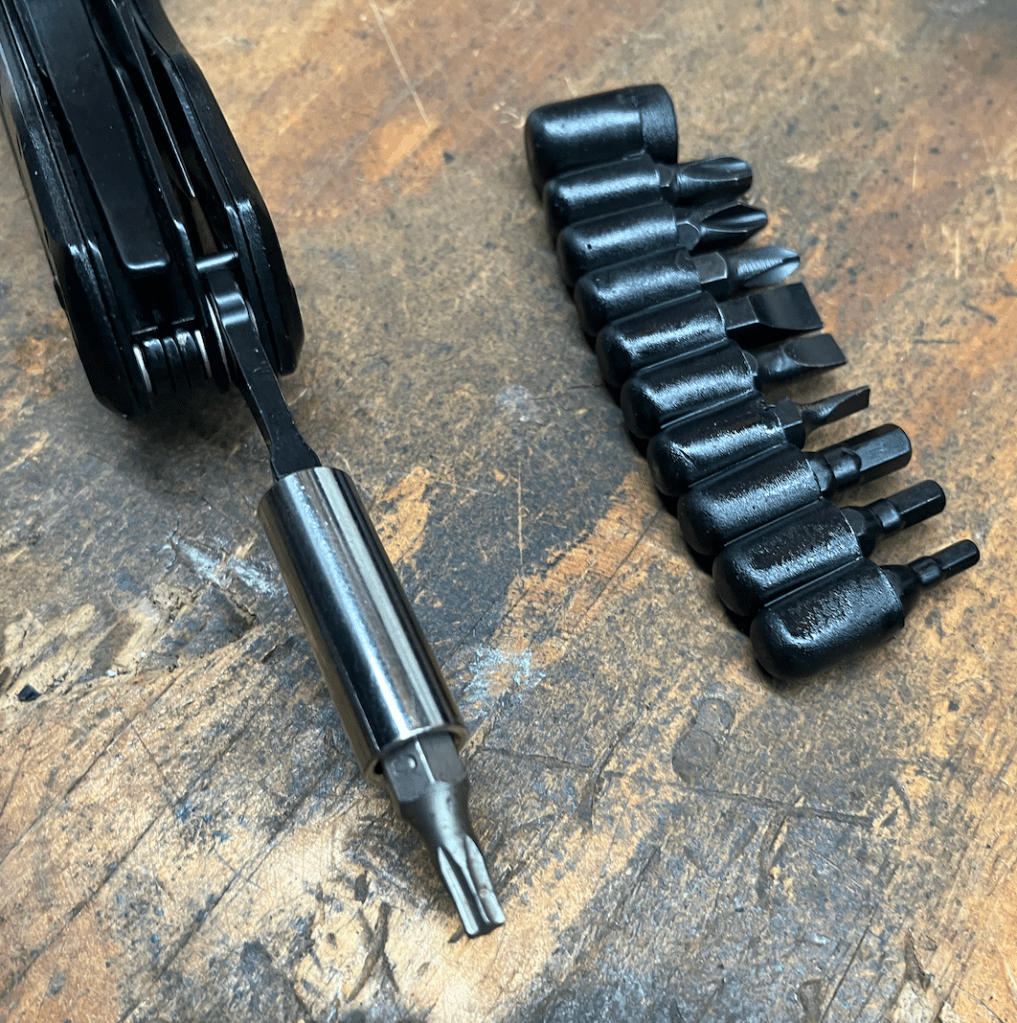
Yes, that is a T-type Apex bit, which is not included in the strip of Apex bits. Something I think is really cool is that you can mix and match bits in the snug rubber stripper to suit your needs. In the multitool I now carry on my belt, I swapped a few bits around to reflect what I’m likely to come across here. After seeing this feature in action, my reservations about the lack of a pocket clip disappeared. Also, this little multitool isn’t terribly awkward on my belt. I see now why you need to wear the sheath; it doubles the possible uses for this tool. Also, the Apex socket itself can be used as a 1/4-inch drive socket- this is a standard size for many small fasteners. Observe.

Let’s discuss the all-important feature of this multitool and the reason I took a chance with it. The pliers. Do they work? In the ad, they looked awkward. How easy are they to deploy, and how do they fit into a very small package? Well, I found out. I used the pliers that same day, and I’ve used them a couple of times since. They are handy as all hell. Check it out.

You lift a tab and swing the handle in a wide arc to deploy the pliers. Like a magic trick, the completely concealed pliers swing into view as you do so. Another question I had was how much beef the pliers have. Would they be so skinny as to be unusable? I found out. It turned out that these are pretty good light-duty pliers; as a bonus, they are spring-loaded. Look below.

The pliers are a 3 in 1 design. They are needlenose with a semi-circular slip-joint style grasper, and they are wire snips at the base. A few caveats here. Note that I said “light-duty pliers.” I mean this. If you honk down on them really hard, they might fail. See the wire above? Pretty tough stuff. After I snipped this, I had to chew it a bit, and then when I went to swing them back into the case, I had to wiggle the pliers a bit. They seemed a little sprung, but the wiggle set things back into place. It could be that if you really gave these hell, they’ll break.
Once again, respect the tool’s limitations. Get another tool to loosen a rusty, frozen 9/16 nut. However, these are great if you need to pick something up in a bad spot, remove a splinter, loosen a small nut, or snip some 14 gauge wire. I’ll show you an example of a chore I did with these pliers; they were perfect for this light-duty task. Observe.

This was a battery monitor I added to the Roxor- its function is to tell me how much I’ve drained the battery while using it as an engine-switched-off work platform. For example, running or charging tools from the inverter, using the lights and radio, etc. You don’t want to be caught with a dead battery in the middle of nowhere, so it’s a nice feature. If you’re down a couple of green bars, let the engine run for a few minutes until you’re charged up, then switch it back off. BTW fairly soon, I’ll post a Roxor update article here.
The multi-tool tightened the nut on the rocker switch, snipped the wires I ran, and tightened the 1/4 self-tapping screws you see on my homemade bezel. Yeah, I ran the screws in with an impact gun, but for the final turns on the delicate plastic housing of the gauge, I used the multitool. It worked as advertised.
Overall, I’m very pleased with this thirteen-dollar purchase. I haven’t seen any other multitools with this exact configuration, which combines the handiness of a pocket knife with the function of the traditional, fold-out style Leatherman, for example. Also, the sheath isn’t so bad once you get used to it. It is somewhat heavy, so a trick you can use when removing your pants is to loop your belt through a pants loop and snug it. I learned this trick back in the day when I wore a holstered weapon at work. While this is nowhere near as heavy as a service pistol, it does have some weight and will fall from your belt.
Time will tell how well this little guy holds out with daily use; it’s an inexpensive knife, and those usually fall apart with time and use. To be fair, however, so do the expensive ones. I’ve broken or worn out Gerbers, Schrades, Kershaws, and Camilluses. With hard use and time, all tools fail. However, this is fantastic as a glovebox tool or an emergency kit. If you need one of these in a pinch, it is guaranteed to work on that one badly needed occasion.
Respecting its limitations and manufacture, this is a damn good value. I’m so impressed that I thought to share it with you.
 The Interstellar Valley