Saving Silver II

Hey, guys. It’s time for the next Silver installment and the drastic measures I took to make it playable and presentable.

First, a bit about my side hustle, writing. The Javan War with JB is getting there, and I’m smack in the middle of Act I of ISOLATED, book one of my new alt-history series. There have been other distractions as well, such as household remodeling/repair projects which have sucked up an inordinate amount of time. It’s been super busy around here as of late.

Alright, just to bring you guys up to date- this is the second installment of the Silver process, the first installment is in the articles below.

Silver was stripped clean. It was time to figure out how to give her a traditional finish.

This was where Mr. Gordon over in PA was, once again, a tremendous resource.

For a traditional finish, you start with eggs. Eggs. You need to seal up the wood on a bare violin so that the color coats don’t bleed into the end grain of the wood; to do this, you need “albumin.” Albumin comes from egg whites.

I was a little fuzzy about exactly how to do this, so I talked with Robert and filled in the gaps with YouTube. It starts with a raw egg. You make a hole in the top, and then you pour out the egg white into a bowl. I used three eggs; I found out later I could have used two. Once I had the egg white, I whisked it until it frothed. When it frothed, I ran the mixture through a fine sieve to get rid of clumps (bad), and then I added some alcohol. BTW don’t use ChatGPT to help out here; Chatty says to add salt. Don’t believe Chatty.

The albumin, which was now fine and thin, was ready. But, before I coated the instrument, I needed to figure out my color. Why? Because to get the color you want, you have to do the entire process on a piece of pine or maple to ensure you reach the desired color. Fortunately, I had scraps of maple to test on.

Observe.
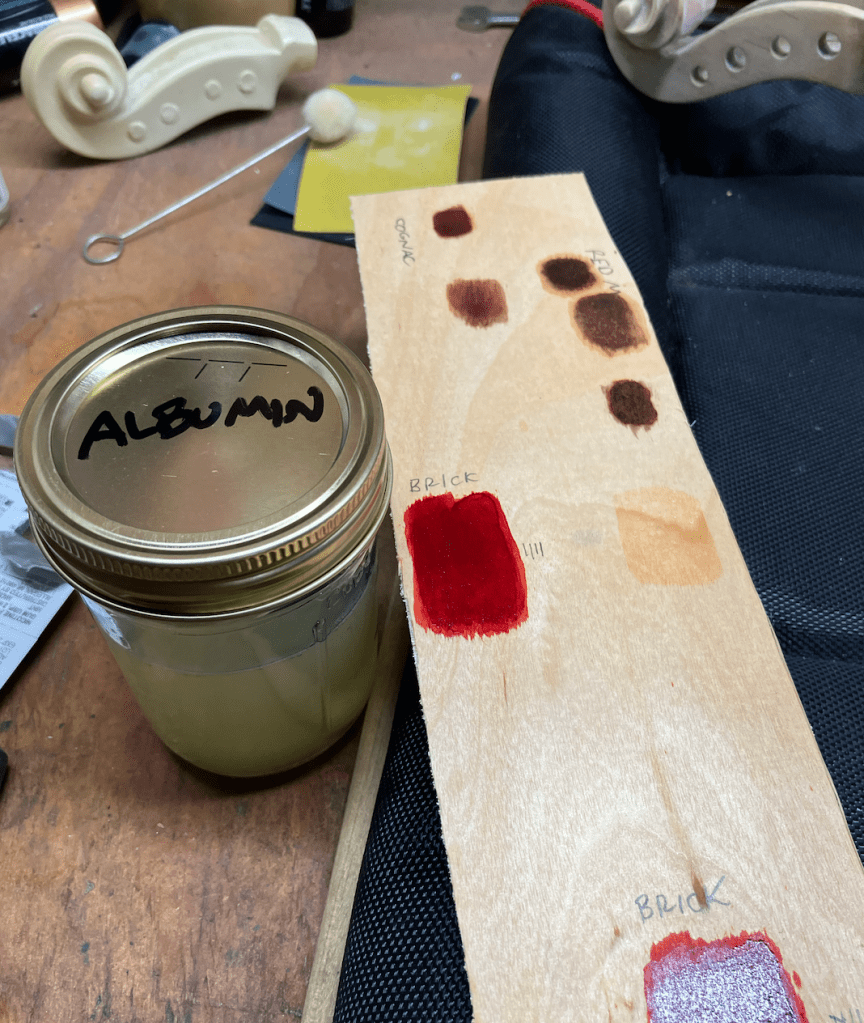
This step is where I discovered that my old go-to, Minwax Red Mahogany, was absolutely not going to work. See ugly brown splotches on my test piece. I wanted this violin to be crimson; big box store stains wouldn’t work.

What to do? It turns out that you CAN buy traditional varnish at a big box store, but you have to research and look. Bullseye shellac in a can is a real shellac (made from bugs); it is an age-old formula suitable for violins. I learned later, though, that you had better not thin it with alcohol. This is because it’s already thinned in the can. But I digress.

Bullseye in a can only comes in clear; you must find your desired shade elsewhere. It turns out that leather dye is appropriate for fiddles. On Amazon, you can find tons of leather dye concentrate in any shade you can imagine. I learned you don’t need a lot of dye to go a long way, now I have plenty.

I settled on the shade called “brick” for this fiddle. I mixed up some experimental varnish and I applied it to the test wood. I liked what I saw, so it was time to varnish.

In my many episodes of YouTube, a luthier had a really cool drying tool. It was a device that held the violin upright as it dried without contacting the violin on any freshly varnished surface. I decided to make such a thing using parts I had hanging around. Observe.
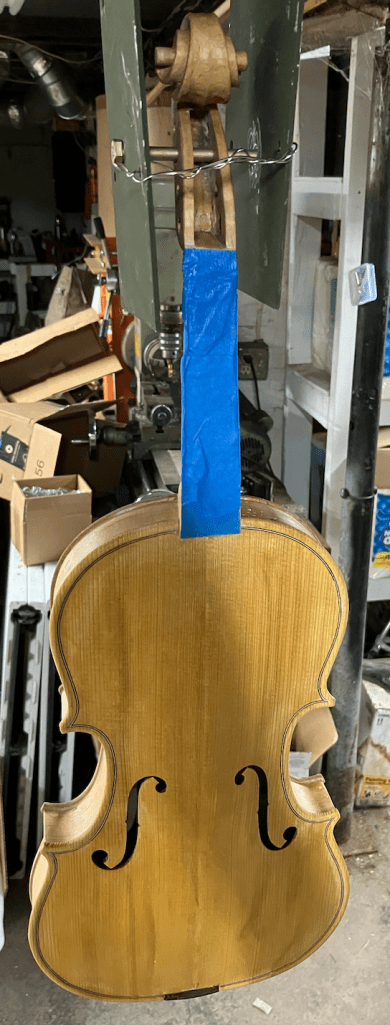
My version of the drying thingy is made from a random scrap piece of Humvee seat aluminum that the Army didn’t need anymore, an OH58 bolt that conveniently fits through the D peg hole, and aircraft lock wire. It’s stupid, but it works.

Once everything was tested and ready, I took the brush to Silver. The naked wood drank in the first coat of albumin, so I hit it again.

With egg guck alone, Silver looked MUCH better. Observe.

Yes, my violin workshop is in my cluttered basement. It is what it is. In this pic, you can see my grandpa’s old Carhartt vest, my ACU IFE from ’05-’09, and a pile of useless fluorescent bulbs that I need to get rid of. But the point is the fiddle. Things were looking good after I buffed it with a clean T-shirt scrap. It was time to clear coat, a step that Robert advised. So, I did. Observe the results.
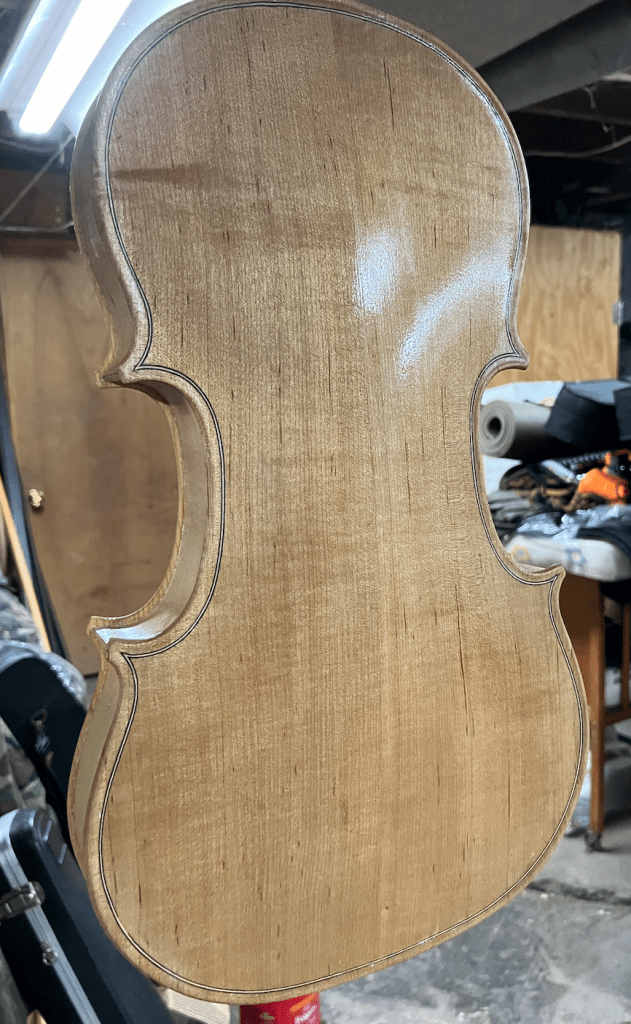
Wow, I thought. This looked great! The paint-covered wood had good character; all I had to do was add a few color coats.

What could possibly go wrong?

Laughs! Plenty, it turns out.

Stay tuned for the next exciting episode, Bat-Fans!
“Stolen Valor” in the Headlines

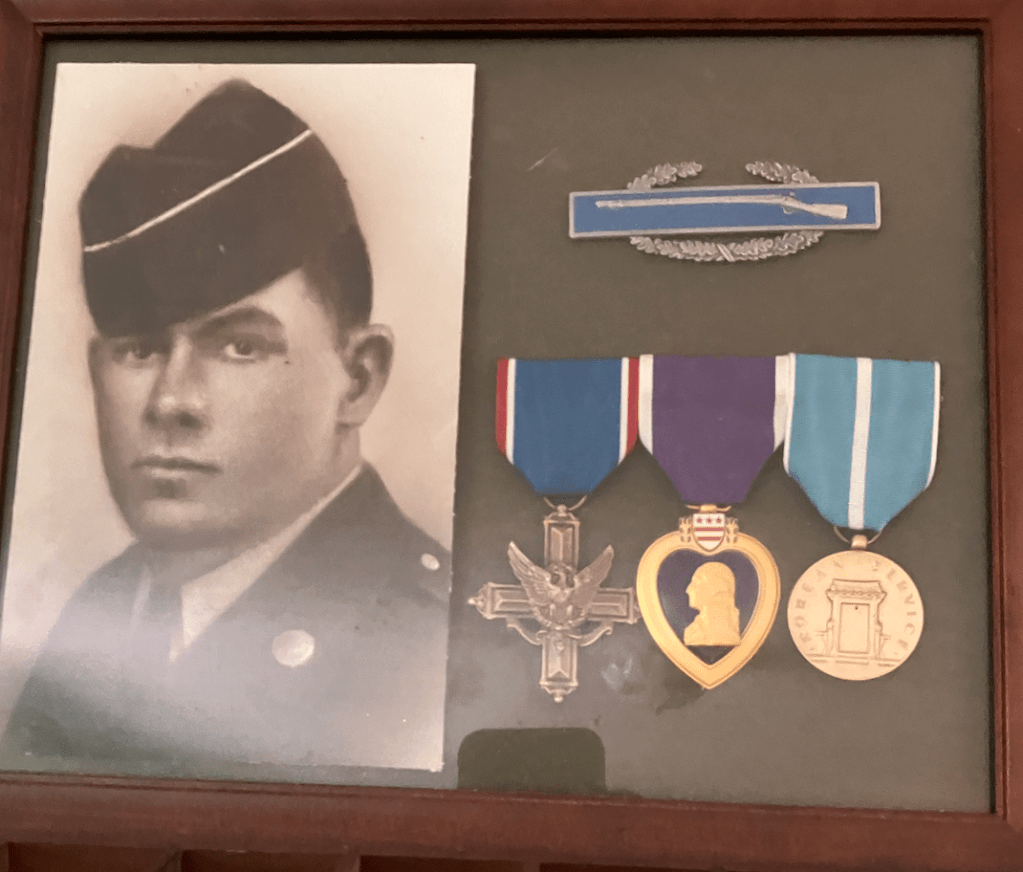
The image above is the sad memorial at my deceased Grandma’s house. It stands in memory of my uncle, Private Merton R. Johnson, KIA Korea, on the 15th of August, 1952. There is a ton of pain behind that little picture frame. I’m not doing a deep dive into it. Suffice it to say that my mom’s family suffered from his loss.

I retired as a commissioned officer in 2014, with three GWOT deployments behind me, counter-drug stuff, and a post-Gulf War hangover tour in ’95-’96. I’m not sure how many months I drew “HFP,” or hostile-fire pay, but it was probably about four, maybe five years, give or take a bit.

This is in no way a boast or loathsome self-promotion. I wish some of it had never happened, but it did. It is what it is, all of it.

From the above, I think I can judge a case of “Stolen Valor,” an accusation that is cheapened by frequent use. Unfortunately, the topic has been in the news lately, with some politicians accusing others of this phrase.

When I read about some of these accusations and looked into them, it seemed to be pretty thin soup.

“Stolen Valor” occurs when someone claims to have earned an award like my uncle’s, but they didn’t. If you claim a “V” for Valor award, be prepared to back up your bullshit. Neither party in this dispute has ever made any such claims, so I’m confused about how accusations of “Stolen Valor” can be made.

IMO a vague statement given off the cuff in an interview years ago by a proven long-service NCO does not rise to this level. I’m sure he regrets his careless wording in this age of eternal documentation and general lack of knowledge re: all things military. The furthest connection most people have to military service these days is playing “Call of Duty,” or they watched “Saving Private Ryan.” This is why I’ve written this article; to help people who may not have direct contact with military life. To tell the tale of a common soldier; much like my fiction.

There are also accusations of “Stolen Valor” regarding the man’s rank. “Stolen Valor,” in my narrow definition, applies to boasts of wartime heroism. But that’s just me. Others may feel differently. Also, the man was promoted to the rank and served as a CSM. I have much respect for anyone who achieves this level of non-commissioned service; while I thought a few CSM’s I’ve known were complete dicks, I’ve never met one who wore the rank to be a soup sandwich. Your knowledge and expertise are godlike if you are a sergeant major with hundreds of enlisted troops under your supervision. Yes, he took an admin bust to master sergeant upon retirement because he didn’t complete some schooling and didn’t have time in grade. This happens to many people; it does not reflect the character of his service. Master Sergeant, three up and three down is still impressive. So I’m mixed on this one in regards to the accuracy of his statements. Yes, he was a CSM. Yes, he retired officially as a MSG. IMO, he can claim either because he was either. Period.

Re: guys he served with who hate his guts. This is the case; those people have popped up throughout his political life. They have many messed up things to say about him—guess what? ANYONE in a leadership position who does his/her job will always have people with beef. Always. You must take these accusations with a grain of salt and look at people’s motivations. The person leveling the accusations didn’t serve as a senior NCO, while the accused did. A corporal doesn’t have the time to accumulate enemies like a CSM, but I’m sure the accused had people who didn’t like him, either. They just haven’t come forward. Yet. The election cycle is still young.

Re: deserting his unit before a deployment. From what I understand, his unit only had vague rumors of a deployment in early 2005 when he filled out his retirement paperwork. Look, I’ve been through the mobilization process. Rumors are just that, bullshit rumors. When I was a reservist going through college, our unit commander stood before us and said, “I’ve got a gut feeling that we’ll deploy.” Later, an old master sergeant said, “If you have a gut feeling, you should go take a fat shit.” He referred to the fact that rumors in the military are worthless—you can’t base any decision upon them. Especially important life-altering decisions. You could hang out forever, waiting on the mythical deployment that may never come, or you can get out and get on with your life. It’s a fact of military life. Until you have orders, it’s garbage. Sometimes, AFTER you have orders, the mission is scrubbed. Sometimes, the orders change, and you do something unanticipated. Long story short, the man did go to Vincenza in support of OEF, and he served for five years during wartime (don’t forget the Gulf War, when tons of Guardsmen were called up). The Fickle Finger of Fate could have screwed him at any time. He had the good luck not to have the Finger land upon him before retirement; at any time throughout his career, it could have caused him to do some bad stuff.

I’m not a fan of people who worm out of deployments. I don’t know about the Marines, but the Army doesn’t casually let people skate when it’s time to go on a trip. Do any of you remember the phrase “Stop Loss?” It was a thing in ’05. Looking carefully at the records of both these guys, I don’t see any history of duty avoidance from either.

This is an important point—the accused did way more than most dudes at Walmart and doesn’t base his entire identity on his honorable service. Let’s also not forget that both of these men were volunteers! Neither had to be there, doing what they chose to do. Both men signed the proverbial “blank check,” which all of us signed, which could be cashed at any time by the enemy.

Honorable service. Both the accuser and accused have it. We should leave it at that and switch to other topics, like individual policy. Politics is a bloodsport; there is plenty of room for the politicians to destroy one another based upon policy ideas and votes.

Leave it at that. Both of these guys did their time and got out, as was their right. Neither “ducked” service, combat or otherwise, or performed any less-than-honorable actions.

This is my take. It’s a good thing to have veterans in politics. It’s a bad thing when they throw mud about perfectly acceptable service. It makes all of us look bad and muddies the water for civilians who don’t know the ins and outs of the military.

Knock it off.

Saving Silver

Morning, everyone. This will be a series of posts about a thirty-day plus project, the rescue of a forlorn, unloved, and ugly violin.

First, a few admin notes. Regarding writing, I’ve got two plates in the air right now. One is the Javan War, a book I co-authored with JB that should launch soon. I worked on it while in Oz, and then John took over from there. The second is my new ISOLATED series, a new alt-history look at the Second World War where everything goes wrong because of small decisions and leadership. All of my long-time readers know that I harp on leadership a bit, because in the real world, leadership makes the difference between success and failure.

Period.

If you choose, you can read along with my hardcore fans on my Patreon site. To date, reader reactions have been good, and I’m excited to write this series.

In addition, I’ve been busy with the folks in Minnesota. Some interesting stuff happening up there.

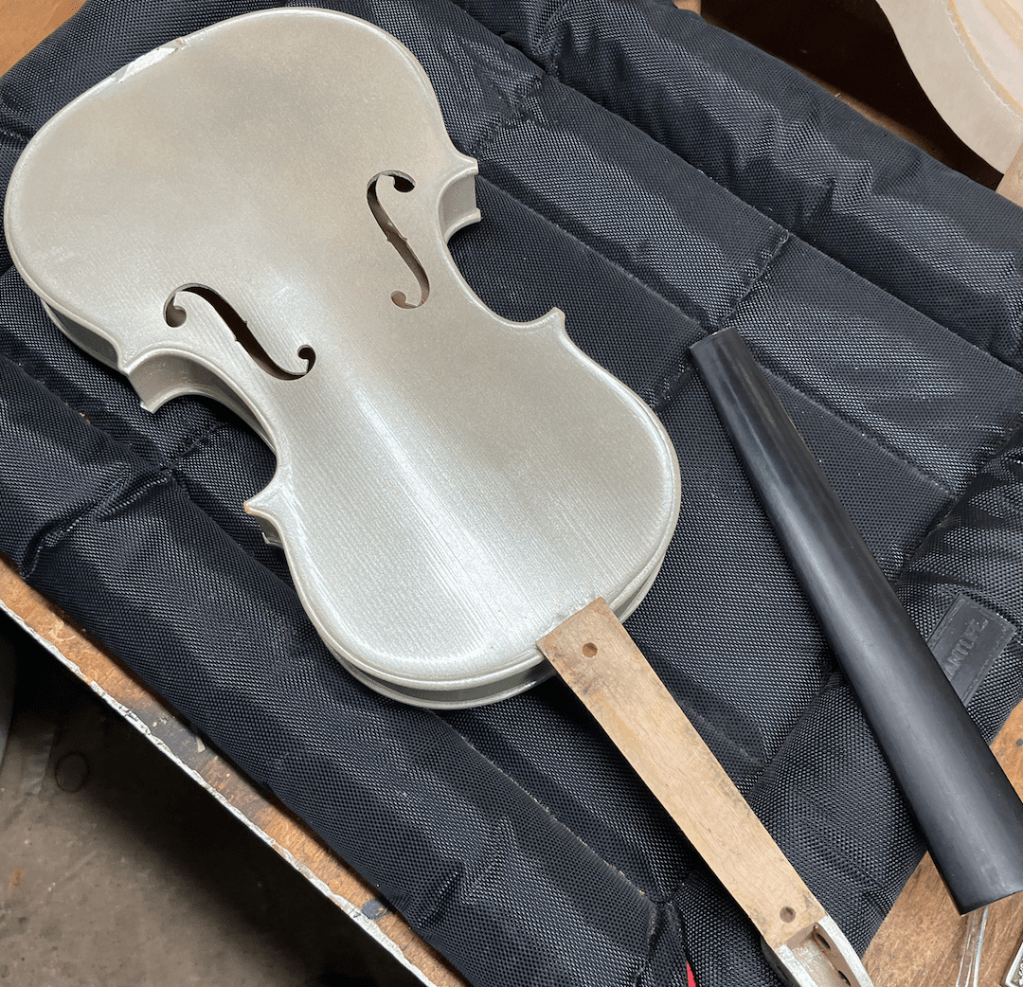
Alright, poor Silver. I recognized its potential when the music store dumped this fiddle on me. Good wood, workmanlike construction. However, it needed the ugly 2004 Chrysler metallic paint stripped from it as a minimum, and I wasn’t sure if I could do this. A friend and mentor in Pennsylvania egged me on, so I bought some materials and started.

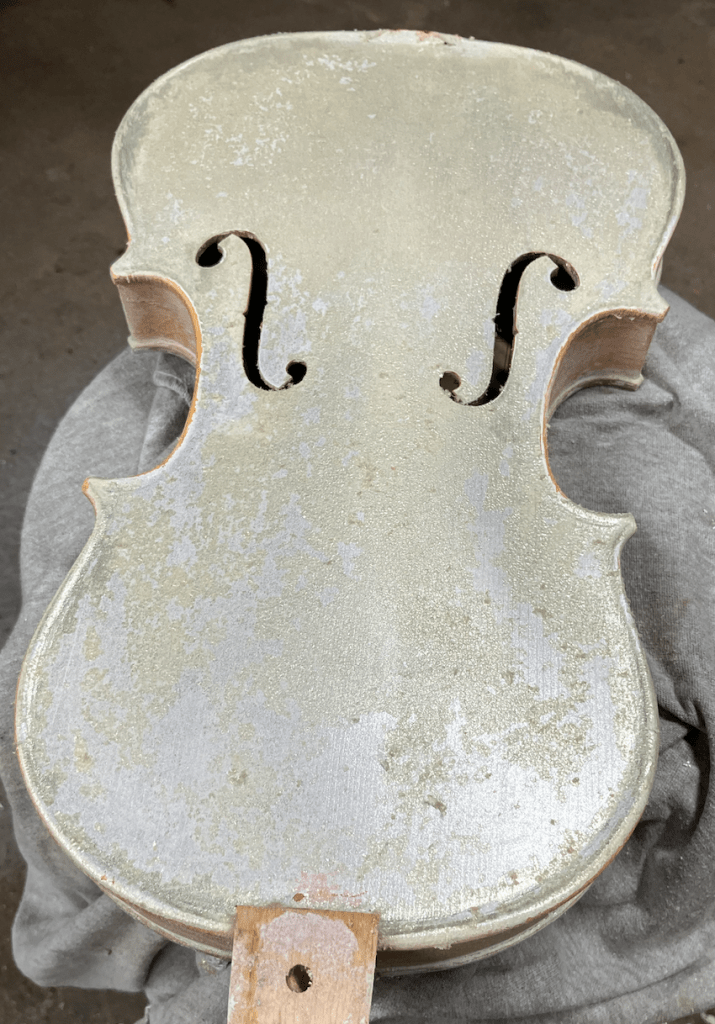
The above picture was the first step in the process. The violin had to be stripped to the body alone. I mostly tossed its worthless furniture, and I took off the painted, low-quality fingerboard with a butter knife. Then, I sprayed a test spot with a chemical stripper. I’ve always learned you should never do this to a violin; however, this fiddle was worthless as-is, so I had nothing to lose. This was intended as a learning exercise, and boy, was I right. See below.

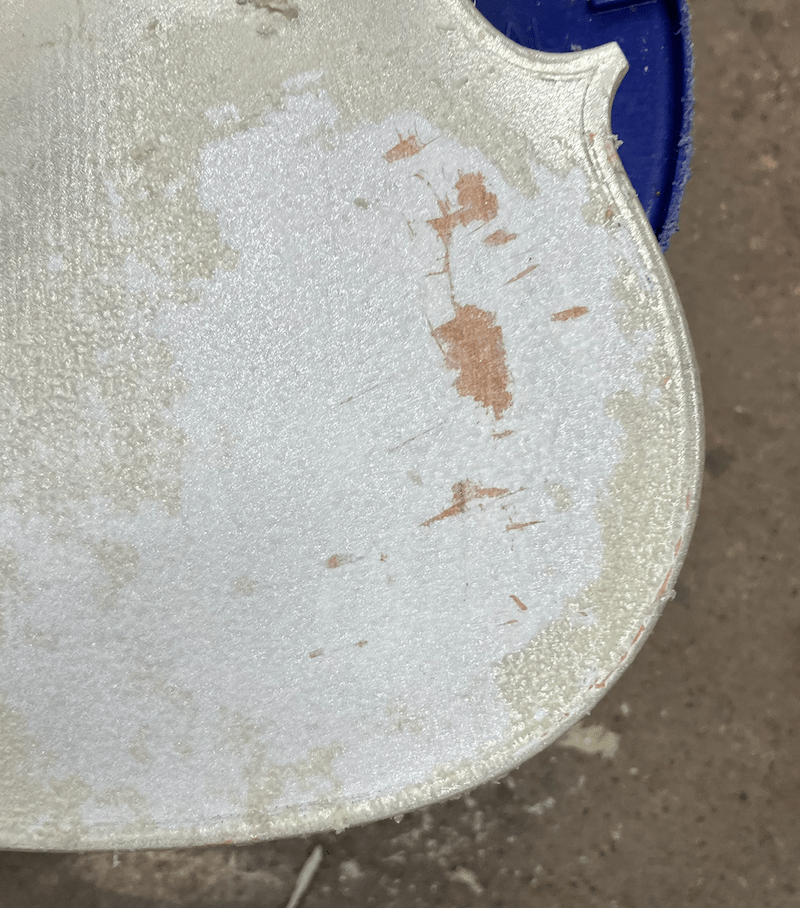
Silly me. I thought the crappy paint would lift easily. No, not so much. It was very difficult to remove; also, I had to be careful with the wood beneath the horrible paint. I used an old credit card to scrape the glop. They are perfect for delicate finishes. When I scraped all that I could, I’d clean up with Scotch Brite.

Did I mention how tough the paint was? This was terrible, and it took a while before I saw the wood.

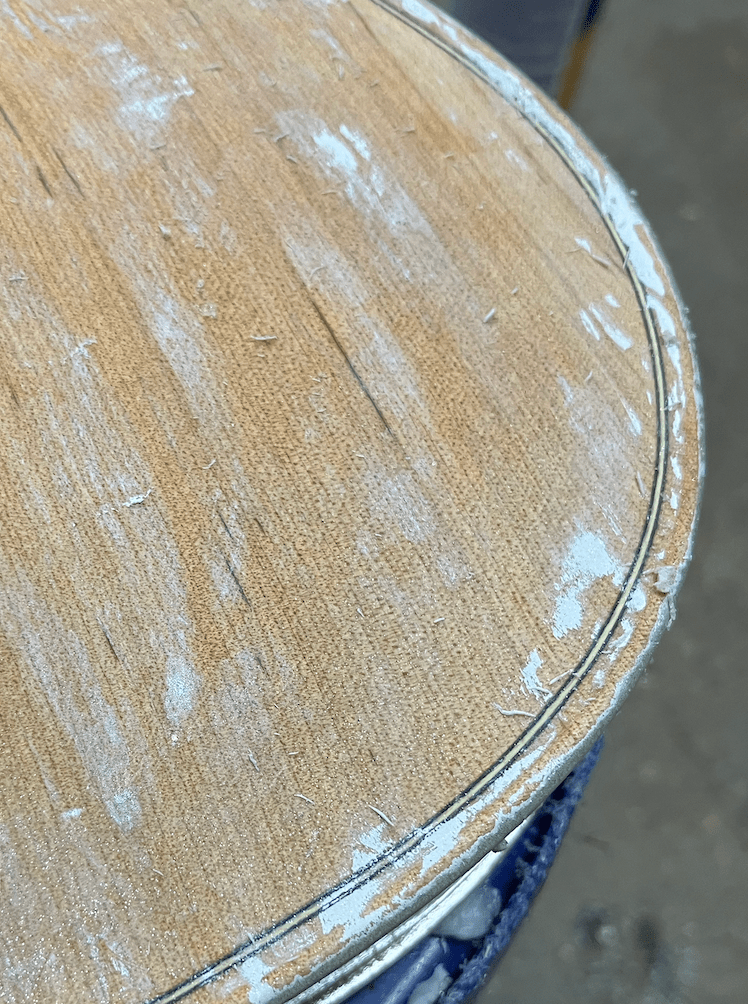
You can see the beginning here. As I suspected, this violin had real purfling (the wood inlay around the edge) and tight-grained spruce. It wasn’t junk.

This took FOREVER. Plus the stripper is caustic, of course, and the old paint JUST DIDN’T WANT TO DIE. But it had to. This became a mission. When I finished the belly, I saw the first inkling of a reward.

There was some decent, if pedestrian, wood under that crap. Wood with character. I pressed on.

The top plate, as expected, was a nightmare. Especially around the F holes! Not only did glop fall into the notches, I had to exercise extreme caution to get that sparkly crap out of the notches. Did I mention that this took forever? It did.

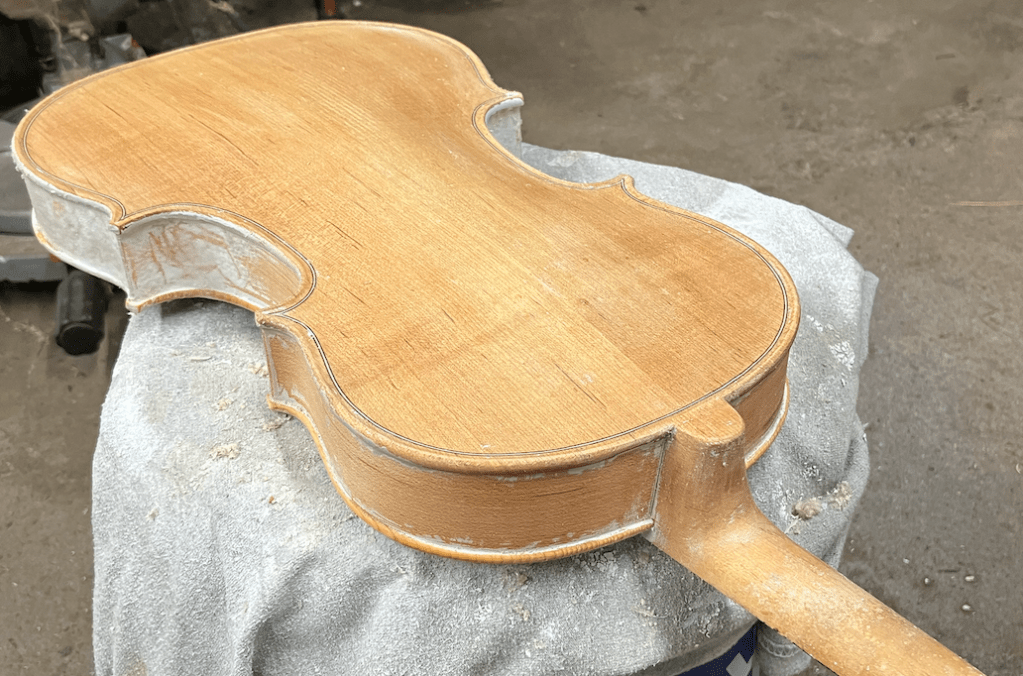
When the top plate was kind of OK, I started on the ribs. Wow, was that crappy. So many nooks and crannies, all loaded down with cheap hell paint. And let’s not talk about the scroll and box. Good Lord, the end of the fiddle cost me days of detail work, and yes, the scroll and box were positively slathered with that silver crap. But I managed. I reached the end of what I could do with stripper, it was time to reach for sharp metal objects.

I learned in this process that it’s not good to really scrub with Scotch Brite while the wood is soaked; it leaves rough patches. Patches I had to fix later when the fiddle dried.

Also, you have to neutralize the stripper by cleaning the entire work surface with alcohol. I did this several times before I had clean wood. See below.

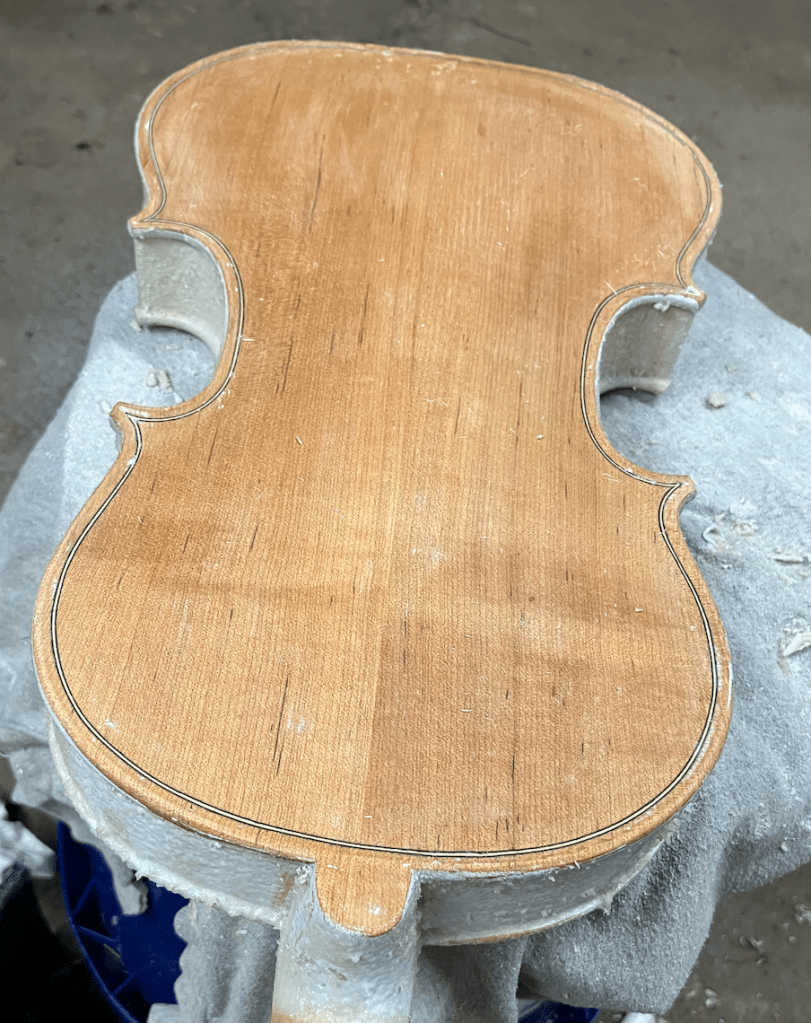
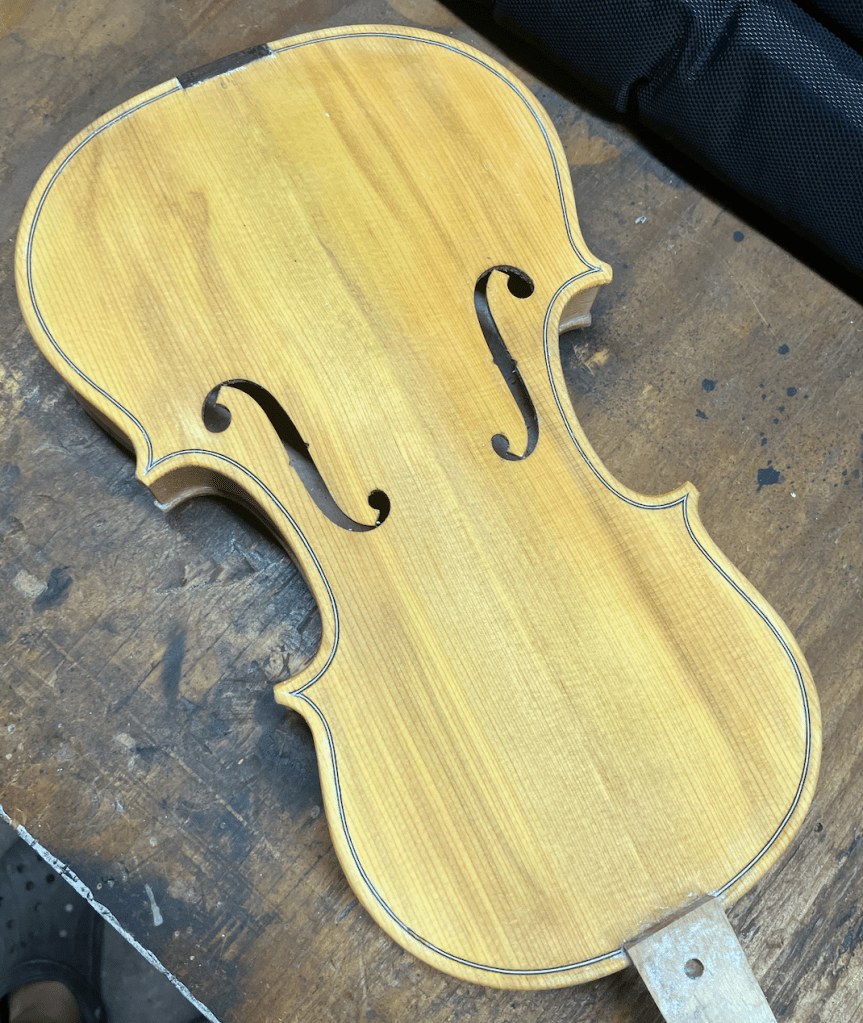
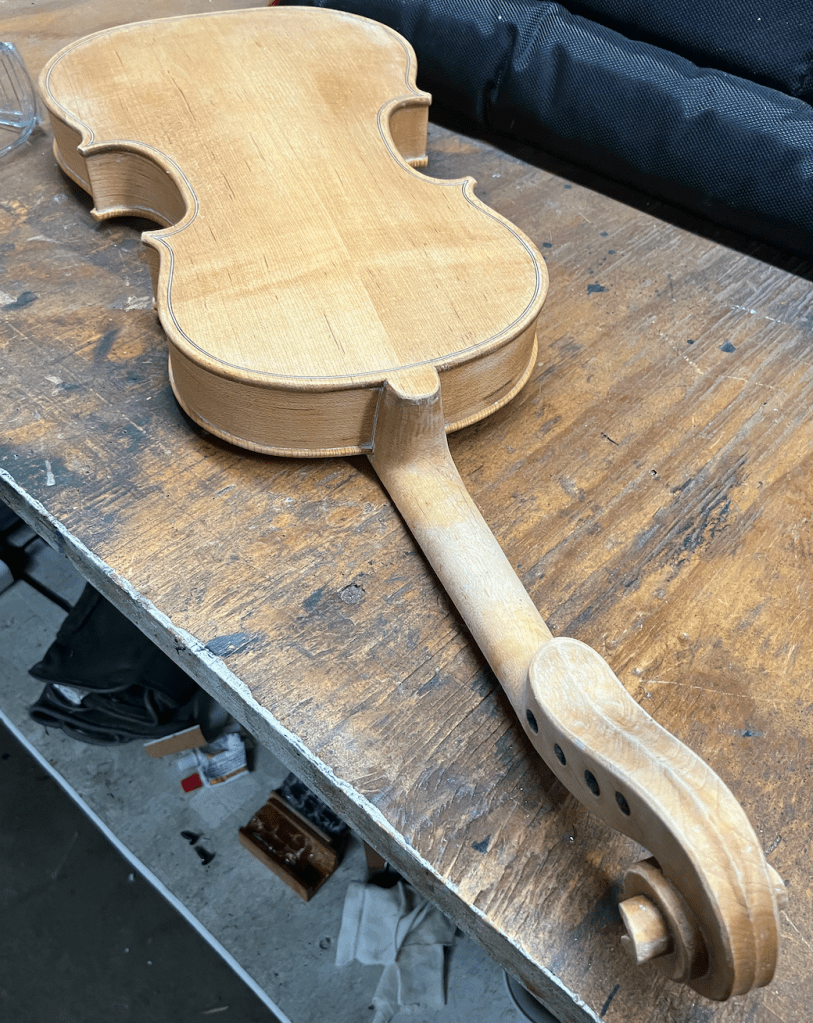
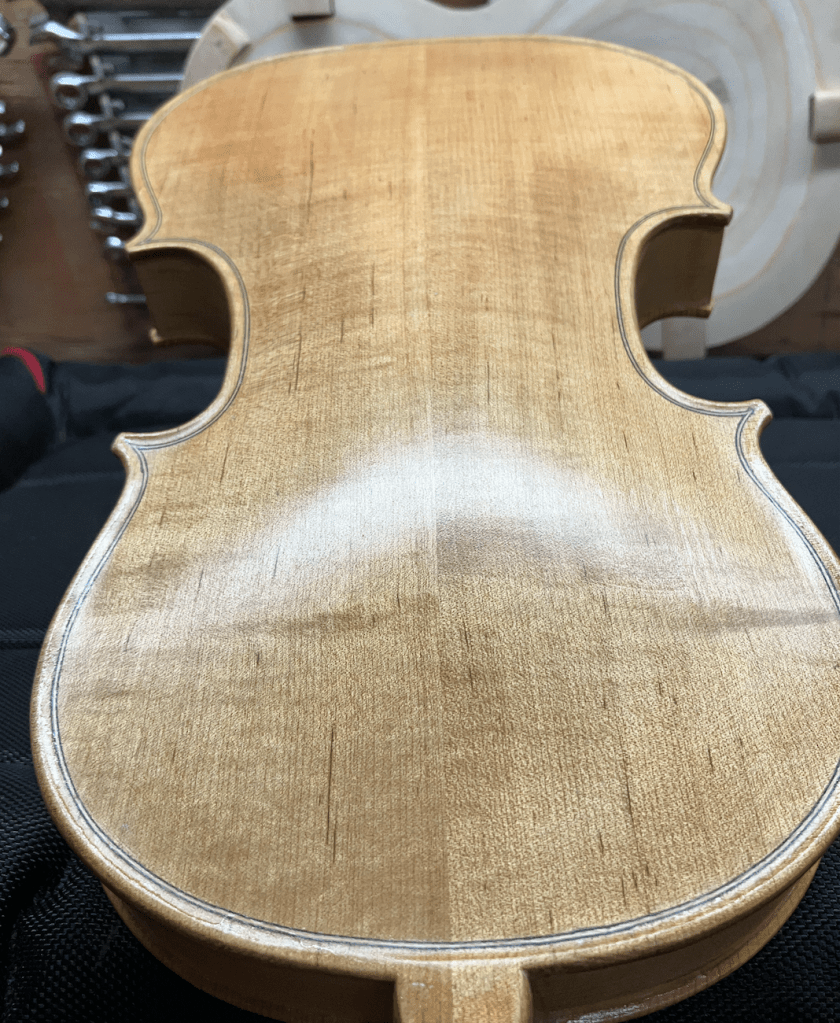
This is the top plate when it was close to clean. I still had detail work to do with tools, but you could see what you’d have. Honest spruce, as opposed to minivan chic.

I’m sure you can imagine what it took to get this woebegone violin to this stage. If not, I’ll tell you. It was three weeks of intermittent scrubbing and gentle scraping. Bad news.

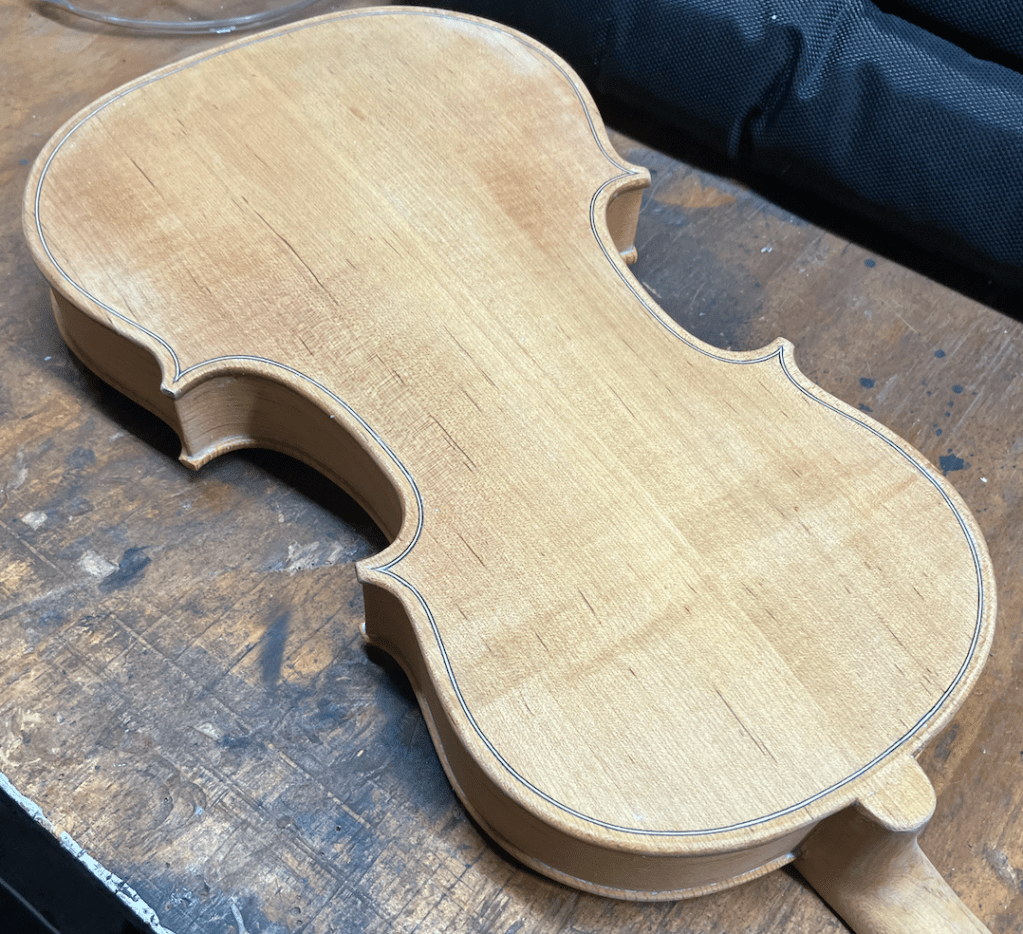
At the end, I had this. A 99.9 percent clean fiddle, dull from alcohol baths. It may not have been perfect, but it was good enough.

Silver was ready for the next step(s).

More follows soon.