
When I was a kid, I knew a couple of ham radio enthusiasts. I’m unsure if every town had them, but I knew two. Both had learned their trade in the Army, WW2, and Vietnam, and both had these crazy dedicated radio lairs full of lighted dials, arcane machines, the smell of ozone, and monster antennas. I remember being fascinated by those shadowy spaces full of hulking metal boxes and buckets full of vacuum tubes and random, unidentifiable parts. The men were messianic enthusiasts; they’d listen to faraway voices, enraptured, and they had long lists of frequencies and times taped to the walls.
Both of them were super good guys with cool hobbies; I wish I had learned more from them. The WW2 guy tried to teach me Morse Code, but with my boyish gnat-like attention span, that didn’t work out. The Vietnam guy got me into it a bit more, but at that point in my life, I was short on cash, and ham radio and a good shortwave receiver cost me money I didn’t have. He took pity on me and gave me a beat-up Hallicrafter S-38 with some extra tubes and showed me how to rig a long-wire antenna with zero cost involved. He died shortly after of a heart attack, and I have the radio to this day. It still works, believe it or not.
I remember messing with the ham transceivers and listening to distant stations on that Hallicrafter early in the morning. For a while, I kept my own reception log with freqs, times, and stations. By the time I left for the service, it had grown (for me) impressively long. Radio Australia, Brazil, Moscow—there were many. It was super cool, listening to those distant voices in the lost years before the internet.
However, I moved on in life, and I forgot about those distant voices for quite a while. The Roxor project got me thinking about communication systems a couple of years back. I wanted to create a facsimile of the trucks we had overseas. An important aspect of those vehicles was communication. Without commo, you had a major problem. While cell phones are nice, they are unreliable when the chips are down. OK, I seriously doubt there will be some Mad Max crazyman situation, but I wanted my off-road machine to have commo. Period.
So, me being me, I began to investigate my options on Amazon, and I soon found that the ham and shortwave scene had changed A LOT since the 1980s! Wow. A hallmark of the hams I knew as a kid was that they spent a considerable amount of their paychecks on their arcane hobby, and the equipment took specialized knowledge to use. Also, it took up a LOT of space. This explains why both of them had dedicated radio sheds. While their spouses were cool about things, those ugly gray and green (a lot of ham and SW equipment was cobbled from Army surplus) boxes looked hideous in the living room.
I’d hate to think about their electricity bills, too. Wow, those old machines sucked power like a vacuum cleaner!
Imagine my shock when I discovered that you don’t need to spend more than SIXTY DOLLARS for a complete SW/ham equipment set, albeit basic. The equipment takes up a shoebox’s worth of space, with tons of room left over, by the way. I found my solution and had more than enough money left over to sample different systems. I thought I’d share this with you today if you are interested.
First, why would you care about old-fashioned shortwave when we live in the age of the internet? That’s an easy answer. The internet, as seen in numerous crises worldwide, has this bad thing about dropping off during difficult situations. It’s the same with cell phones. Nothing sucks worse than hanging out in a power outage or something, and you have <zero> info or comms. It happens. Ham radio and shortwave sidestep both of these problems. After all, we easily forget that our internet infrastructure is about thirty years old and surprisingly fragile. Radio, on the other hand, is far more robust. Reliable.
It’s possible that I’ll never regularly use radio or ham communications again, but it’s nice to know I have the capability if needed. And for sixty bucks, what excuse do any of us have? It’s a very small amount of money, less than two people’s dinner at a chain restaurant, to have crucial information during a problematic experience.
Without further ado, let me tell you what I have found to be the biggest bang for the buck items on Amazon. I’ll tell you the best stuff at the lowest price. You can spent (a lot) more, but you don’t need to for basic capabilities.
First, ham communications. To transmit, you should have a license. If nothing else, if you are unlicensed and you “step” on a licensed ham’s commo, they will get cranky. You may get a fine, too. At worst, if you interfere with the commo of aviation or first responders, you could pay a fine and cool your heels in jail. This is failure. Avoid it. However, nothing stops you from monitoring the ham freqs with a ham radio! You can stay up to date with local events, and in a dire emergency, you can hit “transmit” and worry about cranky ham operators or possible fines later. My two cents. It’s better to have a capability and not need it, than the opposite. ‘Nuff said. Lemme tell you about the best ham radio for the buck.
Hands down, it’s the plain-jane UV-5R, manufactured by Baofeng. You can see one in my lead image, it’s the little walkie-talkie on the upper right. These units sell in various packages on Amazon. You can buy a two-pack for as little as thirty dollars, with different antennas, chargers, extra batteries, etc. You can buy just one for about fifteen or less. These things are small! They fit in the palm of your hand, and the batteries last for about a week on one charge. On the page I linked, you’ll see all sorts of radios with confusing terms like GMRS or ham. Get the ham radios. GMRS is intended for short-range commo. Ham transmissions are much more powerful. Also, Baofeng products are based on the venerable UV-5R platform, so the old UV-5R, if you learn to use it, is a starting point for everything in the Baofeng family.
The UV-5R is criticized for not being as user-friendly as possible, having small buttons and displays, and not being as powerful as its more expensive peers. These are valid concerns, but IMO, they are also irrelevant. People are usually scared away from ham radio and shortwave by UNIT COST. You don’t have much money invested here if you try it out. Also, YouTube is full of tutorials on how to use the UV-5R. It’s actually not bad. The people complaining have never suffered through Army classes or tried to get something to work using that same fine institution’s manuals. They’ve also never been cursed with using military radios in a work setting.
Compared to a SINCGARS, MBITR, or Harris, the UV-5R is simplicity itself, with tons of flexibility and options. I think it’s really great. If you try out the old UV-5R and want something more capable, Baofeng has many economical options to suit. Also, being familiar with the layout and function of the 5R, you can easily transition to their other products. The UV-5R, with the right antenna set-up and topography, can get reach out a surprising distance for such a little guy. If you input UV-5R in the Amazon search bar, you can really find some deals.
Now, let’s talk about budget shortwave receivers. The UV-5R will give you local commo, and FM reception. With SW, you are listening to the world! My go-to brand that I discovered on Amazon is XHDATA. For the money, they are amazing. For as little as ten dollars, you get a radio that listens to the world. I have my prefs, of course. I’ll tell you about them.
First, let’s go low-dollar. This would be the D-220, a hand-held radio that works fairly well on AA batteries. It listens to FM, AM, and SW. See below.
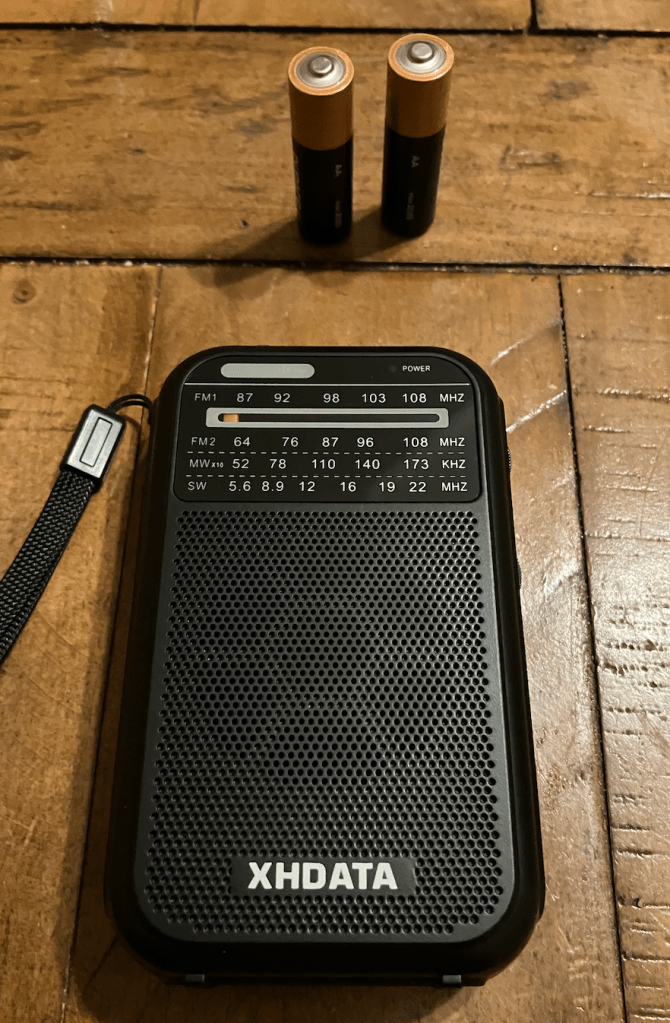
There is a cheaper model, the D-219, but I’m not a fan. I guess you could try it, lots of people like it. The D-220 is the least expensive but still capable model that they have. I would prefer it if it had a power source other than AA batteries, but it doesn’t. I’d suggest you pick up something else to go with your new SW radio. There is a cool little compact long-wire antenna that clips to the regular antenna and can hang from just about anything. This is the XHDATA AN-80, which costs just a few dollars but greatly increases your listening range. See below.
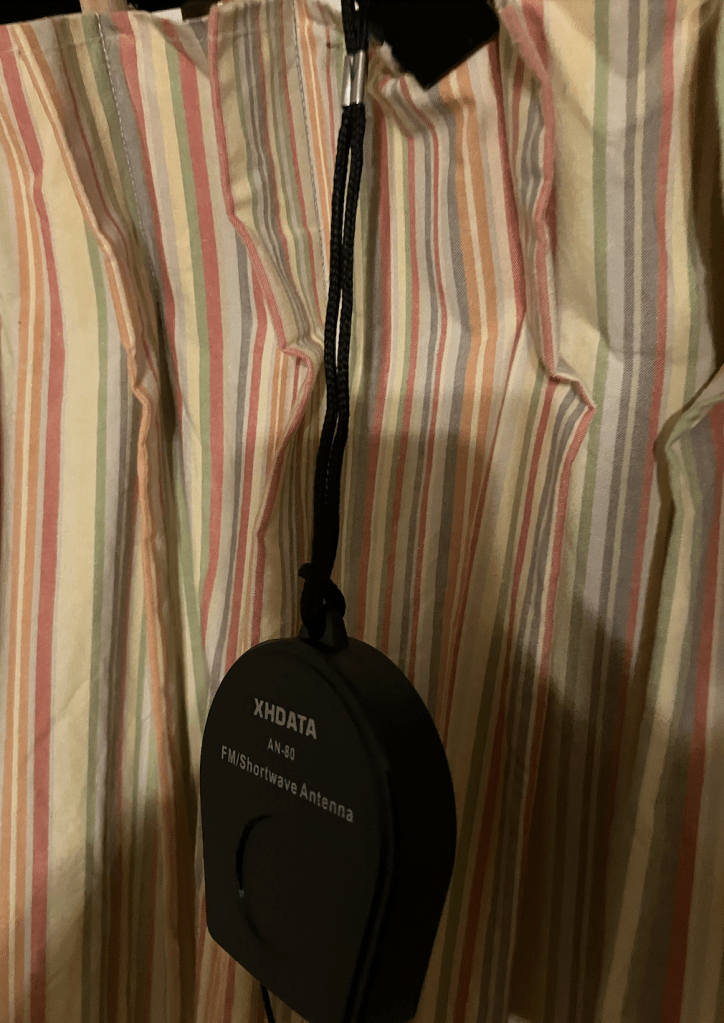
This is the AN-80 hanging from my curtain. It has a neat clip on the retractable spool end, and the other has a clip that securely fastens to your radio’s antenna. Pretty cool, inexpensive, and compact. Below is the antenna clip, fastened to the D-220’s antenna.
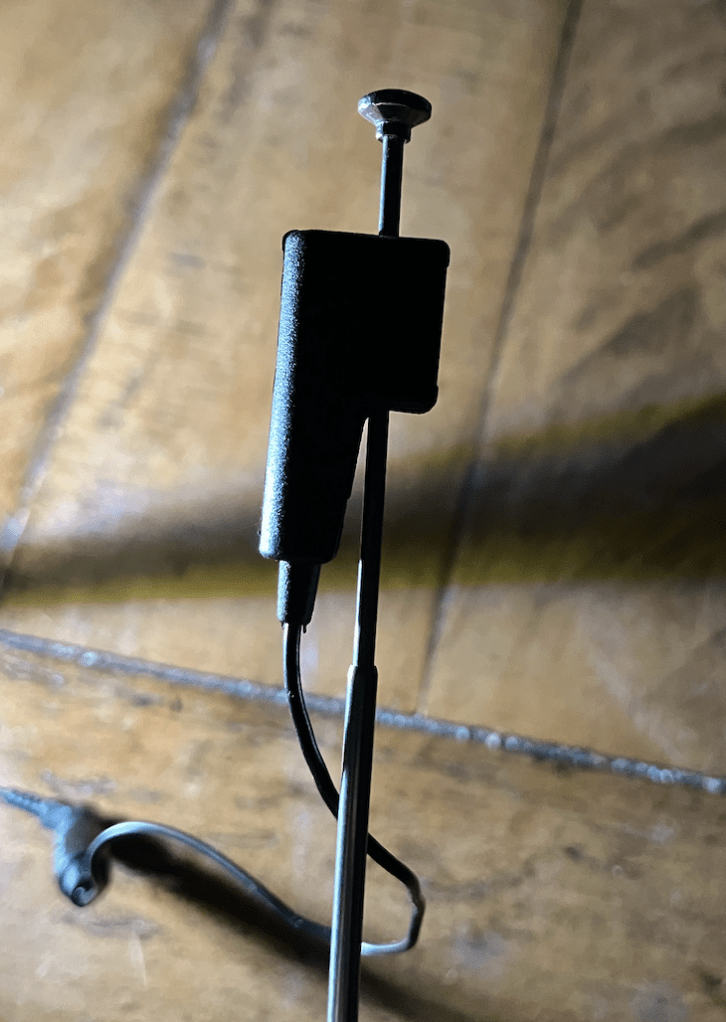
It doesn’t get easier.
The next radio type, which is my favorite, is just a few dollars more than the D-220. It is the D-328. Here’s what I like. First, it is less than twenty dollars. Second, the controls are super easy to use. Third, it has a handy collapsible stand that lets you incline the radio to ease its use. Finally, you can power it using a USB plug that charges an internal lithium-ion battery. This is great—you can either charge it using your vehicle or household power. Also, it’s a nice receiver. Just messing around I picked up a lot. It is also very compact and plays with an MP3 player, if that’s important to you. See below.

Finally, the most capable XHDATA radio for the low-dollar price range is the D-109. It breaks the bank at about thirty dollars, however. Oh, the humanity. In exchange for your riches, you get a digital scan, which is awesome, and the option of saving channels and a whole bunch of other stuff. This floors me. In the eighties, you’d have paid thousands for this, and the package would have been MUCH bigger, with a vastly higher energy draw! This one powers like the D-328, and its lithium battery lasts very long. It lasts so long that I’m not sure how many months it would take to go dead. A while. See below.

This is the D-109, pictured with the handy AN-80 clip-on antenna. I should have placed a pen by these for scale, but this is also a palm-sized unit that’s very easy to use. This is a great unit!
To conclude, I think I’ve shown that you don’t have to spend much to get good commo in problematic situations. A quick cost estimate, if I may. The AN-80 antenna, which can be used for just about any radio, costs 8.30 today. A great two-radio UV-5R package is 31.99. This includes chargers, antennas, everything you need. YouTube instructions are free. The midrange XHDATA SW radio, the D-328, costs about fifteen bucks when you apply the coupon. I guess you could splurge and get the deluxe D-109, which costs a princely 33 bucks after the manufacturer’s coupon.
As I promised at the beginning of this article, the total cost is between 55 and 73 USD, or about sixty bucks on average. For your sixty-odd dollars, you get two ham radios, a handy long-range antenna, and a good SW radio.
You can spend much more at Texas Roadhouse without trying.
It’s worth trying out.






 The Interstellar Valley