See this? I made it with the help of some friends and family. It’s a long story; a project I’ve been busy with for months. For details, you could always subscribe to my pay site and join the cool kids club; however, I’ll let you guys in on a little of it.
In short, we cleared a lot of brush before we could establish a small camp in the North American boreal forests of the far north (for us).
It was one hell of a lot of work. However, at night we could hear the loons and the screech owls—it was amazing.
During the day, we slaved over the little patch. In the evening, we’d start a campfire (conveniently placed upon an inconvenient stump) and eat. It turns out that my cousin, whom I hadn’t seen in decades (also military), has a superpower. He is an amazing field cook, and each night he spoiled me with delicious grilled meats.
Guys, we even had a field shower. It was great. After a week, we were ready to receive guests, and we had one heck of a lot of fun. I even showed him how to shoot the bow. Please see my last post. Observe.
I showed him how to do it and unleashed him on a pile of logs. Great fun! As a reward for helping out, I sent him home with the bow and arrows. It was great. If you want a quality learner bow, please consider this setup.
But seriously. Now that I’m home, I’m cranking up the writing machine again.
I’ve had a thing for traditional weapons for a long time. I think it was an outgrowth of my old trade. I wanted to understand the tools of the past, to handle them, to know how they feel, to appreciate their pluses and minuses. Of course, this has helped me with my books, and it has helped me “feel” the books of others.
Honestly, I blame this on SM Stirling. I found his book “Dies the Fire” in a free deployed GI library; it was great. Reading it, it dawned on me that I knew nothing of the fighting styles and tools of the premodern era. So, upon my return to the States, I looked into it and bought a few things.
One of the items was a genuine English longbow made of yew, which is the style used at battles such as Crécy and Poitiers. I learned to tie a bowyer’s knot, and I taught myself the art. Well, a little. A real archer makes me look sick, but I’m probably better than 99 percent of those living, who have never put string to cheek. I guess that makes me weird, but I had fun doing it.
Recently, some friends have talked about teaching kids to shoot the bow and arrow, so I decided to look on Amazon and see if I could find a decent unit for cheap.
Don’t buy “cheap.” Buy inexpensive. There is a difference.
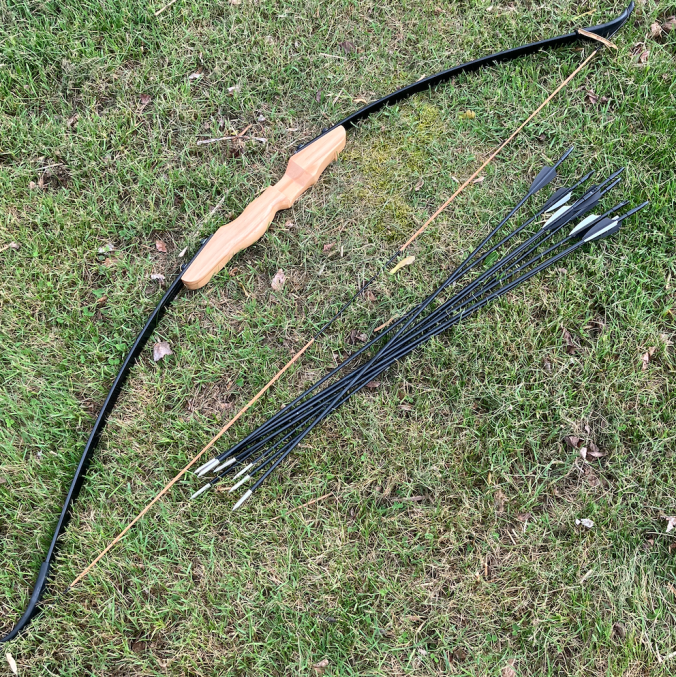
Well. Today, the bow arrived; I unboxed it and assembled it. I picked it for its simplicity, and I thought it was attractive and simple. I don’t like complex things. Complex things break. This bow, an underpowered version of what they used at Crécy, is a traditional longbow, materials excepted. I say underpowered because it has about a forty-fifty-pound draw weight, and proper warbows were over eighty. However, I guarantee you I can take a deer with today’s arrival, and under no circumstances would I want to be on its receiving end.
It is a weapon, and nothing but. It is not a toy.
It consists of two steel staves and a very comfortable central grip. The staves are bolted to the grip. Then, you mount the string using your legs and a quick flip of the string loop. Once you know how to do it, getting the string in place is easy. The string that came with this unit is a bit odd. I’ve never seen anything like it. It is many strands of thin nylon rope with a thick casing over the place where you nock the arrow. Also, the loops are coated, which certainly helps you when mounting the string. It’s an unconventional arrangement, but it works.
As an aside, I have a very old aluminium sporting longbow. I think it was my dad’s. It’s been mounted for many years with a chunk of 550 cord, and it works just fine. Today’s bowstring reminded me strongly of parachute cord—it should last forever.
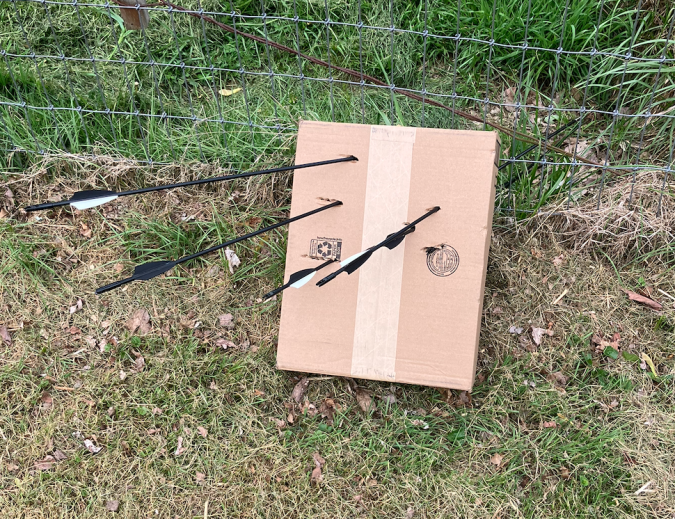
It was time to test the rig out. I took a cardboard box into the back yard, walked ten yards away (it’s been a while since I tried my hand at archery), put on my brace (you don’t want string burn on your forearm), and nocked an arrow.
I tested the draw; it felt smooth. I eased off the string and brought it to bear in one motion. As always, I concentrated on the business end of the arrow, held over, and loosed. Too high, but not bad for the first time in a decade. Plus, the bow shot flatter than I thought. I tried again.
Whap! I nailed the box off-center and started to enjoy myself. Observe.
Not exactly superb marksmanship, and my draw was erratic, but I got the job done. I moved back to twenty, and did it again with decent results. Minute-of-man, we called it in the trade. I was confident in the bow, and I liked it a lot.
Here in the States, it’s a bit of a race against the clock to pick one up like this because it’s made in China. But for my readers outside of tariff-land, you have all the time in the world.
Try it, it’s a good product and a potentially useful skill to pick up.
I have no regrets.
In other news, this was probably the first truly enjoyable thing I’ve done in a long while. There’s a lot going on with this guy, and I’ll try to do better on this page going forward.


 The Interstellar Valley