My grandmother used to say “if you don’t have anything good to say, don’t say it at all.” She was a smart lady, and she lived to be very old. Now, she’s gone, along with 99% of her generation. I knew when those wise old folks, who watched a world burn, were gone, that we would have trouble. I think I’m right. Which is why I took the longest hiatus from this website since I started it seven years ago. I didn’t have anything good to say in December, and I still don’t.
But I do have things to say. It’s up to you to judge if they are good or not.
First, I have experienced a great deal of personal turmoil lately. That’s no one’s problem but mine. The turmoil is a direct result of recent developments in the news; my more alert readers can make of that what they will. Bad news is not hard to find. This has put me off my game.
Second, I’ve always looked for solutions to difficult problems. Right now, I have a problem, and I’ve found a partial solution. I’m not going to say anything more about that. It’s my cross to bear, and if it works out, it should be a lot of fun. Broadening my scope, I’m not sure how we dig ourselves out of our current mess. Leadership matters, and we suffer from the lack thereof.
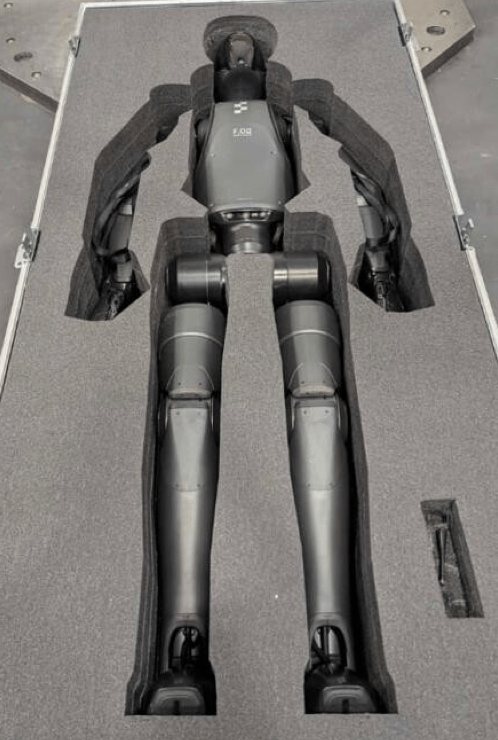
Third, as I alluded to, we are led by people who do not have anyone’s best interests in mind. I’d thought to write an article called “Hyper Intelligent Idiots,” but I decided against it. No one cares, anyway. Three hundred and sixty million people are asleep at the switch, all of us are to blame. This includes me; I am part of the problem. I will show you an image, however. Observe.
This robot, called Figure 02, is made by Figure AI. Alas, I’ve been talking about this since I started writing, and I’ve addressed this specifically in my sci-fi. “This” is the replacement of humans on a mass scale. It won’t happen tomorrow, but it will happen. There is too much money involved, invested by too many intelligent idiots.
What do I mean by an “intelligent idiot?”
A friend remarked that boardrooms are full of them. They are people who are good at exactly one thing, and they pursue that thing regardless of cost. They have zero common sense, and frequently no empathy, either.
These people, whose number includes the wealthiest among us, will bring a Terminator to the store near you. Far fetched? It isn’t. Just two weeks ago, the first robotic combined arms assault in history was launched on the Eastern Front; the Ukraine War has supercharged these bloody-minded developments. By the way, the attack was a success. I’m pretty sure from the beginnings of this website, and certainly in my first book, I’ve spoken of this.
It was a matter of time. Now, it is upon us.
So, fourth, I’ve concluded that our fates are in the hands of insanely wealthy, and possibly unstable, people who think we are all collateral damage waiting to happen; billions of loose ends that need to be tied off. What tool is better for this than the rapidly evolving progeny of Figure 02, who would be just as good on the battlefield as in an assembly plant?
An assembly plant? But what about the workers?
Laughs bitterly. Exactly. You’ve been had. There’s a reason the ultra rich have been buying islands with bigass bunkers or are looking at off world options. Think about it. There’s no reason for me to lay out every last detail of how we have succumbed to the greatest con in history, a trap laid by people who don’t even bother to lie anymore about their motivations.
In conclusion, I’ll talk about a subject endlessly tossed around in the gun mags of my youth. It was the constant rehashing of the folly of Army Ordnance in the 1950s, when they developed the M-14, and the Soviets fielded the Kalashnikov series. In short, when the rifleman’s rifle, the M-14, met the AK series in battle, the AK came out on top. Why, and what does this have to do with this piece?
The AK-47 was the direct result of Soviet battle experience in World War Two, where they discovered that the vast majority of firefights happened within a couple of hundred meters. They also found that a rifle had to work all of the time, including the worst times, and that it had to spit out a lot of lead, quickly. Accuracy and ergonomics were tertiary concerns, at best.
Strangely enough, US Army Ordnance, drawing from experience in the same war, decided that the prewar cult of the rifleman and superb accuracy and ergonomics trumped other considerations. The Army went forward with the M-14, and forced NATO to adopt the new round as standard, the 7.62 NATO, or .308 Winchester. At the time, the US Army could still dictate what NATO did, so several promising allied projects were scrapped, and the European armies adopted, grudgingly, the 7.62 as standard.
We are in the midst of another such folly. Instead of seeing the plain evidence before our eyes of failure on multiple levels, we press ahead with technologies and social patterns that assure disaster.
Some people think it’s a great thing to burn it all down. Of course, they think they personally will not be licked by the flame. I care to differ. Many think it’s a great idea to hand every last little thing over to the jet set. What? The people who run Homeowner’s Associations, and run the country club? Expect little mercy on that front. Others have the idea that having any government in our lives is poisonous. If you know your history, look up what a lack of government has been like, historically. The 17th century Scottish lowlands were a great example. That was a place where life was very, very cheap. Houses looked like forts because they had to be. Terror is a tyranny of a particularly cruel sort. It is frequently disguised as freedom. Finally, people just want to hand everything over to a strong ruler, to give up on thinking for themselves. To accept authority, legitimate or not.
This is the path to perdition, readers. I’ve been talking about this stuff for years, and now it is upon us. I won’t belabor the point.
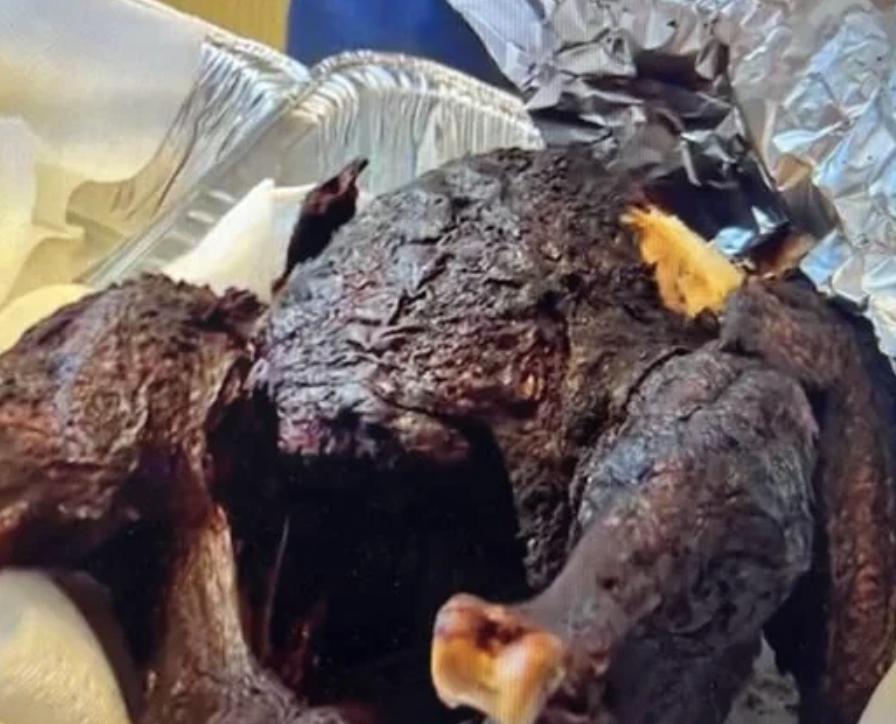
No, this isn’t the same turkey. But it strongly resembles it.
You know how to spot a bullshit story, right? It starts like this—”Well, there I was…”
This Thanksgiving Day tale begins like that. Except that it really happened, Thanksgiving Day, 2011, Camp Kilaguy, Baghlan Province, Afghanistan.
Some background. I think I’d just been promoted, and I was hurting. Most of the team was. Hacking, smoking too much, deadened. It’d been busy for a while, and we just came off a major, stupid thing out in some dive. Duststorms, cold weather, gray skies. A bright spot was that the new victims showed up, replacements from the States. We began the “right-seat ride” process, or orienting the FNGs to the area of operations.
I didn’t expect much, that Thanksgiving. But a crusty-ass NCO rode to the rescue. Sort of.
This guy, I’ll call him Toad, was a leather-faced thief and the author of a thousand tall tales. He was a veteran of the First Gulf, Iraq, and Afghanistan. Maybe other shit, I don’t know. But he had been around. Typical Air-borne 82nd dude, he was fond of mocking guys with a standard airborne badge, “Five-jump chump motherfucker. Cherry,” as he flicked his cigarette.
Toad was a gifted scrounger, which is the polite Army way of saying “thief.” On one occasion, I witnessed a spectacular act. Me and the Colonel were out on a thing, not sure how long. When we returned, we noticed a group of Joes or whoever cavorting in a hidden corner of the motor pool. What the hell was this, we wondered. The Colonel and me, still dusty and gross from the road and the field, wandered over.
There was a fucking swimming pool in the motor pool.
Army motor pools are not intended for literal pools, and to this day I have no idea where the pool came from. The Colonel said nothing, but I watched as his lips formed that dangerous grim line. We walked away, no comment made, and I went to clean my weapons like usual. The Colonel sought our Team Sergeant, the redoubtable Mike.
The pool disappeared like magic. No trace remained. I guess it was fun while it lasted, though.
That Thanksgiving, I didn’t care about anything other than going home, preferably not in a box. But Toad, the crafty, long-service NCO, had a plan to improve our day.
You see, Toad, while at times the epitome of a “leadership challenge,” could back up his bullshit, mostly. No one was better at taking care of soldiers, and he always took the mission seriously, even if nothing else—especially not petty things like Army regulations or the origin of stuff we needed, or just wanted.
Toad knew what we needed that day, and he delivered.
He appeared with a turkey, origin unknown. He had a plan to cook it using scarce, dubious and unsafe resources. You see, in Afghanistan, wood is precious. This is why for day-to-day cooking, people generally used dried sheep shit patties; this was why roadside kebab always had a tang. His plan was to use trash and ammo dunnage for cooking—the stuff that keeps munitions from rubbing together or being exposed to hard shocks; not exactly Kingsford charcoal, but it’s what Toad could get.
Toad executed. I’m not sure what I did that day, but I wasn’t involved with the dubious turkey prep. When not in the field, I had administrative duties or leadership BS. It was nonstop. A good guess would be briefings, training, or written order generation. Maybe weapons or vehicle maintenance, I don’t know anymore. However, at sunset, all of us came together in the supply shack (probably being used these days by the Taliban as a goat shed or something) to eat Toad’s spread; a well-done turkey with a chemical trash-fire tang, and T rat or purloined fixin’s, prepared as well as possible.
It was crowded, I remember. All twelve of us, maybe some replacements, I dunno, and definitely our adopted Air Force guys, the JTACs, or forward air controllers. Those guys! Nicknamed Fucks and Butter, they had gone full Colonel Kurtz and had bushy beards. However, they were real pros in the field, and had delivered for us. They belonged, and we awarded them the Army Combat Action Badge.
Even though one time I pee’d on Butter’s head. But that’s another story.
It was the best Thanksgiving turkey ever. Even though it tasted of burned toys, it was great.
A couple of weeks later, I boarded my freedom bird, never to see the Box again.
Happy Thanksgiving, readers. For all of this, I am grateful.
Dreams are what keep us going in life. I had a dream that was utterly crushed today. Destroyed, annihilated. My dream was purchasing a jug of delicious McRib sauce and using it in amazing BBQ dishes for a looooong time.
Ever since I was a kid, when the McRib first came out, I have loved that sauce. Tangy barbeque perfection, distilled in a rich crimson sauce on a simulated rib patty. I had dreams. McRib sauce on chicken. McRib sauce mixed with mayo for French fries.
McRib sauce in my damned breakfast cereal. It was going to be glorious. But, no. Not so much.
I knew it would sell out fast, so I was diligent. I set a calendar reminder that duly notified me one hour prior to the sale. Then, I set an alarm for 0957 US EST this morning, the dark day of November 25th. When the alarm went off, I stationed myself by the computer and watched as the launch page, with a helpful timer, ticked down.
The microsecond that the button changed from “unavailable” to “buy now,” I jammed that sucker so hard my mouse squealed in protest. A window popped up telling me that my order had been filed, “two-minute wait.”
After a minute, I saw that my supposed two minutes would stretch into eternity, because some jackals with sniper software had beaten me decisively. SOLD OUT, the page said. Sold. F’n. Out.
You bastards, I thought.
How did I think, for even a second, that this would be in any way fair, or that McDonalds would have enough on hand to sustain a five-second supply?
How naive, and this will soon be the standard for many things dictated by our AI and Silicone Valley, rugged individualist overlords.
Crushed, I finished the dishes, mocked by my McRib sauce phantasms. Then, on a hunch, I decided to check eBay.
Observe.
This was posted FIFTEEN MINUTES AFTER THE SALE ENDED. Fifteen bloody minutes.
I’d guess that this seller has a real future in Washington, working for the Department of Human Services.
Unreal. Just shitty and unreal, but hardly a surprise in Our Year of the Lord 2024.
This image is apropos of exactly nothing except a source of great amusement around here, the wonderful BirdBuddy, which sends us pictures and videos of the denizens of our bird feeder. All we have to do is to supply bird feed and sunlight, and we get a series of pretty darn funny pics.
No. Today, I’d like to talk about a new writing direction I’m thinking about, and for which I busted out a short on a grey and gloomy day.
You guys know I’ve struggled lately; it’s been a real pain. But it’s OK; that’s life. I’ve taken some steps to alleviate my funk—this has helped. Yesterday, while imagining my extracurricular project, I suddenly wanted to write. The weather outside of my window seat was ghastly. It looked like a winter sunset at 1400—gray and sodden. Not the thing to lighten up one’s mood, but we went for a long walk, anyway. Movement and exercise are important.
Upon return, I mulled over a potential future project. I had an idea. Lately, I’ve been thinking about the Roman Empire. This is partially due to Doc Wetsman’s books and “Pax,” an excellent non-fiction by Holland. In addition, thanks to my distant bud, I’ve been mulling over possibilities in fantasy and alt-history.
I started “Pax” because I needed a little help with antiquity. This has never been a strong part of my knowledge base. I’m OK with the broad strokes of history, but I tend to focus on certain eras. Therefore, some reading was a must. I don’t adore the Roman era or think it was some ideal part of history. Actually, the times we’re living in are MUCH better than the era around the birth of Christ.
Even deep within the “civilized” world at the time, a party of soldiers or bandits raiding a homestead for plunder and rapine was routine enough to be utterly unnoteworthy. Anybody could be enslaved for the slightest reason. Slaves and criminals were crucified. Crowds screamed in pleasure at the sight of hundreds meeting gristly ends, along with any wild animal that could be found. Entire regions were put to the sword, and no one batted an eye.
This was Rome and the Pax Romana. The “Peace of Rome” was frequently the peace of the grave, and those who idealize it are fools.
However, it’s fascinating. Also, I guess the Roman Empire was better than squatting in some miserable mud hut and selecting an unpopular villager for the annual sacrifice to the sun. This happened every year around what we know as Christmas (The Church was GREAT about stealing ancient holy-days; see Ostara, otherwise known as Easter. Her symbol, the fertility goddess, was the rabbit.)
Like it or not, we still see the modern world through our ancestor’s eyes. Those muddy villagers who kept pigs in their huts? Yeah, that was us. The centurion who shrugged and put the slave on a cross? Both the crucifer and the crucified, us, too. The person who crouched and knapped flint by the treacherous Great Lake? Us. The courtesan in the Eternal City? Us. The long, sun-blackened, and endless pursuer of game, who could run a gazelle into exhaustion, us as well, somewhere back there.
These are our archetypes. They inform us today, whether we like it or not. I think this is what draws people to fantasy. Times in our deep past, when the fae were real, and owls carried the spirits of the dead. We want to touch those dark and endless forests as we recline on our nice warm couches. We want to shiver in the cold, while wrapped in fell dread. We wish to chant with our cousins (who were also our mates) while passing the horn filled with holy-day mead as the Chosen roasts on the pyre. A part of us wishes to cry havoc and unleash the dogs of war.
Unfortunately, we still have those desires in a time when war could easily mean our extinction. This creates real problems.
We are, for the most part, divorced from the reality of mortal, daily danger. This is why this sort of fiction is so popular. It’s an escape to a time when our ancestors scoured the woods in search of anything edible, but they wouldn’t touch a fairy ring of delicious mushrooms; for the revenge of the fae would be dreadful.
Better to starve.
With this in mind, I created a writing sample yesterday. It was a joy to write, but I won’t publish it here. It lets too many cats from the bag; but it was great fun, my first foray into fantasy, that most popular of genres. It’s just below romance—laughs, count me out, there. Not that I don’t enjoy a good love story, I do. It’s just that I cede the field to those with more talent. See Outlander and Bridgerton, and their respective, juicy successes.
When our current reality descends into madness, bleakness, and actual horror, it’s incumbent upon those of us in the “creative class” to provide escape. Yesterday, I provided my own.
Morning, everyone. First, I’d like to apologize for my hiatus here. It’s been far too long since I posted; actually, my longest break on this site since ’17, when I started this thing. My reason(s)? Some life events, current events, and a creeping sense of disaster. It has messed with me, to be sure.
There are a number of things I could write about, among which is my long-delayed violin series, which just needs to be posted. Also, I could write about my books, or a lack of effort on that front (Did I mention the whole creeping paralysis thing? I think I did). I could discuss interesting electrical experiments (a side-growth on a really cool solar generator I’ve been messing with), or continuing work on the Roxor. There’s a lot to choose from, and all of them are fun and in-line with what I do here.
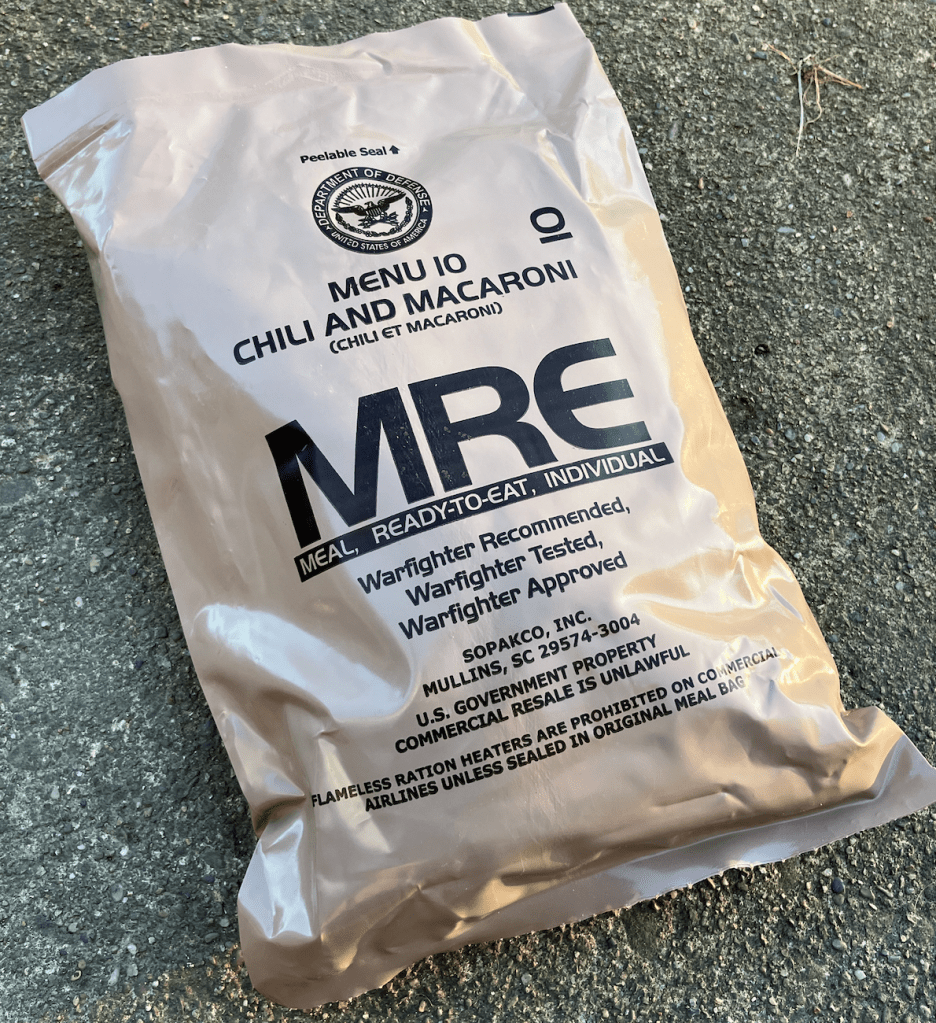
However, I’d like to talk about MREs, or, “Meals, Ready-to-Eat.” Why? Because I found a few old ones laying around in my basement, and I was curious if they were still edible. Note: Don’t try this at home. Always follow FDA guidelines in regard to stored food and its shelf-life. Don’t listen or take as advice the ravings of a retired and half-crazed ex-GI. This information is for entertainment only.Discard any food you regard as suspectand that has exceeded its sell-by date.
OK, that had to be said. Live it. The following words are written just so you can laugh at me and wonder why I did something so dumb. Once again, don’t try this at home. Or, worse yet, build old MREs into your disaster planning.
Here goes.
I’ve always heard anecdotal information about how long GI rations will last. As a kid, I heard from a number of RVN veterans how they were fed rations from WW2, complete with stale Chesterfield cigarettes. I know an elderly Dutch fellow who had a can of GI fruitcake dropped in his yard at the close of WW2, and he opened it and ate it on the 70th anniversary of Liberation Day in the Netherlands. He said it looked fine, and tasted as well as one could expect from vintage GI fruitcake.
Overseas I can’t say that our rations were old, but they were definitely improperly stored, and I doubt that they were properly rotated for age. I recall a stifling conex box heaped with MREs and T-rations, scorpions skittering about, covered in dust. I had no idea when those rations were thrown in there, but I can say for certain that the inside of that metal shipping container reached temperatures above 120F/49C. I’m also pretty certain that some boxes had been there for multiple years. This was far from ideal storage. I ate that crap anyway, and I didn’t get sick. I got sick from kebab roasted over sheep-shit fires, but not from that.
I have eaten so many MREs over the years, it’s not funny. Over the course of my career, I watched as the ration generations changed, as well as the appearance and menus. Modern, 2024 MREs are a far cry from the old dark-brown bag garbage of my youth. Later generations were the early OIF versions, to late war, to present. In the early nineties we had the dreaded dehydrated beef patty. Then, we “improved” to Omelet, Ham and Cheese. We received the frankly delightful hamburger with BBQ sauce, jalapeño cheese packets, and beef jerky. These days? All kinds of goodies. A fav is the GI milkshake, but I digress.
Suffice to say that I know what an MRE should look and taste like. I’ve had thousands. I do know a fellow who got sick from one; botulism. It happened because he ate a spoiled packet at a patrol base in the pitch black. He was in a hurry, was laying prone, and it was raining. Not ideal circumstances to inspect food packets, btw. I guess he slit the thing open and squeezed the rancid contents in his mouth; he spat it out immediately, but the damage was done. He had to be medevac’d out of there and was very ill for quite a while.
So, I’m pretty careful about this stuff. If a packet leaks, is damaged, or is puffy like a pillow, you don’t want it anywhere around your mouth.
Lately, I’ve been making an attempt to clean up my basement. The storage space is home to layers of old Army junk, and I’m trying to organize it. I’ve been doing this in lieu of way more important stuff like writing my new book because right now, frankly, I can’t handle it. This stupid election and negative life events have really put the zap on my concentration; I can’t imagine I’ll write until this dumb thing is over. Or, at least until the possible choas is charted out. There are way too many assholes in this world, and right now they all seem to have megaphones, so I’ve temporarily checked out. Thus, I clean and organize my basement. In the process, I came across some vintage MREs, and I have several cases of new Humanitarian Daily Rations, one of which I wanted to try in comparison to USGI swill. It’s been a very long while since I ate one, and I wanted to see how they stack up and write-up a comparison.
After I reveal the edibility/grossness of the vintage GI MREs, I’ll talk a little about the new HDRs.
Let’s get into it. I selected some very old USGI MREs, probably 2007/2008 vintage. Once again, I’ve eaten mountains of these, and I can spot bad stuff. When I slit these two packs open, I carefully inspected the contents. Everything seemed to be as good as the day they left the factory; there were no puffy or leaking packets. Everything that I opened, I smelled and looked at the contents carefully. If it smells or looks gross, don’t taste it, period. Not even a little bit.
This is what I found with two sixteen or seventeen year old MREs.
The first one I opened was just for reference; I didn’t eat it. However, several times I unthinkingly licked my fingers when food got onto my hands; don’t repeat my mistake! If our old friend botulinum was hanging out in one of those packets, this would have been enough to put me in the hospital. Let’s start with the throw-away/inspection example first.
This is what 17 year old GI peanut butter looks like. I made sure I kneaded the package; it looked and smelled fine. I didn’t knead the strawberry jelly packet, which was a mistake. The solids had separated over the years and it looked like hell, frankly. The sticky stuff got on my fingers. This was where I licked. It tasted like…strawberry jelly.
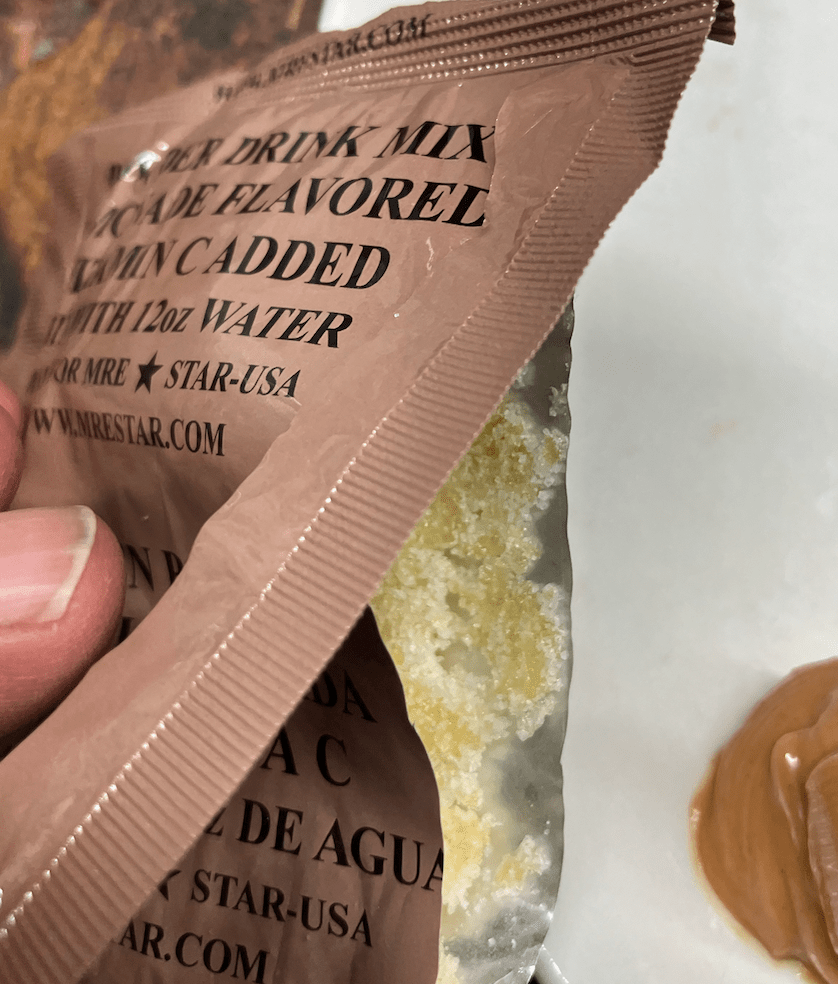
The next thing I cracked open was the beverage powder. Lemon-lime, like usual. The raspberry is much better, but infrequently encountered. I wonder if this MRE was heated up at some point in the past, note the clumping of the powder. However, this dissolved just fine in water, so it’s a matter of appearance. Note: they put drink powders in MREs for a reason. Number one is to mask the taste of crappy water. Number two is to give the soldier vitamin C. Always use the drink powder! But don’t pour it into a canteen. Use a cup. Canteens are for water only. This is a field hygiene basic tenet.
The next item I opened was GI bread. It looked, smelled, and felt as if it had been baked yesterday. Really remarkable, and I wonder what sick, dark magic goes into the manufacture of this stuff. Even though I didn’t intend to eat this MRE, I wouldn’t hesitate to eat this.
Then, I looked at the pound cake. It was as I remembered them, and it looked kind of delicious. No defects noted. Finally, it was time to have a look at the entrees, whose packets were nice and flat, undamaged. How would seventeen year old Mexican Rice and Vegetable Lasagna look and smell? I found out.
Turns out, they were both fine. This is where I caught myself licking my fingers again, a serious mistake. If this stuff had the crud, I was toast. However, I’m not dead/hospitalized, so it was fine. The Mexican Rice was clumpy, stinky, and unattractive, but so is a packet made yesterday. This is NOT one of my favorite entrees; spoiler, both MREs I tested had lousy entrees. But I digress. I’m speaking to this being edible, and it was. The Vegetable Lasagna was also fine, if gross as-new.
BTW, MRE entrees have a peculiar smell; it gets better when you heat them. This is normal but off-putting to someone unfamiliar with all things MRE. I attempted to use the MRE heater, but in both MREs they were as dead as stone. I added water as you should and nothing happened. I waited a while, too.
Weird how the purely chemical, dry heaters last for much less time than the food. Seriously, Uncle Sam, WTF?
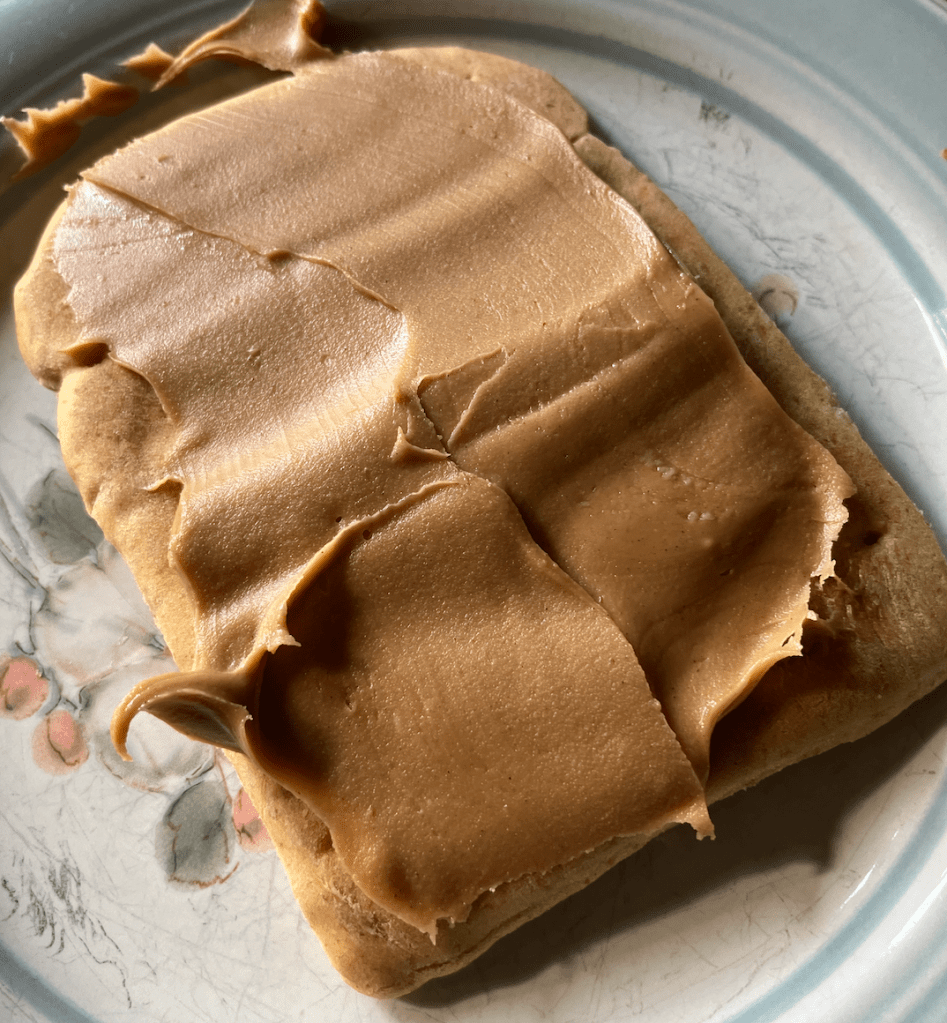
Convinced that these ancient mariners were marginally edible, I decided to eat the other one the next day for lunch. I guess it’s a spoiler that I’m typing this, so you know in advance it must have been OK. Kind of tough to post from an ICU. Well, I lived and experienced no signs of gastrointestinal distress. The first thing I ate was the peanut butter and jelly combo on the bread, and this time I made darn sure to knead the packets. Here’s what the peanut butter alone, spread over the Immortal Bread, looked like.
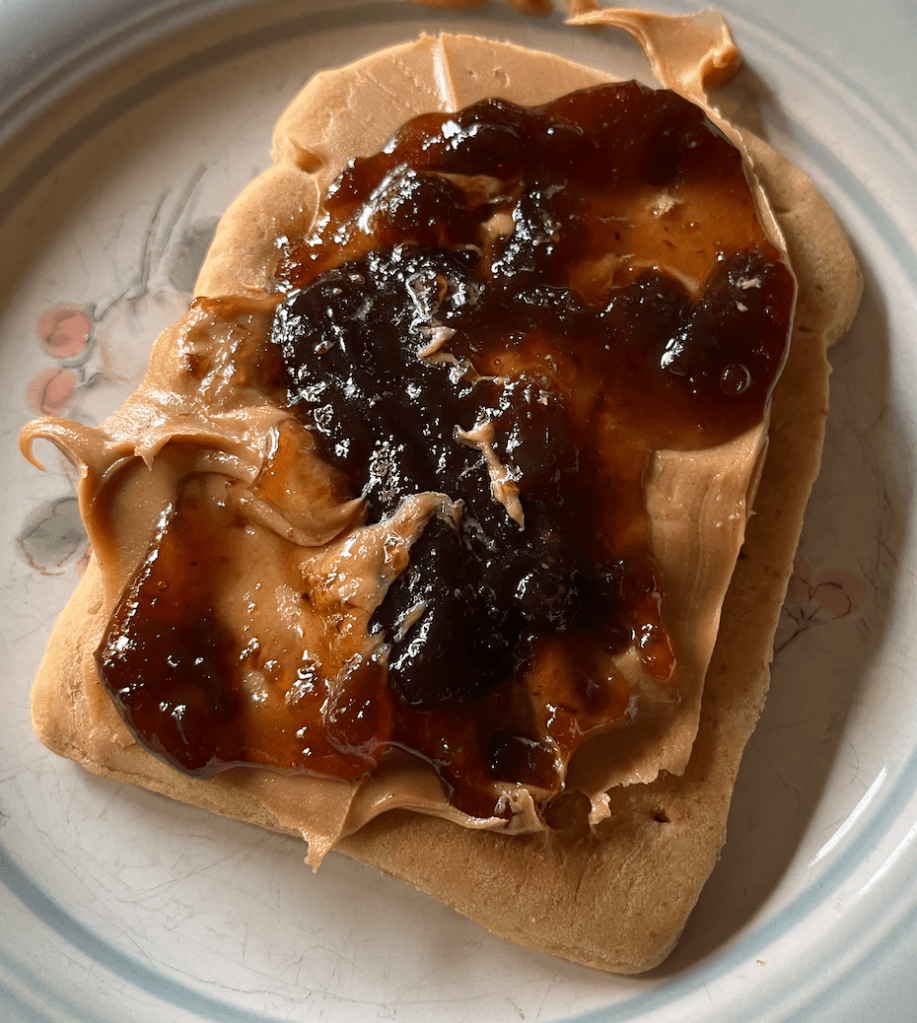
As you can see, there is nothing freaky here. The peanut butter looks like I just grabbed a jar of Skippy from the pantry, and spread it on the GI near-bread. I assure you this is 17 years old. Then, I made a PB&J.
It really helps if you knead the jelly packet. While this will never make the cover of a foodie mag, it worked. I ate it, and it tasted like every darn GI PB&J I’ve ever had, albeit a lot older (Probably. You never know in the Army). BTW, I drank the raspberry drink packet later, it was fine. Also ancient.
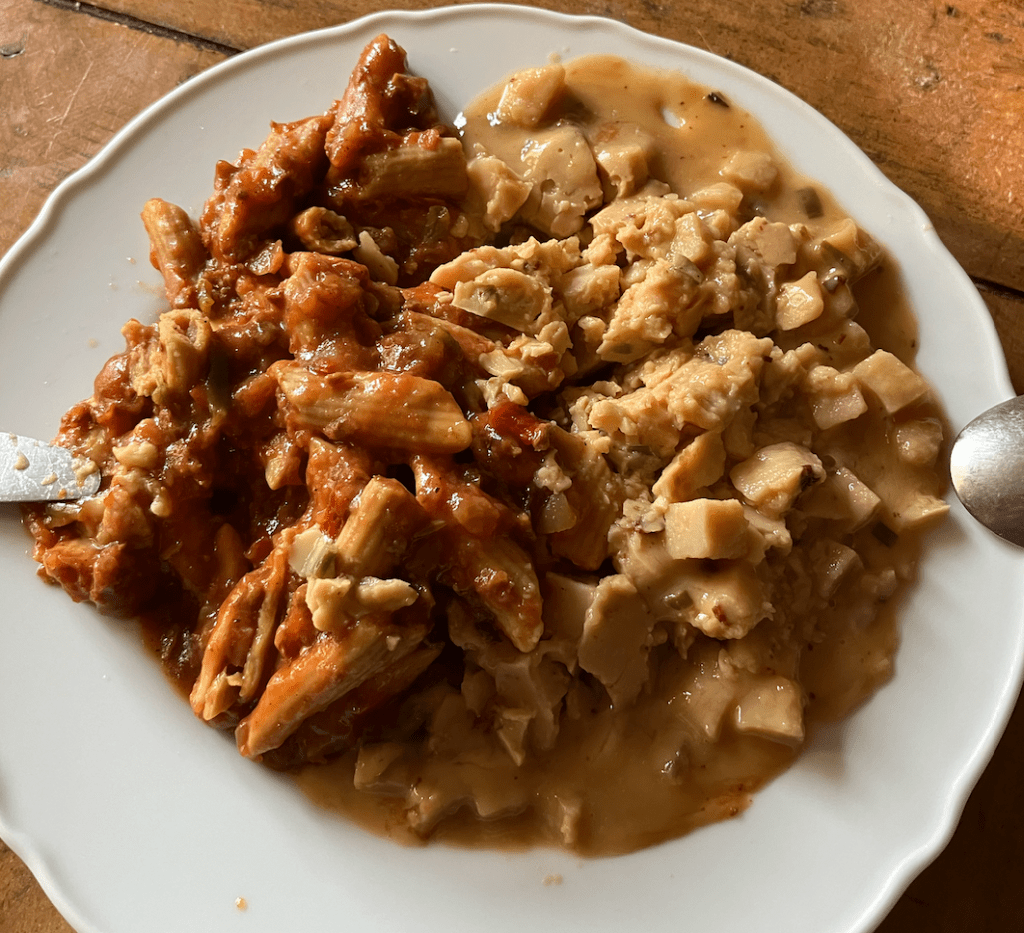
It was time for the entrees, Penne Pasta in Tomato Sauce and the dreaded Potato Soup, Bacon Flavored. I scooped it from the undamaged packets, looked at it, smelled it, and chucked it in the microwave for a minute.
Yes, this looks like hell. It tasted like crap, too. However, regretfully, this is the norm for the terrible potato soup. The pasta was marginally OK, so I ate all of it. Like usual, I only managed to choke down half the potato soup. Lemme tell you, when they pass out the MREs, and you’re the loser of the MRE lottery, no one will trade you for the potato soup; or, if your luck is particularly bad, for the Ham Omelet.
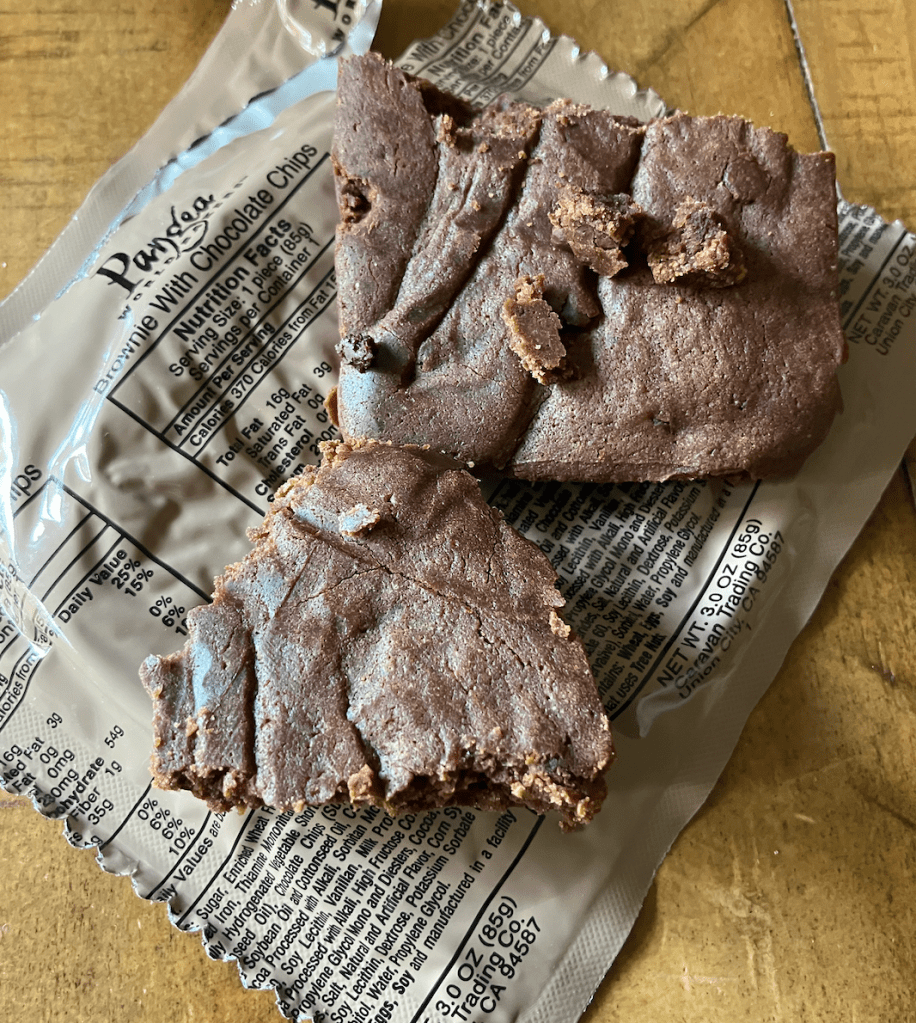
This is the definition of starvation rations. You’ll eat all of it if you’re ravenously hungry. I wasn’t, so I ate just enough to see if I’d die. I didn’t. After the Potato Soup ordeal, I saved a snack, the Brownie with Chocolate Chips.
This looks terrible, but it’s not. Something I’ve noticed in MREs over the years is that they compensate you if the entrees are gross. In this case, this MRE came with a delicious brownie. Yes, it was awesome. Even after seventeen years.
In conclusion to the old MRE writeup, I guess just the fact that I’m sitting here typing tells you what you need to know. While it’s not preferrable to eat MREs that are older than kids who can vote, I guess it can be done, judiciously. But only me. You shouldn’t do it, nor do I advise you to.
After that hell, I moved on the the meals that Uncle Sam provides to refugees. How did they stack up to USGI? What were the differences? How do they taste?
Let’s start. First, I’ll state the obvious. The HDR I tested was from 2022, so I had no fear factor eating it. Second, HDRs are (much) less expensive than USGI MREs. Third, there is more stuff in an HDR than an MRE! The MRE is designed to be issued three times a day (although in practice that’s waaaaaay too much, but those were the planning factors we had to use for heavy labor). The HDR is not. The HDR, the Humanitarian Daily Ration, is just that. It’s a once-a-day minimum for some poor bastard who can’t get any other food. This person is dead lucky to get one of these, and it can be stretched over multiple days at need. Finally, the HDR on the civvie market is 35/case of ten, 3.50 each, USD. The USGI MRE is 135/case of twelve, 11.25 each, USD.
I was shocked when I looked up the cost this morning. I know that HDRs have gone up since Hurricane Helene, and for good reason. Basic supply and demand. However, they are only up about 5$/case, which isn’t insane. USGI MREs? While they’ve always been more expensive than HDRs, now they are really expensive! For less food, you pay more than three times more for USGI. For someone doing disaster prep, unless you are very well-heeled, this doesn’t make sense to me.
I can tell you the difference, in layman’s terms. The USGI has a slightly better grade book of matches. The MRE has a self heater (see above for why this isn’t worth it). The USGI comes with name-brand junk food. The MRE has entrees with meat; they are culturally incompatible with a few major world religions. The USGI has milkshakes (a major advantage, I admit).
Is the above worth paying 11.25 a meal? I say no. So, let’s talk about my taste test with the new-ish HDR.
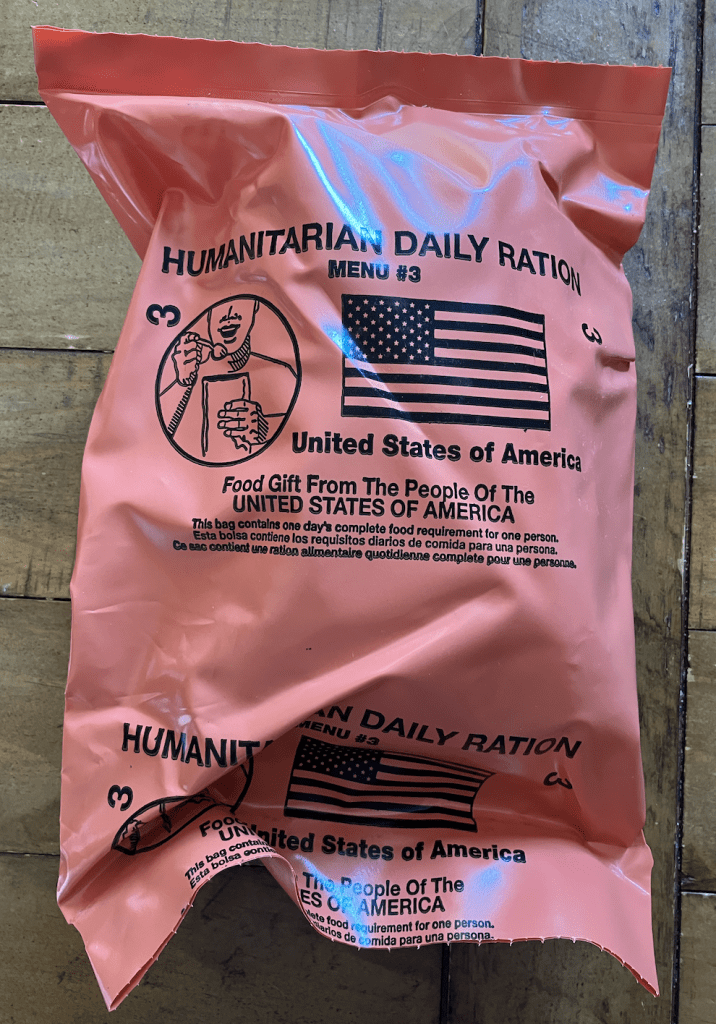
This is the HDR. Like the MRE, it comes in a tough, waterproof thick plastic outer shell.
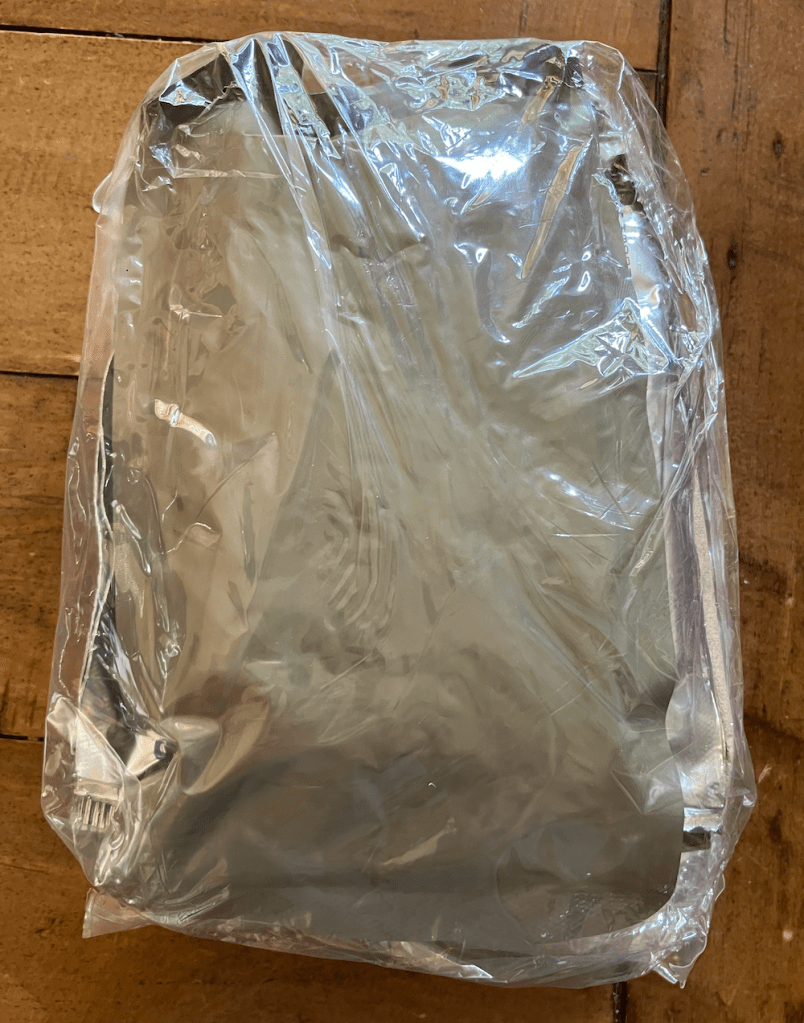
The contents are double-sealed in this compact plastic wrap. BTW, if you want to use these immediately and desire a more compact package, like in a ruck, strip the outer shell and carry them like this. What, pray tell, is inside this packet? It’s been so many years since I had one, I was curious. I have a lot more experience with MREs than HDRs. See below.
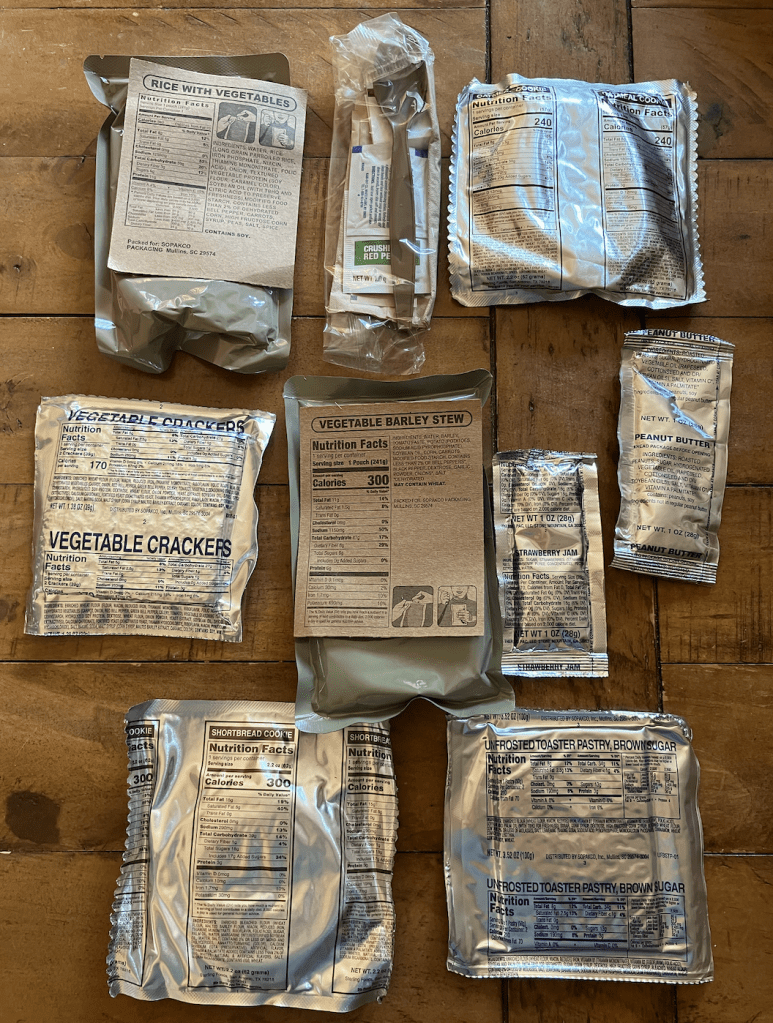
As you can see, this can be split into breakfast, hot lunch, hot dinner. The packets, if you want to heat them up, can be chucked into hot water to heat. Or, you can do like me and scoop out the contents and microwave. I’d imagine you could heat on a skillet, too. The toiletries packet isn’t as awesome as USGI, but it’s pretty good. There’s salt and black pepper, red pepper flakes, napkins and a moist towelette. Pro tip: save the napkins and moist towelette for your nether regions in the field. There is also a book of matches. The HDR is a comprehensive package.
For your benefit, I’ll give you a notional day with just this packet alone, Menu Number Three. There are four menus randomly mixed per case.
Breakfast: Crackers, with peanut butter and strawberry jelly. If not enough, get a boost with the toaster pastry (a pop-tart), which can be heated in a pan. I am well familiar with MRE crackers, these are identical. So is the PB&J, and the pop-tart. Note that the packets aren’t USGI brown. So what? But hey, if you want to spend three times as much for brown packets and less food…go ahead.
Lunch: Rice with Vegetables, throw in some pepper if you want some spice, and have a sweet treat with the Oatmeal Cookie.
Dinner: Vegetable Barley Stew, served warm. Add the Shortbread Cookie for dessert.
You’re not going to get fat, but you won’t die, either. If you really must have tabasco sauce or M&Ms, spend three times as much. I won’t stop you.
I ate this stuff without qualm. How was it? A first impression upon opening the entree bags was that for whatever reason the entrees didn’t have that USGI reek. Could this be because of Halal prep methods? Different, meat-free ingredients? I don’t know, and I don’t care, I guess. Just an impression. I scooped the rice and barley stew onto a plate and zapped it for a minute in the trusty microwave. How did it look? How did it taste?
Observe.
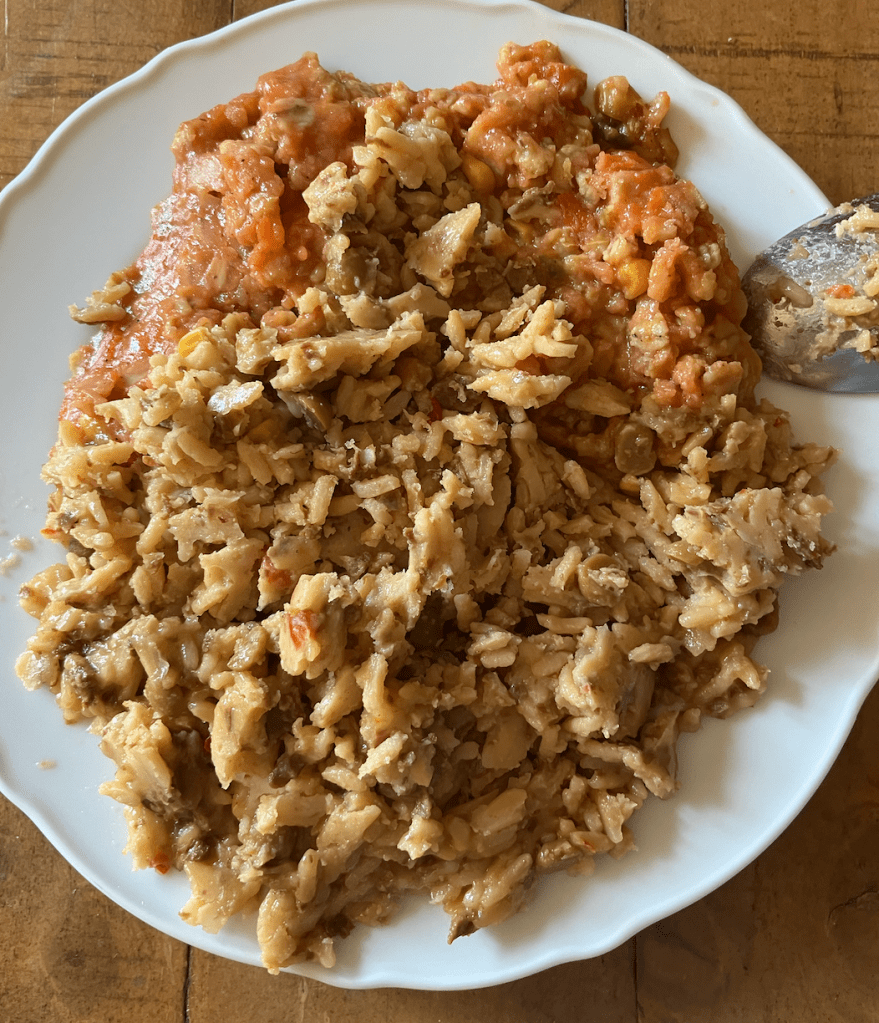
One hell of a lot better than USGI, frankly. Don’t say “But you ate antique MREs.” I did. However, they were NO different in taste and texture from brand-new USGI! This HDR food was superior. Yes, there was no meat. However, you don’t really need meat for nutrition, your protein requirements will be met with the total HDR. If you must have meat, I guess spend the big bucks. Your call.
The HDR entrees actually smelled good cold, and they tasted good, too. The rice and veggie combo was WAY better than “Mexican Rice.” It didn’t need the provided salt, and I thought it had just the right hint of spice. The barely stew was good, too. It was filling and kind of delicious. I should have tossed on some of the provided red pepper to try it out, but I’m sure it’s fine if you want some nip. And the oatmeal cookie? It was great, and added to the substance of the meal. There was no way I could eat the entire HDR in one sitting!
Long story short, I rate the HDR as superior to USGI. This considers overall palatability, cost, and calorie count. One thing I didn’t see in the HDR, which might have been just this one, was the lack of drink mix. However, this isn’t a big deal, and you definitely aren’t missing anything with the lack of a heater. Both ration types seem to age well if properly stored, but the HDR wins the contest hands-down.
Look. Maybe I’ve had bad luck at times, some terrible experiences. Without getting too deep into the weeds, life has taught me that all the good things of your existence can be taken from you in a millisecond. People routinely float through their day-to-day blithely assuming that as life has been, so will it always be.
Bullshit, I say.
Recent events, namely Hurricane Helene, prompted me to write this article. As I understand, much of the American South has been devastated by the effects of this storm, with an untold number of people cut off from supplies and help due to washed away and debris-choked roads. People cannot access safe drinking water, food, or medical care. In addition, internet and cell communications are down for many, compounding the disaster.
To those who can read this, I’d like to suggest small measures that you can do NOW, to help you mitigate disasters that may happen to you.
It doesn’t take much effort or money. Seriously. There are no hidden passwords, no arcane knowledge, and no weird doomsday-preppers stuff. Also, what I suggest doesn’t take up a ton of space in your house or garage. I will only suggest supplies that I have used and possess. None of it costs much, and all of it is perfectly legal and dead necessary when the chips are down.
Rest assured, at some point, the chips will be down. Count on it.
Your primary needs in a disaster are water, shelter, and food. I’d add medical care, communications, and a means of defense as secondary needs, albeit vital.
Let’s start.
The thing at the top of this list is water. Without drinking water, you are out of luck. Period. You need safe water to survive. Most natural sources of water are not safe. You will get sick if you drink it. Sick as in terrible diarrhea. I’ve been there, done that. For months on end. This is failure, and it’s easily avoided. How?
By knowing where there’s a good spring, storing water, or which is the method available to everyone, by keeping and knowing how to use water filtration equipment. I’d suggest my hillbilly drinking water rig. It combines the $7.49 Harbor Freight siphon pump and the Joypur 3/$25 filtered drinking straw. It works incredibly well. In advance of the event, flush the HF siphon pump with hot water to get the factory gunk out of it. Then, attach a Joypur drinking straw to the suction hose on the HF pump. Test it on anything. You stick the filter straw in gross water (the clearer, the better) and slowly pump. Clean water will come out of the discharge end of the pump. It’s that easy. Disassemble the rig, allow it to completely dry, and store it with your “this sucks” gear.
Shelter? Just go buy a tent somewhere adequate for your family or for yourself and know how to set it up. Go with shelter in place or use your vehicle if possible. But do keep a good tent. It’s smart. This could cost fifty bucks or hundreds. It’s your call. For Pete’s sake, if nothing else, buy a high-quality tarp. It’s better than nothing. I thought after the fact that I should tack on bedding. Let’s not forget the humble sleeping bag; I found this low-cost option a while back. BTW, these arrive vacuum-packed and take up very little space.
Food? You could go nuts in this area, but you don’t need to. Suffice it to say a few cases of MREs, which can be had for as low as $32/case of twelve, go a long way. The rule of thumb is one MRE per person, per day. I’d keep a minimum supply of one week’s food.
Then, there’s medical care. I’d always suggest attending free medical training at a local hospital or fire department. If you ask around, these agencies give free classes to the public—free, for potentially life-saving information. None of you need to be an EMT or a trauma doc to save a life. You can go far with basic knowledge. Also, you might be surprised that many do not even have a rudimentary first-aid kit in their house or vehicle. Please don’t repeat this mistake. For $18 dollars, you can avoid it here.
It sucks to be cut off from the rest of the world. I’ve been there for months on end. Trapped in horrible mountains, surrounded by bad people, with <zero> means of touching base with your loved ones. It was a job requirement for me back then, but right now, it’s a reality for unknown thousands down south. You can easily avoid this if you act now. It’s really nice to have communications. I’d suggest two energy-sipping devices. The first is the $17 XHDATA D-238 shortwave radio. The second is the $40/2 Baofeng UV-5R ham radio. The SW radio takes close to no training to use, and you can find out what’s happening in the broader world. The ham radios take a bit more expertise and practice, but in a serious emergency, they can be used to summon help if the cell towers are down. I’d like to note that in real-world emergencies, THE CELL NETWORKS ARE ALWAYS DOWN. Think about it, pay the money, learn to use the gear. It’s not that hard or expensive.
Then, let’s face it, the world has some shitty people. You need to defend yourself or your family. Also, you need basic tools for just about everything, especially when life sucks. I’m not going to suggest you build some kind of arsenal. That’s not me. Here’s stuff I personally own or have used. The first thing you need is a good knife. This $30 dollar unit will last for a lifetime and is strong and plain. The next thing I’d suggest is a good multitool. I thought to help the readers out because the options here are dizzying, and it’s possible to buy junk, name-brand, or generic. This $32 dollar option is fantastic. It’s also nice to have an entrenching tool, which doubles as a weapon at need. I’m hardly going to touch on firearms, but I will say that the number one survival/defense caliber is the humble .22LR. It is a killer, rest assured. Buy a brick of hollow points and keep it with your rifle, preferably a Ruger 10/22, the best of the breed.
I’d also suggest a power source for your devices independent of household power. Many would say you need a gasoline generator. I disagree for a few reasons. One, a gas generator is a complex machine that takes some degree of expertise to operate safely. Two, it’s going to cost hundreds, at least. Three, they’re noisy. Finally, they require gas, which may be in short supply. Also, laughs, try buying a gas generator after a disaster! I’ll bet my bottom dollar that there’s not a generator to be found in North Carolina right now. Lemme give you the lowest-cost option that works for almost everyone, the cheapo $32 400W vehicle voltage inverter. You plug it into a car’s cigarette lighter port and flip the switch. Presto, you have a means of powering devices or 400W worth of household power. I’d suggest a higher-cost but also great, $230 solar generator. This thing is dead easy to use, rest assured. But as with everything I’ve suggested, knowing how to use it BEFORE your bad day(s) is key.
Finally, there are some other low-cost, nice-to-have items. Even though the first I’d suggest is the humble map compass, I’d never go without one. Get one, and know how to use it. Then, it’s nice to have lighting. I’ll suggest a few options, but there are many. One that’s really cool and endlessly practical is what we called firefly lights in the service. You can buy an $8/8 pack here. Then, there’s an all-purpose, rechargeable LED lantern. Kind of nice to have for $26. I’d also suggest buying a three-pack of Bic lighters at Wally World or a gas station, and for Pete’s sake, learn how to build a fire.
This is my readiness pitch to all of you. The definition of a disaster is an unforeseen event that drops on your lap and screws everything up, or endangers you or your family. This no-shit happens, and you are damn right it can happen to you.
Do like a good Boy Scout, and be prepared. No, you cannot possibly cover all contingencies. But you can cover most with the little bit of stuff I suggested above. It might take up 1/4 of a clothes closet, or a corner of your garage. Oh, OK. It’s better than being stranded and completely dependent upon outside help.
Help that may be weeks in coming. Very shitty weeks, I might add.
Give it some thought, and then maybe open your wallet. ‘Nuff said.
When I was a kid, I knew a couple of ham radio enthusiasts. I’m unsure if every town had them, but I knew two. Both had learned their trade in the Army, WW2, and Vietnam, and both had these crazy dedicated radio lairs full of lighted dials, arcane machines, the smell of ozone, and monster antennas. I remember being fascinated by those shadowy spaces full of hulking metal boxes and buckets full of vacuum tubes and random, unidentifiable parts. The men were messianic enthusiasts; they’d listen to faraway voices, enraptured, and they had long lists of frequencies and times taped to the walls.
Both of them were super good guys with cool hobbies; I wish I had learned more from them. The WW2 guy tried to teach me Morse Code, but with my boyish gnat-like attention span, that didn’t work out. The Vietnam guy got me into it a bit more, but at that point in my life, I was short on cash, and ham radio and a good shortwave receiver cost me money I didn’t have. He took pity on me and gave me a beat-up Hallicrafter S-38 with some extra tubes and showed me how to rig a long-wire antenna with zero cost involved. He died shortly after of a heart attack, and I have the radio to this day. It still works, believe it or not.
I remember messing with the ham transceivers and listening to distant stations on that Hallicrafter early in the morning. For a while, I kept my own reception log with freqs, times, and stations. By the time I left for the service, it had grown (for me) impressively long. Radio Australia, Brazil, Moscow—there were many. It was super cool, listening to those distant voices in the lost years before the internet.
However, I moved on in life, and I forgot about those distant voices for quite a while. The Roxor project got me thinking about communication systems a couple of years back. I wanted to create a facsimile of the trucks we had overseas. An important aspect of those vehicles was communication. Without commo, you had a major problem. While cell phones are nice, they are unreliable when the chips are down. OK, I seriously doubt there will be some Mad Max crazyman situation, but I wanted my off-road machine to have commo. Period.
So, me being me, I began to investigate my options on Amazon, and I soon found that the ham and shortwave scene had changed A LOT since the 1980s! Wow. A hallmark of the hams I knew as a kid was that they spent a considerable amount of their paychecks on their arcane hobby, and the equipment took specialized knowledge to use. Also, it took up a LOT of space. This explains why both of them had dedicated radio sheds. While their spouses were cool about things, those ugly gray and green (a lot of ham and SW equipment was cobbled from Army surplus) boxes looked hideous in the living room.
I’d hate to think about their electricity bills, too. Wow, those old machines sucked power like a vacuum cleaner!
Imagine my shock when I discovered that you don’t need to spend more than SIXTY DOLLARS for a complete SW/ham equipment set, albeit basic. The equipment takes up a shoebox’s worth of space, with tons of room left over, by the way. I found my solution and had more than enough money left over to sample different systems. I thought I’d share this with you today if you are interested.
First, why would you care about old-fashioned shortwave when we live in the age of the internet? That’s an easy answer. The internet, as seen in numerous crises worldwide, has this bad thing about dropping off during difficult situations. It’s the same with cell phones. Nothing sucks worse than hanging out in a power outage or something, and you have <zero> info or comms. It happens. Ham radio and shortwave sidestep both of these problems. After all, we easily forget that our internet infrastructure is about thirty years old and surprisingly fragile. Radio, on the other hand, is far more robust. Reliable.
It’s possible that I’ll never regularly use radio or ham communications again, but it’s nice to know I have the capability if needed. And for sixty bucks, what excuse do any of us have? It’s a very small amount of money, less than two people’s dinner at a chain restaurant, to have crucial information during a problematic experience.
Without further ado, let me tell you what I have found to be the biggest bang for the buck items on Amazon. I’ll tell you the best stuff at the lowest price. You can spent (a lot) more, but you don’t need to for basic capabilities.
First, ham communications. To transmit, you should have a license. If nothing else, if you are unlicensed and you “step” on a licensed ham’s commo, they will get cranky. You may get a fine, too. At worst, if you interfere with the commo of aviation or first responders, you could pay a fine and cool your heels in jail. This is failure. Avoid it. However, nothing stops you from monitoring the ham freqs with a ham radio! You can stay up to date with local events, and in a dire emergency, you can hit “transmit” and worry about cranky ham operators or possible fines later. My two cents. It’s better to have a capability and not need it, than the opposite. ‘Nuff said. Lemme tell you about the best ham radio for the buck.
Hands down, it’s the plain-jane UV-5R, manufactured by Baofeng. You can see one in my lead image, it’s the little walkie-talkie on the upper right. These units sell in various packages on Amazon. You can buy a two-pack for as little as thirty dollars, with different antennas, chargers, extra batteries, etc. You can buy just one for about fifteen or less. These things are small! They fit in the palm of your hand, and the batteries last for about a week on one charge. On the page I linked, you’ll see all sorts of radios with confusing terms like GMRS or ham. Get the ham radios. GMRS is intended for short-range commo. Ham transmissions are much more powerful. Also, Baofeng products are based on the venerable UV-5R platform, so the old UV-5R, if you learn to use it, is a starting point for everything in the Baofeng family.
The UV-5R is criticized for not being as user-friendly as possible, having small buttons and displays, and not being as powerful as its more expensive peers. These are valid concerns, but IMO, they are also irrelevant. People are usually scared away from ham radio and shortwave by UNIT COST. You don’t have much money invested here if you try it out. Also, YouTube is full of tutorials on how to use the UV-5R. It’s actually not bad. The people complaining have never suffered through Army classes or tried to get something to work using that same fine institution’s manuals. They’ve also never been cursed with using military radios in a work setting.
Compared to a SINCGARS, MBITR, or Harris, the UV-5R is simplicity itself, with tons of flexibility and options. I think it’s really great. If you try out the old UV-5R and want something more capable, Baofeng has many economical options to suit. Also, being familiar with the layout and function of the 5R, you can easily transition to their other products. The UV-5R, with the right antenna set-up and topography, can get reach out a surprising distance for such a little guy. If you input UV-5R in the Amazon search bar, you can really find some deals.
Now, let’s talk about budget shortwave receivers. The UV-5R will give you local commo, and FM reception. With SW, you are listening to the world! My go-to brand that I discovered on Amazon is XHDATA. For the money, they are amazing. For as little as ten dollars, you get a radio that listens to the world. I have my prefs, of course. I’ll tell you about them.
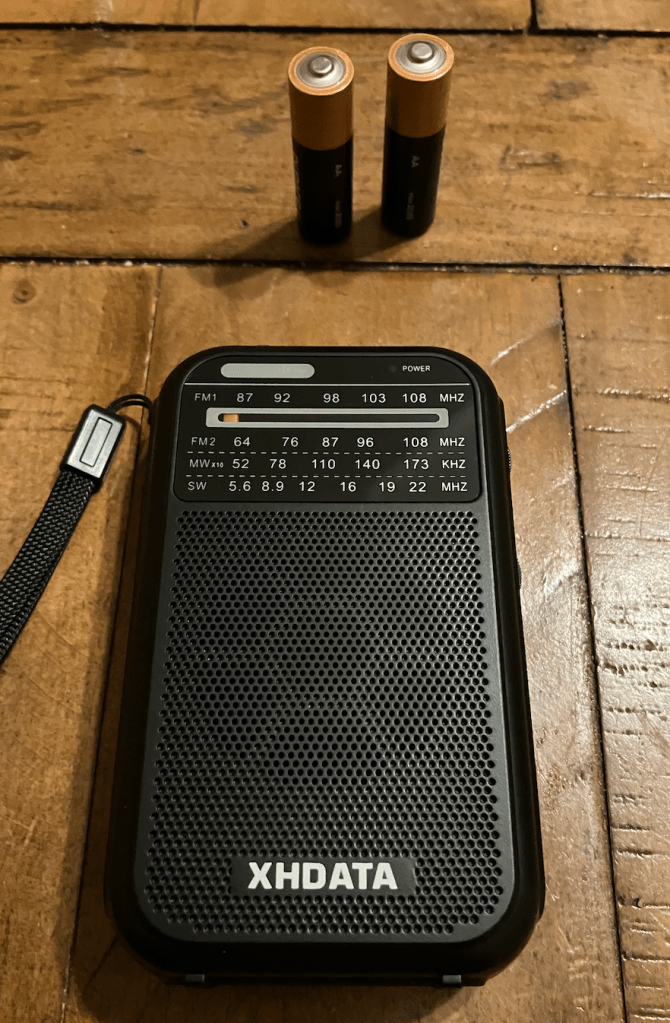
First, let’s go low-dollar. This would be the D-220, a hand-held radio that works fairly well on AA batteries. It listens to FM, AM, and SW. See below.
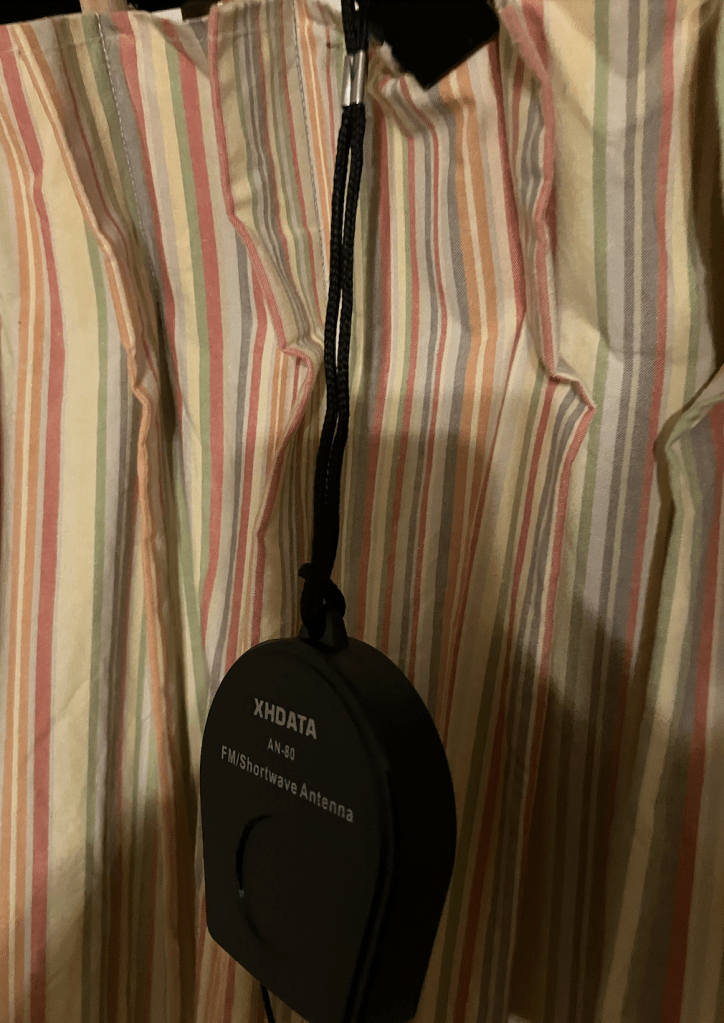
There is a cheaper model, the D-219, but I’m not a fan. I guess you could try it, lots of people like it. The D-220 is the least expensive but still capable model that they have. I would prefer it if it had a power source other than AA batteries, but it doesn’t. I’d suggest you pick up something else to go with your new SW radio. There is a cool little compact long-wire antenna that clips to the regular antenna and can hang from just about anything. This is the XHDATA AN-80, which costs just a few dollars but greatly increases your listening range. See below.
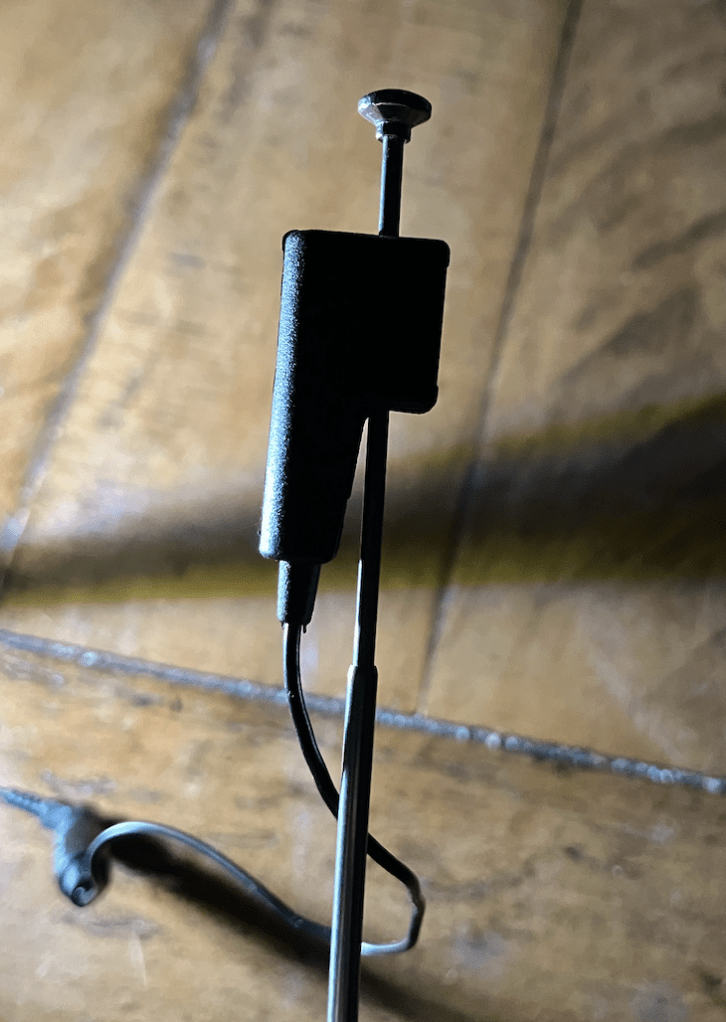
This is the AN-80 hanging from my curtain. It has a neat clip on the retractable spool end, and the other has a clip that securely fastens to your radio’s antenna. Pretty cool, inexpensive, and compact. Below is the antenna clip, fastened to the D-220’s antenna.
It doesn’t get easier.
The next radio type, which is my favorite, is just a few dollars more than the D-220. It is the D-328. Here’s what I like. First, it is less than twenty dollars. Second, the controls are super easy to use. Third, it has a handy collapsible stand that lets you incline the radio to ease its use. Finally, you can power it using a USB plug that charges an internal lithium-ion battery. This is great—you can either charge it using your vehicle or household power. Also, it’s a nice receiver. Just messing around I picked up a lot. It is also very compact and plays with an MP3 player, if that’s important to you. See below.
Finally, the most capable XHDATA radio for the low-dollar price range is the D-109. It breaks the bank at about thirty dollars, however. Oh, the humanity. In exchange for your riches, you get a digital scan, which is awesome, and the option of saving channels and a whole bunch of other stuff. This floors me. In the eighties, you’d have paid thousands for this, and the package would have been MUCH bigger, with a vastly higher energy draw! This one powers like the D-328, and its lithium battery lasts very long. It lasts so long that I’m not sure how many months it would take to go dead. A while. See below.
This is the D-109, pictured with the handy AN-80 clip-on antenna. I should have placed a pen by these for scale, but this is also a palm-sized unit that’s very easy to use. This is a great unit!
To conclude, I think I’ve shown that you don’t have to spend much to get good commo in problematic situations. A quick cost estimate, if I may. The AN-80 antenna, which can be used for just about any radio, costs 8.30 today. A great two-radio UV-5R package is 31.99. This includes chargers, antennas, everything you need. YouTube instructions are free. The midrange XHDATA SW radio, the D-328, costs about fifteen bucks when you apply the coupon. I guess you could splurge and get the deluxe D-109, which costs a princely 33 bucks after the manufacturer’s coupon.
As I promised at the beginning of this article, the total cost is between 55 and 73 USD, or about sixty bucks on average. For your sixty-odd dollars, you get two ham radios, a handy long-range antenna, and a good SW radio.
You can spend much more at Texas Roadhouse without trying.
This weekend, I attended my tribe’s powwow in Mendota, Minnesota. I discussed this at length on my paywall site. If you’re not signed in over there, maybe you want to check it out. The barrier to entry is low. But I digress.
During the activities, our tribal secretary suggested that I check out one of our vendors, a tribal member named Jeff Bardon. I did so. He runs a business called River Valley Trading Company, and he sells unique Native-related art and products. I bought some cool stuff from him, and during the course of arranging shipping, we talked a little. Somehow we got on the subject of violins, and he mentioned that he had a frustrating experience with his, a standard Amazon Cecilio MV-300 model.
Long-time readers know that I am very familiar with this exact model. In my older posts, you can find my review of those violins. The MV-300 forms the basis for the economy fiddles I sell at flea markets. The bodies are solid products, but their fitting is terrible. Bad bodies can’t be fixed, but fitting can.
I always have a few MV-300s sitting around here awaiting prep for sale. We made an agreement. He’d send me his to trade for one that I prepped. When his arrives, I’ll prep it for sale. Meanwhile, I whipped one of mine together, finished it yesterday, and shipped it. I thought I would tell my violin-interested readers about this process, it turned out pretty good.
First, I gave him the pick of the litter: a body with decent wood character on the belly. It is by no means super fancy, but for an economy fiddle it’s nice! See below.
It was stripped, of course. I usually don’t reuse factory furniture; I save that stuff for donations or super-inexpensive repairs. Here’s what the start of the process looked like.
Ok, so this isn’t the very beginning. In this pic, I’ve already installed the new pegs and end pin. But minus those parts, this is how I start. The violin clamp simplifies all the maintenance you need to do on a fiddle. It holds it steady and level as you work on it.
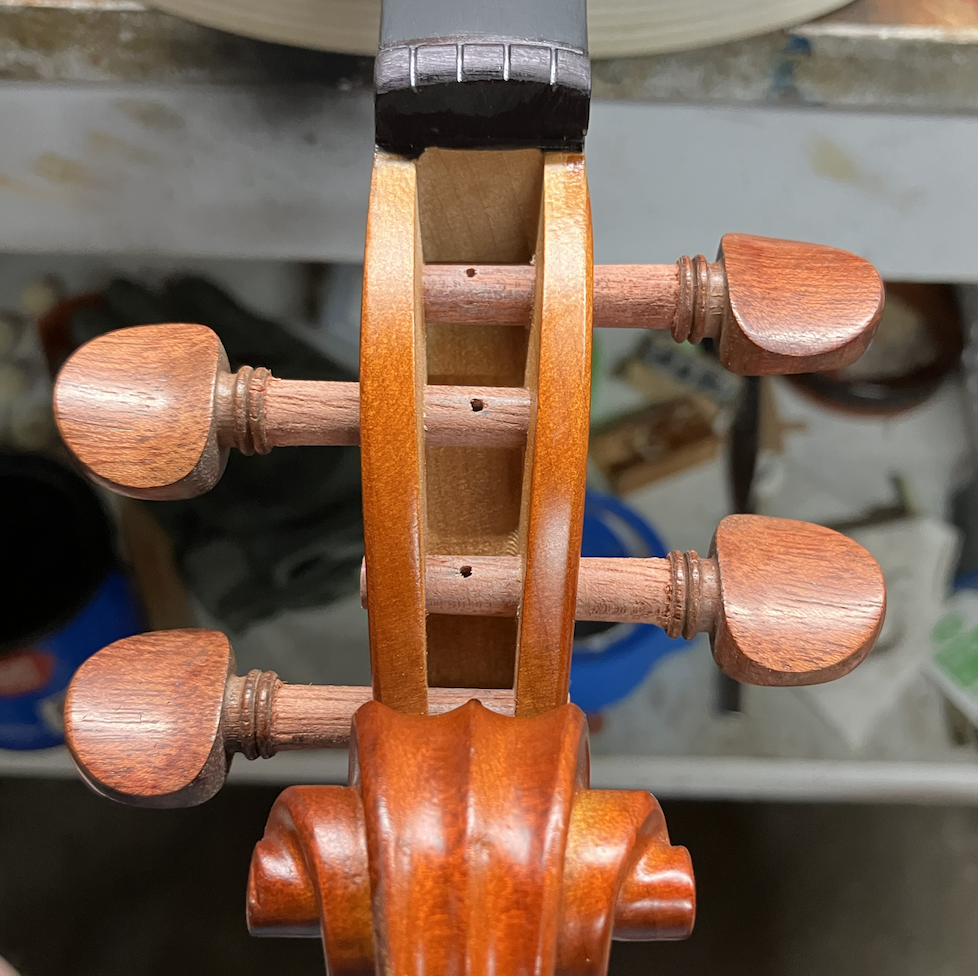
The pegs determined the look I wanted for this violin. I happened to receive a shipment of mahogany pegs while I was in Minnesota, so I thought I’d try them out on his violin. They were good pegs, and certainly an upgrade over factory. I’ll show you the work on the box below.
The factory nut was an abortion, as usual, so I shaped it and cut new grooves for proper spacing and string depth. I also penciled the grooves for lubrication. I shaved, fitted, trimmed, and drilled the pegs as well. These should last for years of normal use. Once the boxwork was done, I headed south, as usual.
I selected a good bridge and carved it. After I carved it, I fitted it to the plate. This is one of the most important steps of this process! A poorly fitted, low-quality bridge will adversely affect the instrument’s sound. Mind, a bridge DOES NOT have to be name-brand, but if you buy megapacks of generic bridges (I do for economy builds), you must carefully select the good ones. In this case, I thought I’d be fancy and give Jeff a nice Teller bridge.
Of course, while creating the bridge, I looked at the location of his sound post. To my surprise, the factory did OK, so I left the sound post alone. With the bridge completed, the next logical step was stringing the fiddle. It was time to make two decisions, one aesthetic and one practical.
I installed mahogany pegs, so I was inclined to use earth-tone furniture instead of traditional black. Of course, the fingerboard was painted black, but without getting into the weeds there wasn’t much I could do about that. The fingerboard was 100% serviceable, but I could help the violin in other ways. At first glance, I thought to use an economy brown furniture set I’ve used on other projects, but the more I looked at this fiddle, the more I realized that that wasn’t the best choice. I rummaged through my parts drawer, and I had the good luck to find a nice red boxwood set that complemented the pegs. I held it up to the fiddle, and I liked it.
Then, I needed to decide which strings to use. Jeff is a budding fiddler, so high-end strings wouldn’t be a good choice. I immediately thought of Red Labels, my go-to strings for students. Also, these Cecilios like Tonicas, too. However, I had another idea for this violin. Low-cost, old-school strings called Black Diamonds have a bit of a cult following with the bluegrass crowd, and I just happened to have a set lying around. I decided to use those.
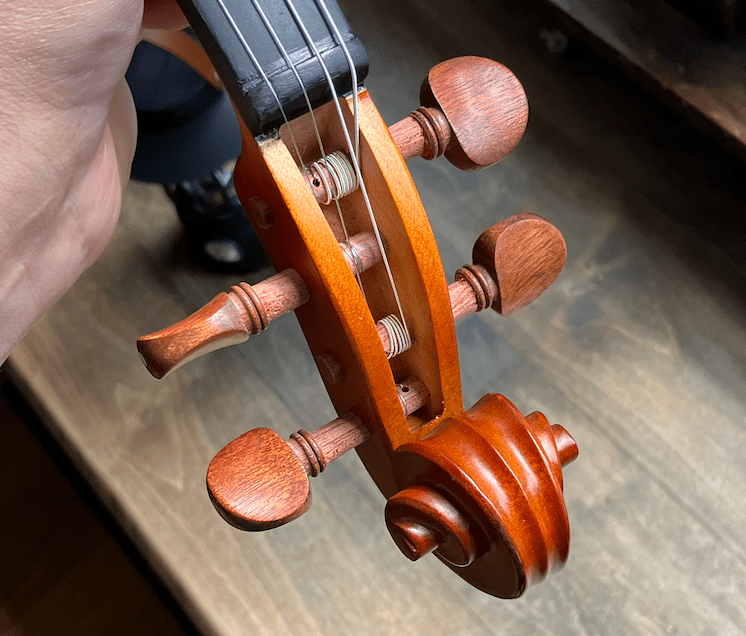
Decisions made, it was time to string the instrument. See below.
This was turning out pretty good, I thought. After winding the strings, I started to tension them per SOP, slowly but surely, while watching the bridge. As expected, the Black Diamonds were “hard” without much stretch. It was time to play Jeff’s fiddle. First a few detail pics, though.
The end pin detail, with the tailpiece and chinrest I picked. I also added some fine adjusters, good Wittners, because this is a fiddle, not a concert violin. Of course, I prepped the adjusters with a tad of bearing grease, and prepped Jeff’s bows, too.
This is the box, wound and ready.
I think the red theme really suits this violin. While this is, and will remain, a student violin, it’s important that the player likes how it looks. I ran the new look across Jeff via text, and he seemed pleased. This was good enough for me. It was time to play, the moment of truth. How did it sound?
While hardly high end in terms of resonance and tone, it was journeyman good. Perfect, I think, for a student! The Black Diamonds, while inexpensive, helped with that old-time sound, and they BEAT THE CRAP out of factory strings! ALWAYS pitch those in the trash, I’m not sure why they include them, honestly. They’re terrible!
While I enjoyed working on it, it was time to re-home Jeff’s fiddle. With a final check to make sure I included everything he needs to play, I cased it and prepared it to ship. Here was my final view of Jeff’s fiddle.
I boxed it and went to the post office.
Hopefully, this will get Jeff on the road to becoming a fiddler. It’s a solid learning platform. The MV-300, once properly tweaked, is a great place to start.
Today is a long-awaited event for my partner, the esteemed JB, and me. It is the day Javan War, our Cruel Stars origin novel for Lucinda Hardy, went “wide.” This is a first for me, I’m usually Kindle exclusive for some very good reasons, being a small-scale author.
However, John doesn’t have those encumbrances, so this launch is simultaneously wide or available across most platforms. Pretty cool, really.
As you may know, we’ve been working on this since 2017. Things happened, and there were delays. C’est la vie, but now it’s here. JB’s concept of a non-linear structure turned out great, but much was left on the cutting floor.
However, fear not. My paywall peeps get the cutting-floor stuff, as the book was originally written. I wanted to delay the release of this material until after the launch—well, it’s been launched!
Sooooo…more follows, soon. Plus, more ISOLATED stuff.
You can find this here, here, or anywhere—really. Even the Apple ecosystem. Just look on your iBooks app. This is the power of the Gold Hovercraft, which I was privileged to ride briefly.
Hey all. I know I’ve been a little quiet here lately, and for good reason. I originally posted this on my paywall account, but decided to set it free here, as well.
When you open a text post in Patreon, it will prompt you. Today, the prompt said, “Tell a story.”
Well. I have a story for you; it involves the imminent release of “The Javan War,” a co-authored novella that has been simmering for a long time.
The story goes back to 2017. I had just finished my original trilogy, the Valley series. I wrote the first book before I was in contact with JB. That thing was a hangover from my final tour, and the idea to write it wasn’t mine. It was my counselor in the Combat Stress Recovery ward. She said I should write a book because I had a long list of craziness to work through.
Write a book? The thought hadn’t ever occurred to me, and WTF did I have to offer? How was I supposed to write a novel? What would it be about? I didn’t have a clue, but I thought about what she said.
In 2013, I had nothing but time. I was on active duty, and my assignment was a “healing mission.” It said so on my OERs, or my Officer Evaluation Reports. Yes, even when undergoing the Army Medical Board, you are still required to file those. The Army, the Board, and the Bureau of Motor Vehicles said I shouldn’t be driving due to loss of conscious episodes, so I couldn’t drive. It was the purest hell. I felt like I was fifteen again; on the cusp of adult mobility, but not quite there.
I spent a lot of time in the hospital. There were endless appointments and evaluations I was required to attend. When the Army said, “You are permanently disabled, your career is over,” it was like a lightning bolt to the nuts. What was I going to do?
I had no idea.
So, I decided to follow the good Doctor’s advice, and I dreamed up a novel.
I didn’t want to write a biography or some dumb shit. Self-promotion sucks, and who wants to read about a long career that was mostly boring? Nobody. However, I have read a lot of sci-fi and other fiction.
While deployed, books were a source of comfort and entertainment. Some books I had read many times, and on every re-read, I found new things to enjoy. Authors I read? Wow. The list is long.
Of course, there are many more, but these were prominent names in my collection.
What to do?
I wanted action like JB. I wanted a narrative sweep like Asimov. I wanted bitterness like Haldeman.
Given a sci-fi setting, I wanted to write about things I knew, but I didn’t want to write about me. I crafted a character, Private Paul Thompson, who left home young and returned home broke and old. He is a star-traveling soldier who saw a chunk of the universe and wished he hadn’t.
I began to type without a clear plan. The words became blurry, and before I knew it, I had a manuscript.
Meanwhile, the cottage industry of indie publishing was born, and Amazon catered to that crowd.
This made it possible to bust out my book, totally ignorant of the publishing world and its pitfalls, to a “wide” audience.
I paid a lot of money to a self-publishing venue, CreateSpace, which held my hand through the process—for a nominal fee, of course—but the deed was done.
In June 2014, the year and month I grudgingly retired, In the Valley launched into the void.
And readers, it was a void. I sold seventy books in the first two years after Valley launched. Later, I learned that this is typical of most self-published books. Friends and family, and maybe an odd rando or two.
I got my license back and put my stupid book on ignore.
I’m not sure what I did during that period. 2014-2016 is a dead space in my life. I’m pretty sure I worked at a retail job stocking shelves, which was a humbling experience. I had an episode at work, which was noticed by coworkers. Deeply embarrassed, I quit the next day.
A normal life, I could see, was not in store for me.
What to do? No idea. I drank a lot back then and tried to pick up the pieces as a father and husband, with mixed success.
Then, one day, randomly, I received an email from some guy in Wisconsin. He asked me when I would write the next book. Also, I was in tentative touch with JB, who was so kind to respond when I shot him an email- “Hey, I like your books.”
Trust me, most authors don’t bother. This touched me.
I decided to write a follow-on novel to Valley, The Captain’s Cauldron and committed to completing a trilogy.
For fun, I pinged JB and let him know work was underway on Book Two.
To my vast surprise, he answered with, “Wait, what? You wrote a book?”
Yes, I said, and I gave him the deets.
Meanwhile, I busted into one of my writing fugues and completed the MS for Cauldron in a month. I shot it to CreateSpace and published the bastard.
John got back to me about Valley—he read it and liked it! Whoa! Then, he hawked it on Burger! This was a holy shit moment for me, seriously. I think in ’16 was the first time we had a video chat. This was mind-blowing for me. I spoke to an incredible author whose work I carried in combat—I remember reading “Final Impact” during Operation Andarab, a seriously shitty trip.
Our relationship evolved, and by 2017, while I wrote Immolation, the final book in my original trilogy, we were in regular contact. He became a mentor and a friend, and he recommended some professional reading. One of the books I latched onto was his entertaining tome, How To Be A Writer, which was great! For my budding authors here in the in-group, I highly recommend this.
By fall of 2017, I’d done a few bits of nip-and-tuck for him. Little shorts, some advisory work. This led to his proposal in the fall of 2017- would I like to do a co-authored thing with him called The Javan War, an origin story for Lucinda Hardy, the chief protagonist in the Cruel Stars series?
Uh, yeah, I said.
With a premise, I pitched in and wrote a bit.
Then, things happened beyond our mutual control. Diseases. Issues. Delays.
Eventually, I kind of forgot about JW. But the files were there, nestled into the cloud. Meanwhile, John had other projects, and so did I. CreateSpace went out of business, and I wasn’t sure how to publish anymore.
It turned out to be a left-handed gift, and through a series of conversations with John, I learned how to publish on my own at about 1/10th the cost of using an outfit like CreateSpace, with better results, frankly. The funny thing is that CreateSpace was the lowest-cost all-in-one publishing package out there! If you want to be ill, research this yourself. I could name names, but I won’t. You can easily drop 10k on your very own novel; I guarantee you that 99.9 percent of the books created like that will never see a neutral ROI, let alone a profit, no matter how slim.
I did consider the Houses for my new novel, The King’s Ohio Rifles, but they expressed zero interest. To be fair, I didn’t try particularly hard. I had heard too many stories of authors’ nuts being put into a sling by that crowd, so I was satisfied with my 70 percent royalty cut from Amazon.
Oddly enough, The Ohio Rifles series was finished before I published my next book, The Storyteller’s Heaven, in 2022, when I broke a six-year publishing gap.
The crack in the wall led to a flood. I established my Patreon paywall site, and began to publish books fairly rapidly. Due to a backlog of material, this was easy.
By the time I made my belated trip to Australia, I had eight long-form novels out there. When I left for the trip, Light’s End was on the cusp of publication, but I didn’t want to launch it from Oz in case there were complications I couldn’t deal with while overseas. During the working trip, I put the last details on LE and obtained a cover.
While there, John surprised me by expressing an interest in capping off the Javan War; of course, I was game! I spent a week typing away on it when he told me his vision for the ending. I shot him the files, and the vacation neared its end.
Before I passed through the door, however, a cabal of creatives met. We hatched the plan for ISOLATED, I had a concept when it was time to take the bird.
I got back to the States and launched LE. Then, I started cranking on ISOLATED, which has gone slower than I’d like, but it is what it is.
Meanwhile, John did his thing with Javan and decided to take the non-linear route for structural reasons, which also slowed him down.
But now, the moment is almost upon us, and I thought to share the story of The Javan War, a long-awaited mutual venture.
Two things will happen on Patreon.
First, all of my paywall peeps get a free copy via BookFunnel.
Second, after the launch of the final version, I’ll start dropping chapters from the original copy. Much of the book ended up on the cutting floor; for structural reasons this was inevitable.
However, if you are familiar with The Cruel Stars, you’ll note that some of the cutting floor stuff ended up in canon. Also, you’ll see all of it, anyway, and you may agree with John that some material distracted from the throughline of our novella.
More soon on Patreon, and notice of publication here on Interstellar. Behind my paywall, there will be a free copy of The Javan War, ISOLATED1, and serial drops of the first draft of JAVAN WAR.

















 The Interstellar Valley