A Rough Story

Alright, readers. Right now I have my fingers in about twenty different pies, although most of you can see none of that. There’s some stuff going on in my life that is deeply distracting. Not bad stuff, more like being hit with a fire hose of new information. Stuff you never knew.

Well, this is all pretty crazy. So I’ve finished the rough draft of an alternate history series, some 250,000 words. Now I’ve embarked on another trilogy meant exclusively for a Patreon page that I need to create. Pretty much to the midpoint of Book 1, if I wanted to I could launch my website tomorrow.

But I’m not going to do that. For a change I would like to exercise real tactical patience and go slow and smooth into my ventures, as opposed to plunging headlong into something, like usual.

What the hell is this guy talking about, perhaps you ask.

Alright, I have a bit of a dilemma. I really want to write about two different things. One of them is the aforementioned trilogy, straight-up sci-fi, for my future Patreon site. Another is something I’ve been made aware of these past few months.

It’s a true story. A very rough story.

The tale spans the period of the early days of the American Republic to present. It is violent. Parts are shameful. Most of it will make you shake your head with the sheer injustice of it all.

I’ll give you a hint. The story has similarities to two films, maybe more. If you liked “The Revenant” or “Hostiles,” maybe “Unforgiven,” then this story is for you.

One problem.

It is fascinating, but I don’t know if I want to write it. For one thing, I’m a science fiction writer, not historical non-fiction. And there’s a problem- if I wrote this tale, it would have to be dead accurate. The past demands that I would have my facts entirely straight, that I would tell the story correctly. That I would be fair when I don’t want to be, that I would reveal some harsh and ugly truths.

This story is America, the good and the bad.

I’ll give it to you in a nutshell. I’m curious what you, my readers, think.

In 1799, a party of French fur trappers out of Canada moved south along a great river, the locals called it M’ni Sota, or cloudy waters. These days we call this area the confluence of the Mississippi and Minnesota Rivers. There was a long-standing camp there of the Dakota tribe, to be specific the Mdewakanton. The camp was called M’dote, a Dakota word that roughly means “an area where the rivers come together.”

The French, being French, ingratiated themselves to the Dakota, and while they were catching beavers for the voracious European markets, they took local wives. A man named Michel took a Dakota lady, the daughter of the Chief Wabasha, as his wife. They had a number of kids, one of whom was known as Francois. Francois became quite a trader in his own right, he roved the west looking for deals, and at one point he even went to Washington to help represent his relatives in making a treaty with the whites.

Speaking of whites, this territory, the ancient homeland of the Dakota people, started to fill with settlers. Washington wanted a deal with the Dakota, they had claimed this “new” land and they named it Minnesota. It was a form of the old Dakota word for the great and sacred river, whose legendary center was known to the whites as Pike Island. This area, with the old village of M’dote, now called Mendota, was supposedly reserved for the Dakota. In exchange for their land, the Dakota had been promised an annual annuity and a reservation.

Francois probably knew there was going to be trouble. He ran a trading shop in the Lower Sioux Agency, in what today is Morton, Minnesota. The situation went south in August of 1862, when a US Government official idiot suggested that the starving natives could “eat grass and dung” when he was informed of the critical situation involving the Dakota.

You see, the Federal Government was late paying the promised annuity, and the Natives were no longer allowed to rove outside their reservation for food. No money, no food. It was an entirely preventable situation that was directly caused by Washington.

Some young men, many of them relatives of Francois and his family, called for war to their chief, a man known as Little Crow. At first Little Crow told them they were crazy, but the pissed off young men called him a coward. Little Crow, although he had real reservations, couldn’t let that insult slide.

The Dakota attacked. The Dakota War of 1862, also known as the “Sioux Uprising” started. You can click on the link for plenty of detail, I’m not going to give you all a blow-by-blow.

Suffice to say the Francois was one of the first to fall; he was probably related to the man who killed him.

Francois, who had a number of children with his wife Judith, a Fox woman, had a son named George. George was pretty pissed off that his father was killed. He signed on with a militia outfit known as Renville’s Rangers. The Rangers, under the command of a mixed Mdewakanton named Gabriel Renville, played an important role in protecting civilians and native non-combatants during the vicious fighting that took place that terrible late summer.

Predictably, after some early successes, the Dakota were crushed by the Union Army forces arrayed against them.

In an atmosphere of poisonous racial hatred, hundreds of Dakota warriors were sentenced to death by hanging. This was the first time that Native combatants were tried as civilian criminals rather than enemy combatants, as had previously been the case. The trials were substandard, usually lasting no longer than five minutes per person. By bitter coincidence, they were held in Francois’s office, one of the few buildings that survived when the Lower Sioux Agency was torched.

Hundreds of people were killed, both the innocent and the guilty. President Lincoln himself, in the midst of the slaughter of the Civil War, took the time to review each “trial” of the “guilty,” and he personally nullified or commuted hundreds of sentences of the captured warriors.

But still, 38 men were sentenced to hang. On December 26th, 1862, the United States saw its greatest mass execution when the men were hung together on a custom made scaffold.

One poor fellow, possibly more, was hung by mistake. Later on, two of the leaders of the rebellion were captured in an illegal raid in Canada. They were drugged, smuggled across the border and hung in Fort Snelling in 1865.

Fort Snelling was located by the ancient Dakota town that was now known as Mendota. After the war, the remaining Natives were rounded up. Men, women, and children. Everyone of Native blood. They were herded onto sacred Pike Island, the Dakota center of the universe, and they were held in deplorable conditions.

George’s family was among those who were incarcerated. Hundreds died of disease and starvation.

The war, as all wars do, ended. The Government passed laws forbidding any Dakota, under penalty of death, from remaining in Minnesota. There was one exception; Dakota who had remained neutral in the war or who had helped the whites were allowed to stay in a very limited space in ancient M’dote, or Mendota. Other Dakota secretly returned as well; though this was a very bold move.

Why?

Ever heard the saying “he’s off the reservation?” It means someone doing something crazy.

I learned that in the 1860’s to the 1890’s that Natives could legally be killed and scalped if caught “off the reservation.”

For a handful of gold, some poor person’s life. The thought makes me want to vomit.

This. This was the poisonous aftermath of the 1862 War, that eventually led to the massacre at Wounded Knee; a shame and blot upon the US Army’s colors.

George and his family tried to keep their heads down in an apartheid-type existence, they were marked forever as “redskins” and undesirables. Oh, they did laugh and love, but they always knew that the larger society saw them as worthless. George and his wife Josephine had about ten kids, one of the last ones was named Odelia. She was born when he was nearly fifty, a real late-comer.

Of course, I wasn’t there, but I get the idea that Odelia, who preferred the name Matilda, was a bit of a handful. At some point she was sent to a special Indian school, where they taught her that her background was shameful. That everything she knew was tainted. That her beliefs, her family’s customs, were savage and uncivilized. That her Native blood was a curse, to be obfuscated and lied about, denied, by any means necessary.

She returned to Mendota from the school, and she had a brand new plan.

Matilda was tired of being spat upon, treated like shit over an accident of birth. She caught the eye of a fresh veteran of the War with Spain, a fellow named Merton. They married, and in the meanwhile the old warrior George, son of Francois, breathed his last in 1907.

When he died, Matilda decided she needed a change. When her new son was born, she decided that there was no way she wanted him on the Indian Census. You see, there used to be a separate census for the Natives, and they were called “IN” or “MB” (Mixed Blood) or worse, “Half-Breeds” on official government documents.

If these racist terms were used on dry government forms, then what did “Matilda” hear from day to day?

I can imagine, and it wasn’t good.

The young mixed-race couple ran like hell, and for the rest of her life Odelia was ashamed of her past.

It was a hell of a note for the child of fierce warriors and leaders.

“Matilda” ended up being the mother of warriors herself; Wabasha and George would have been proud.

Her children smashed teeth from the mouths of dead Japanese; they faced Banzai charges with numb hands and a smoking Garand. One son fought the Chinese; never to return. His family, the elderly Matilda included, was riven by grief. More faced “Victor Charles,” they watched as naval gunfire pounded the hostile hills. Other sons faced the Jihadis, the nameless enemy that crept at night. The placers of bombs, the killers of kids. The sons of Matilda followed the warpath, the tradition, to this present day.

And it all started with a fur trapper and his Native bride.

This brief missive just skims the tale, and every word is true.

It is but one facet of the tale of a remarkable people called the Mendota; a community that despite everything still survives.

I wonder if I should write this. I found the story by accident; it sucked me in like quicksand.

Remarkable.

One of the best

For some reason I think that war poetry does a better job of conveying the sense of battle than stories. Just my two cents. Here is one of the very best war poems, ever.

The Battle of the Tenaru, August 21st, 1942

By Robert Leckie, USMC

A helmet for my pillow,
A poncho for my bed,
My rifle rests across my chest-
The stars swing overhead.

The whisper of the kunai,
The murmur of the sea,
The sighing palm and night so calm
Betray no enemy.

Hear! river bank so silent
You men who sleep around
That foreign scream across the stream-
Up! Fire at the sound!

Sweeping over the sandspit
That blocks the Tenaru
With Banzai-boast a mushroomed host
Vows to destroy our few.

Into your holes and gunpits!
Kill them with rifles and knives!
Feed them with lead until they are dead-
And widowed are their wives.

Sons of the mothers who gave you
Honor and gift of birth
Strike with the knife till blood and life
Run out upon the earth.

Marines, keep faith with your glory
Keep to your trembling hole.
Intruder feel of Nippon steel
Can’t penetrate your soul.

Closing, they charge all howling
Their breasts all targets large.
The gun must shake, the bullets make
A slaughter of their charge.

Red are the flashing tracers,
Yellow the bursting shells.
Hoarse is the cry of men who die
Shrill are the woundeds’ yells.

God, how the night reels stricken!
She shrieks with orange spark.
The mortar’s lash and cannon’s crash
Have crucified the dark.

Falling, the faltering foemen
Beneath our guns lie heaped.
By greenish glare of rocket’s flare
We see the harvest reaped.

Now has the first fierce onslaught
Been broken and hammered back.
Hammered and hit, from hole and pit-
We rise up to attack!

Day bursts pale from a gun tube,
The gibbering night has fled.
By light of dawn the foe has drawn
A line behind his dead.

Our tanks clank in behind him,
Our riflemen move out.
Their hearts have met our bayonet-
It’s ended with a shout.

“Cease fire!” -the words go ringing,
Over the heaps of the slain.
The battle’s won, the Rising Sun
Lies riddled on the plain.

St. Michael, angel of battle
We praise you to God on high.
The foe you gave was strong and brave
And unafraid to die.

Speak to the Lord for our comrades,
Killed when the battle seemed lost.
They went to meet a bright defeat-
The hero’s holocaust.

False is the vaunt of the victor,
Empty our living pride.
For those who fell there is no hell-
Not for the brave who died.

This poem is real. In particular, the last quatrain. I am glad that this poem received worldwide exposure on the HBO series “The Pacific.”

It deserved it.

2034: A Review

BLUF: A riveting, horrifying and fast-paced read with some easily overlooked flaws.

A friend provided me with an Amazon gift card, and at the same time he was kind enough to give me a recommendation for a new book. I have been considering this book for a little while; his enthusiasm pushed me over the edge and I bought a hardcover.

I’m glad I did. For one, it was nice reading a “real” book again. The tactile feel of paper, the smell of freshly printed pages, wonderful. This leads into the next nice thing about the book; it is a natural page turner. Actually, I burned through this book in a day. I didn’t have to force myself to read this. Finally, 2034 was a tense book with lots of action and a too-real sense of immediacy.

Any of you who have been following this page for a while know that I don’t have a lot of patience for ridiculous cost overruns in defense procurement and the stupid fetishization for technology rampant within some in military circles. This book jumps up and down upon exactly these points; our vulnerabilities to disruption along dozens of point failure sources.

There are those who say that we have it all figured out, that we will always stay ahead of our legion of adversaries.

This makes me laugh, bitterly.

Great empires and nations have always said this as the termites chew away at the foundations of their respective civilizations.

When the defense of the republic becomes divorced from the realities of most of its citizens, bad things happen. Also, when the republic buys goods that are defective at birth and expensive to boot, no one should be surprised when they fail, taking talented young lives with them.

Let us never forget that fighters and ships, etc, are expendable end-items. They are tools of war, meant to seek and deal out violent death. They should protect our military men and women as best as possible, they should be mass-produced and cost-effective, and they should be dead reliable and fail-safe on multiple levels.

This all leads into my book review.

The US military as portrayed in 2034 has fallen deeply down a technological well from which it cannot recover; it has been choked to death with legacy systems and fickle cutting-edge tech.

The Chinese military, aided and abetted by Russians and Iranians, proceed to kick the USN and the US Government squarely in the nuts.

OK, as an ex-Army guy I’d love to see the author’s take on what happens with my old branch, but I understand the focus on the Navy and Marine aviation. For one thing, the Navy is at the top of the list for an organization caught up in the technology siren song, as well as being the possessor of extremely expensive “white elephant” surface ships. This makes them prime candidates for disruption by hungry, rising opponents.

The authors deliver on this premise in excellent and horrifying ways.

A complaint: it would have been nice to see how the USAF, another organization loaded down with white elephants, would get pulled into the Pacific vortex, too. Because they would definitely be there.

However, these are quibbles, really. I have others, but I hesitate to add them to this review for fear of introducing unnecessary spoilers.

Suffice to say that I don’t think there was enough of an exploration of emerging warfare assets in space, or perhaps, given the author’s emphasis of this throughout the book, potential usage of the old Mark One Eyeball to foil the various plans of the Chinese and American antagonists.

If you read the book, you might see what I mean.

However, the chief role of fiction authors is to deliver entertainment through a vehicle, in this case a harrowing novel like 2034. Another role some authors have is to deliver a message.

The authors of this book have succeeded in doing both.

This book is an entertaining read, period. Also, the authors successfully point out that American supremacy, hegemony, is not a given; any empire, even if unnamed, requires not just heaps of money spent but money and blood spent wisely.

At present I am far from convinced that this is the case; after reading 2034 I can see that I am not alone in this view.

Will influential people read this book and draw conclusions from it? Impossible to tell.

But some people should, before we live through Zero Day Code or On the Beach.

Decisions

Art mirrors life.

There. I’ve said it. If what you put on the page strays too far off from what your readers expect, then you have a lot of work trying to explain yourself. If you explain too much, you’ll lose your crowd. Also, just as in life, your protagonist must make decisions.

Decisions are central to a narrative, just as they are essential in life.

Duh, you say. Of course.

No, it’s no duh. People have trouble making decisions, I know I do. Your character in your story needs to make decisions, even if they are seemingly minor, because decisions reveal character.

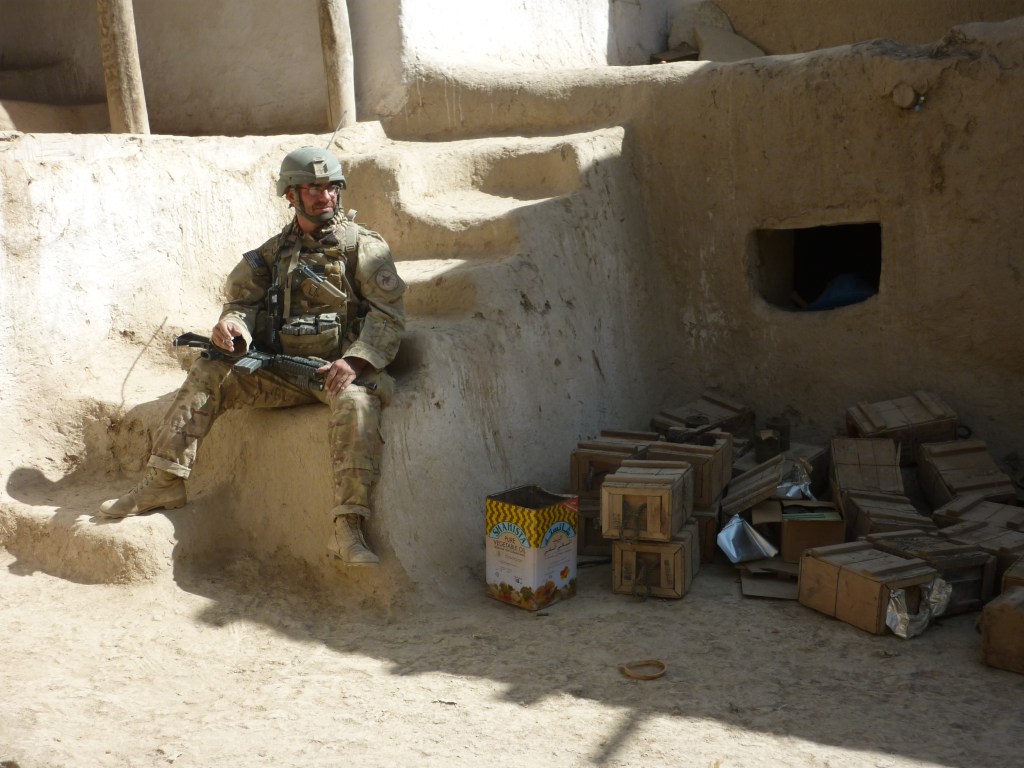
God knows I’ve made some bad decisions in my day. I’d like to say I’ve learned from them, and I’ve progressed as a person, but some days I wonder. Of course, I think I’ve made some pretty good decisions, too. See photo above. There’s a story there.

On that day me and my guys captured a mountain of ammo and bomb making supplies from the bad guys. It wasn’t easy, but the job got done. What decision did I make, you wonder.

One of the hats I wore was Counter Improvised Explosive Device team leader, or the C-IED guy. We captured a ton of explosives, so it was a bit of a question what we should do with the junk. An option was to dump it all in a field and have one of the circling Apaches drop a Hellfire on it.

It would have disposed of the ordnance.

In my opinion, it would have also toppled a few structures and shattered every pane of glass within half a mile. I didn’t doubt then, or now, that someone innocent would have gotten seriously injured.

My boss asked me for a decision.

I made one. With multiple pissed-off groans, we ended up humping the explosives out of there on our backs. There was limited vehicular access, but the infantry has doubled as mules since the dawn of time.

Ten years later, and I am still convinced it was the right choice.

As my boss back then told me, no decision is also a decision.

A person who has never done anything has it easy when it comes to criticism. I am reminded of this when I watch the feeding frenzies on Internet personalities. I ask myself what decisions have these people made, what risks have they taken?

Chances are, few. Good old fashioned jealousy and schadenfreude seem to be the chief motivation of some.

Now, I am not saying to go out and make bad decisions. And some feeding frenzies are richly deserved. But that’s not the point of this piece.

What I am saying is that when you’re crafting a story, even if it is one that no one will ever read, the action is propelled forward by choices, good and bad. Be conscious of this, identify the various catalysts in your narrative. Make your character someone who acts, not someone who is passive, who is acted upon.

No one wants to read that. Also, no one wants to be that, either.

Start making decisions, whether it is a fictional narrative, or your personal journey.

It’s the stuff of life, and it’s what people want to read.

The Very Beginning

All, so I have embarked on a new trilogy as discussed in the last post.

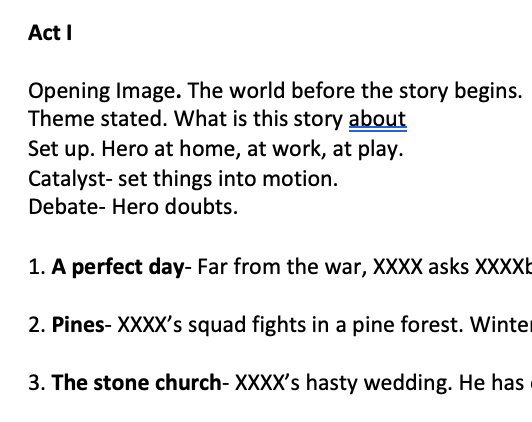
Something I promised a long time ago was that I would discuss my writer’s journey as it unfolds. Well, something I learned back during my first trilogy was that before you do squat you need to have a coherent outline. Pictured above is a real outline of a book that I have completed. Using just those skeletal prompts pictured, I write entire novels.

This approach may not work for you, but it works for me. I guess the broader point is that if you want to write a book, you need some form of plan.

It doesn’t have to be an outline. It doesn’t have to have any type of formal shape. It just needs to be.

A plan. Without one you are probably whistling Dixie.

OK, so here’s what I do. I learned this from a master, and from the professional reading he assigned me. It works very, very well, and I really don’t know what I did before I learned the THREE ACT STRUCTURE.

In a nut shell, here’s what it is.

Act I

Opening ImageThe world before the story begins.

Theme stated. What is this story about

Set up. Hero at home, at work, at play.

Catalyst- set things into motion.

Debate- Hero doubts.

Act II (Twice the size of Act I or III)

Break into two. Hero must make a choice to step into II. Now or never.

B-Story activities.

Fun and games. Explore new worlds. Promise of the premise.

Midpoint. Stakes raised. False victory, defeat. Time clock. Pace accelerates.

Bad guys close in. Hero team issues or bad guy threats.

All is lost.

Dark night of the soul. “Whiff of death.”

Act III

Break into three. Hero steps up and goes all the way.

Finale. Final exam. Does hero learn lessons.

Gather team, load up.

Storm the castle.

Hightower surprise.

Rally!

Execute new plan.

Final image- the world after. Cocoon- butterflies.

At the top of my outline segments, I leave the “beats” that a given act must fulfill at the top as a reminder. It is not a slavish guide, and I frequently diverge from the outline if I sense that the flow or structure needs something. Seriously, though, my two sentence blurbs turn into about 2k-2.5k chapters. This is how I roll.

But before I set a single word onto the manuscript, I MAKE AN OUTLINE!

The outline is the skeleton. It forms a frame upon which you hang all the squishy bits. There is a reason that most higher life forms have a skeleton- those stony, hard bits protect the nerve bundles and jelly stuff that makes you, you.

Trust me, you need a skeleton.

Now, as I said, your skeleton can look vastly different from mine. What would work well (and I should experiment with this) would be a white board with sticky notes; but because I’m a boring, stuck in my ways type, I like a column of ideas arrayed in a linear fashion upon a Word doc.

As I said, whatever works for you. But please, learn from my experience and make the outline in whatever form. My first book had some mistakes I could have avoided if I would have simply followed this basic step.

***

So that’s what I’m up to right now- I’m doing something familiar (making an outline), but I’m doing it in such a way that is entirely new.

What do I mean.

I’m making an outline, all at once, for a new trilogy. About 120 planned chapters, and I have to make it all work within a given structure.

Curious how this works. Should be OK, but I don’t know.

Something I run up against all the time is I make a chapter outline, and then I think “Those two sentences sum this up. How can I expand this without putting my readers to sleep?”

Kinda having this now with this mega outline. I know where I want to go with the trilogy, what terrain I’d like to cover. But there are important questions.

Who are my enemies? My friends? How do the circumstances shape my characters, what drives them forward? How do they live, and how do they die?

All of these are questions that need answered.

The answers lie in the outline.

Once that’s done, all I have to do is write.

2021 release of… something!

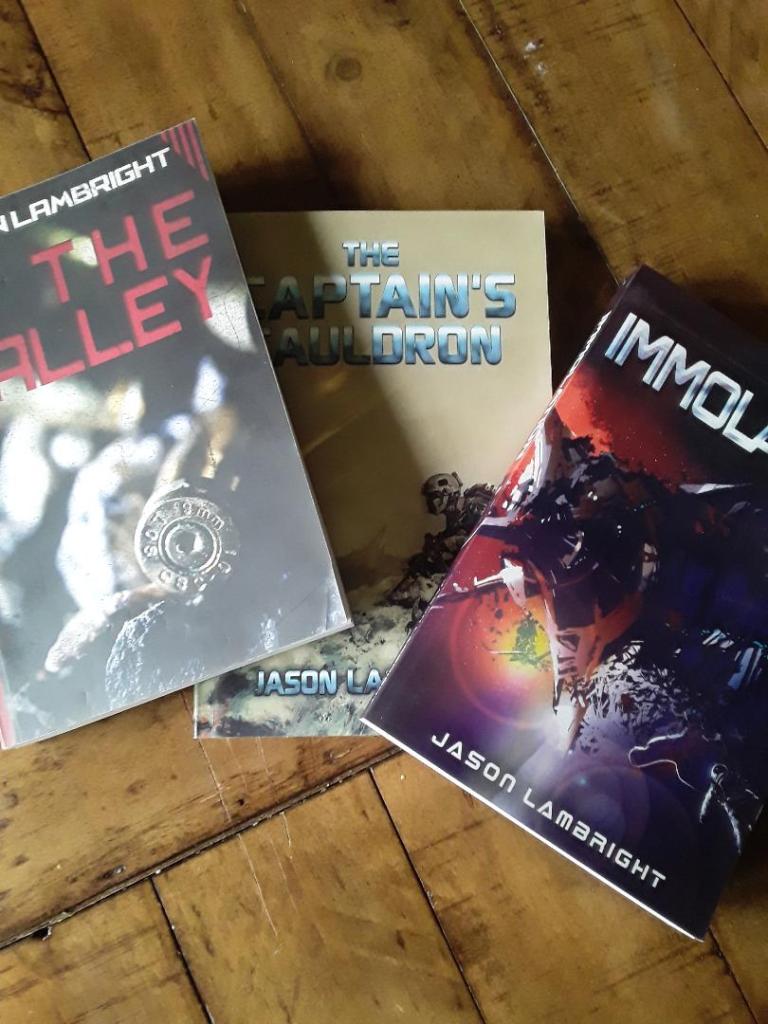
Pictured above are some hardcopies of my first trilogy. The last book in the series, Immolation, was published in May, 2017.

That’s four long years ago.

Since then, I have been busy. I have written in shared universes, and I’ve created one of my own, an alternate history.

The shared universes are exactly that, they are shared. They do not belong to me.

Long time readers know my publisher went belly-up a couple of years ago. This may have been a left-handed gift because if they were still around, I probably would have released my alternate history in a knee-jerk fashion.

News flash: I would have lost money on it. Unfortunately, that seems to be the cold hard truth for 99.9% of indie authors.

You will lose money.

It’s so easy to look at the sheer volume of the competition out there and get discouraged. At times I want to throw up my hands and say the hell with it, that this is a fool’s game and a massive waste of time.

But then I read through some really positive stuff that some people have had to say about my work, and it makes a difference.

Years ago, after my first book, I had sold something like fifty copies. The thing was going nowhere. It embarrassed me, my thoughts were “hey, I did this. I said I would. Now it’s done and no one wants to read it. I’ll never do this again.”

I walked away.

But then a curious thing happened. First, I was contacted by a fan who said he really liked the book. He asked me when I was going to write the sequel; I told him I hadn’t really thought about it.

But then I did. Then I heard from an author I was in occasional contact with, John Birmingham. He told me the book was a good read. I was blown away to hear this.

So I sat down and I wrote the second book in what became a trilogy. By May of 2017, it was done.

Then I got involved in a bunch of projects, lost my publisher, and finished another trilogy.

By now, April of 2021, the dam is about to burst.

I want to release my alt history trilogy so bad it hurts.

So I come back to what has sustained me throughout the years, my readers and friends. I have a question to pose to you. A series, really.

Here are my dilemmas.

First, I don’t want to go thousands of USD into the hole again. But I also don’t want to publish an inferior product. So the pure indie route isn’t that attractive. Sorry, Amazon, but for most Indie authors you are a money sink, not a revenue generator.

Second, selling the trilogy is still a possibility, and it’s by far the most preferred one. I consider my current trilogy to be locked up in this process for the time being. However, one must always have a back-up plan.

Here it is.

I really admire John Birmingham’s Patreon page.

This. This seems to be a sure-fire method of getting my work out to you all, and I would be paid some small amount per month to do so.

I take this question to you readers directly: would you be interested in paying a few dollars per month to see my latest and greatest? What would you like to see? How much would you be willing to pay?

Hell, how many of you would actually cross the threshold and join the Cool Kids Club?

I need answers to these questions.

Something I could do is begin work immediately on a NEW TRILOGY, one that’s not tied up in commitments. A new sci-fi universe, just for my readers.

You.

At least once a week you would get a new chapter to chew on, and we could hang out and talk it over. At the end of each book, you’d get a complimentary e-book copy.

What do you think?

This is something I’m interested in.

But who cares about me.

The question is: are you interested?

I’m all ears.

The Battered Helmet

Hey, readers. Welcome to the North American spring, boy, am I glad that the better weather is finally here.

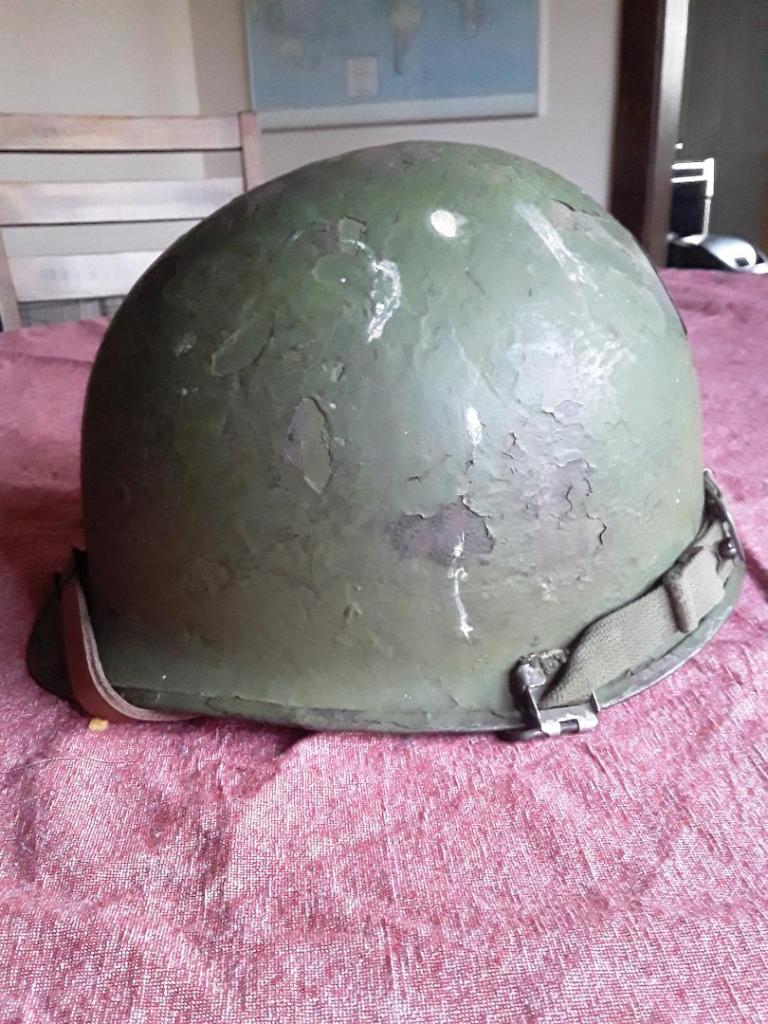
Well, with good weather comes flea markets and what are known as “garage sales,” sometimes I go to those. You never know what you can find. I attended a large one in this area recently on a sunny but cold day, and what do you know, I found this battered helmet for sale. The price was reasonable, so I decided to add it to my collection.

Kooky, I know. During the lockdown things got a little weird. I wrote A LOT. Plus, I spent tons of time on the internet. At times I made purchases; I decided to start collecting helmets.

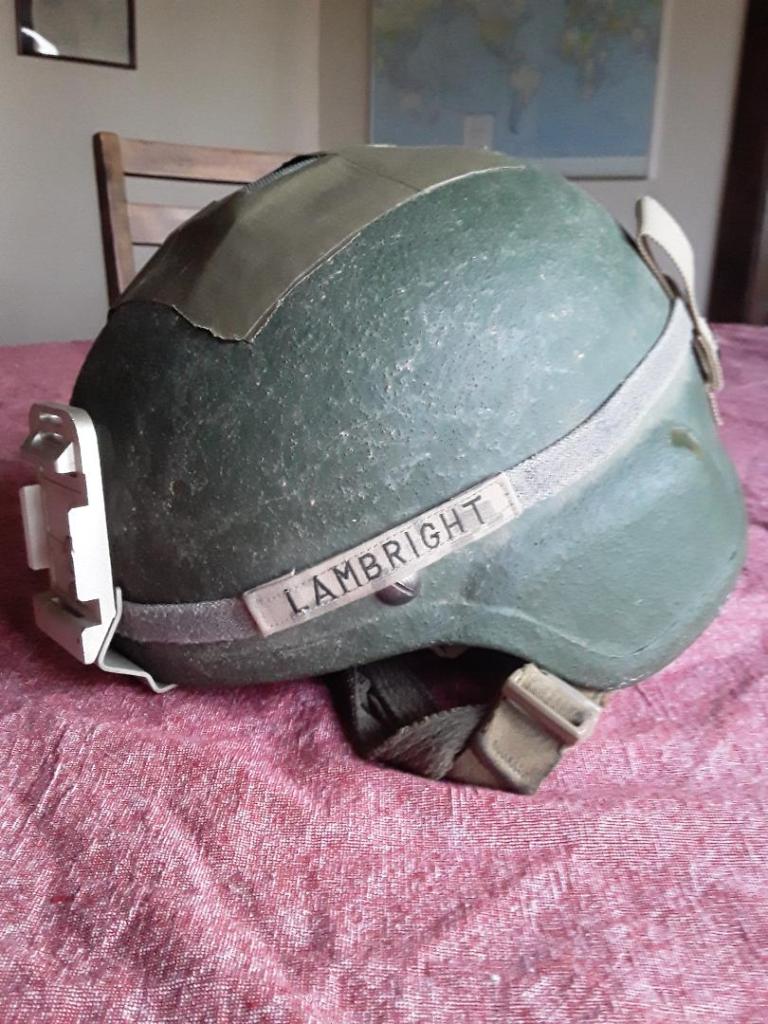
Now, I already had a small collection. There were a few I had inherited, plus there were a few that I got in the service.

See below.

I see the helmet as a signature clothing item for a soldier; a piece of protective wear that signals what it is that you do for a living.

In this case, the helmet protects against flying bits of metal, blunt force trauma, and under the right conditions they will even stop a bullet.

The US has eighteen million living veterans, so that means that there is a lot of this type of junk to be found at yard sales. Much of it has a story, good or bad. The helmet I found a couple of days ago had obviously seen hard and long service, it was produced by McCord in late 1944. It was covered in several layers of brushed on ugly green paint, and what was cool was that in places traces of the original WW2 paint was visible.

This helmet has a story. To make things even better, a soldier’s name was carved in the paint on the inside, along with the name of a tiny town in Tennessee.

I googled the name, the gentleman is still alive. He is of the Korean War generation.

This. This is history. The price of admission is low, a couple of twenty dollar bills.

Maybe it’s odd, but I find this sort of thing to be fascinating.

This interest in history translates into writing; it blends well with science fiction. Mix it up, then puke the words onto the page and you get an alternate history trilogy.

My chief goal for 2021: Get the trilogy’s first book published, no matter what.

Attack!

Ha, readers, here is a sample from my alt history trilogy! I am pretty much dying to publish this!

***

Ernst turned away and scuttled into the irregular belts of rubble and fighting positions. He ran from hole to hole, calling for the commander of First Company. Finally, there was an answer by a Maxim position.

“Over here, sir!”

The Maxim was firing in steady bursts, it looked to Ernst as if von Hassel was directing its fire. He nodded approvingly. He called out.

“Von Hassel!”

The Leutnant jumped.

“Sir!”

Ernst cut to the chase. “Hey, I’ve got a company of Sturmtruppen at my back. We are going to attack right here, right now. Can you provide us with covering fire?”

“Fuck yes, sir.”

“Then wait for us. I have to go get them and lead them here. As soon as we set up, we attack. Tell your men! No fucking friendly fire!”

“I’ll arrange passage of lines. How soon?”

“Five minutes.”

Von Hassel’s eyes went wide. “Christ! That’s soon!”

“Better get moving, LT.”

“Yes, sir!”

Ernst turned back toward the south, he ran, his heart pounded. His Bergmann pumped in his hand as he sprinted along the treacherous footing, his canteen and gas mask banged along his hip. He passed back to the smashed cluster of houses where Leutnant Hofsteder and his grim one hundred awaited.

With a final dash, he reached their waiting spot. He called out.

“Hofsteder!”

“Sir!”

“I’ve arranged passage of lines! We attack right now.”

Hofsteder called out.

Manner! On your feet!”

Ernst watched as dozens of men arose from the rubble. They looked like so many wraiths in the flickering darkness.

“Follow me.”

Ernst padded off, he could sense the special assault troops following in his wake. He retraced his steps, he returned to First Company’s perimeter, the chunk of blasted city that they held by their fingernails. 

Ernst grinned. He knew he was going to kick the lousy XXXXX right in the bollocks. He approached the Maxim nest where von Hassel lay.

“Leutnant! Are your men ready and warned?”

“Yes, sir!”

“Good.” Ernst turned, Leutnant Hofsteder was sending his men left and right, into a rough assault formation. It appeared to Ernst as if the man arrayed his company to attack in a rough skirmish line, divided into three parts. He crouched and hastened over to the Sturmtruppen leader.

“Ready, Hofsteder?”

“Hell, yes.”

“Alright, let’s go! I’ll accompany you; I will guide you to where I think the English commander is waiting. We hit there with everything we have.”

“Do or die, Major?”

“Is there any other way?”

“Nope.”

“All set?”

Hofsteder looked around, he shrugged. “Yeah.” He pulled out a flare pistol.

Ernst spoke. “Hold on.” He called out between bursts of the Maxim. “Von Hassel!”

“Sir!”

“Tell your gunner we assault now. Keep the fire right over our fucking heads.”

“Meter and a half?”

“Yeah. Close shave.”

Ernst heard von Hassel scream something to his machine gunner. He looked over at Hofsteder.

“Now!”

Inevitability

Hey all, you may have noticed that it’s been a bit quiet around here recently. This is entirely my fault, and if you want to assign blame then I am that fellow. There’s been some crazy stuff going on in my personal life, nothing to worry about, but also not something I’m getting into in a public setting.

The events of this month have skewed everything, really. It’s been an avalanche of one thing on top of another. Included in there has been a tax fiasco, among everything else. It’s been really good times.

But finally, sun is breaking through the clouds, much as our weather has done. It’s really beautiful out there, and my lilac bush is sprouting leaves at last. It is past time to continue work on my fitness and finish up my ongoing project, the long-banked alternate history trilogy.

I will have you know that I am in Act III, or the finale, of the final book in the series, which has the helpful name of “3.” This makes for exactly 111 chapters completed, with maybe ten to go. As is usual when I get to the end of a book like this, I feel an acceleration.

Maybe that’s not the right word, but it fits how I feel. Suddenly there is no problem with motivation to write, stuff picks up and the story almost begs to be written.

So I sit down and I write, usually at odd hours. My best times are early in the morning, although I’ve written at all hours depending on the household situation. My standard has been a chapter, or 2-3k words per day, everyday.

In March, I failed to meet the standard.

See vague life circumstances and distractions above.

However, something I did when this current writing blitz started in December was to plan in ample time for project completion. I established my own internal deadline as to when I want to finish up, and I mean to stick to it.

I’m not sure if it will be possible, but I want Book 3 to be done as of 1 April.

Right now I’m on Chapter 31 of a planned 40.

Today I’m feeling the bug, although the sun is shining outside. On days like today I can easily do two chapters. If I try more I usually get a headache and my left arm begins to tingle. So I try to limit myself. Although three chapters would be great, and at this point, easy to do.

The feeling I have, almost every time, at the beginning of Act III is one of falling. It feels like standing on sand in an hourglass, and you are being pulled inexorably toward the little Venturi in the bottom. It is a feeling of inevitability.

This is very good! It means the story is doing EXACTLY what it should be doing at this point in a novel- it is picking up the pace, it is speeding up.

And this was the problem with the first book I wrote.

The structure was entirely instinctive, I wrote it without a plan or an outline. There are those who say it’s a good book, but there are others that have justifiably criticized it.

Well, that book was a real learning experience. And I did learn. By the time I completed the trilogy, I had some very important friends and mentors, as well as fans (!), and I had done some professional reading about writing and structure.

So now I wouldn’t dream of starting a novel without an outline. There is no way I would commit a word to paper without taking flow into account.

But instinct is still important. Feel. It is crucial, and I’m not sure how you learn it except to read or watch a LOT.

And what I’m feeling about this trilogy right now is good.

Will I make the first of April? I don’t know.

But I’ll do my damndest.

Writing Sample

A passage from the third book in my unpublished alternate history trilogy. After a month of intense distraction, the time has come to resume work.

Bill called out.

“That’s torn it, sir! Every Heinie and his mother will drop into our fucking laps!”

“Quite, Sergeant. Lieutenant McBride!”

“Sir!”

“We have seen quite enough, young man. Do turn your men about with dispatch.”

Tracers zipped along, they would hit objects and curl crazily into the air. Bill looked heavenward; it looked much like a series of racing fireflies disappearing heavenward. Blokes started to turn to the north; as Bill watched a man was struck. From the sound it was a solid hit; a meaty “thunk.”

The poor bastard hit the ground, a flare popped and Bill watched as black crud and bubbles poured from his mouth.

He was a goner, for sure.

Someone grabbed the wounded man by the collar. They started to drag him north, toward safety. Or at least perceived safety.

The wounded man’s rescuer took a bullet to the thigh. Bill saw a chunk fly off. The man screamed and fell. Bill looked for someone to shoot at, anybody. All he could see were muzzle flashes and the quick bright lines of the tracers.

It was time to fucking go.

McBride’s platoon hustled rearwards. Bill and the Colonel took up the trail position. They were slowed by the wounded; the further they moved the more they had. Fucking Birdcage, Bill thought. We did a recon, all right. You get close to the Birdcage, you get shot.

The night lit for a fraction of a second, and it wasn’t a flare.

It was the whizz-bang gun.

Bill heard the “whizz,” he felt the “bang!”

A chunk of shrapnel pulled at his trouser leg. Bill leaned down to free himself from what he thought was barbed wire. When he found the hole, his blood ran cold. The damn thing had nearly removed his left calf. He kept the Colonel in sight, what had been an orderly, tightly disciplined raid had turned into a headlong flight to safety.

The screams and grunts of their wounded hastened their steps. The 7.7 gun blasted them, the machine guns lashed at the retreating men.

The raid had been a costly debacle, and it had put xxxxx into a rare downcast humor. Later that day, he looked to the south and spoke.

“Sergeant, I fear the Hun is mocking us.”

Bill nodded. He lit a cigarette.

“Smarmy bastards. I should call Divarta and shell that detestable Birdcage to pieces.”

“It’ll just make it easier to defend, sir.”

xxxxx simply looked at him. He said nothing, then he returned to his vigil. He put a cigar in his mouth then he spoke after he puffed it to life with a trench lighter.

“I say, Sergeant, do you think the Birdcage would make a worthwhile study on canvas?”

Bill shrugged. “Sir, I don’t know anything about art.”

“Surely you must have studied the finer things of life in school!”

“They taught me how to read and write.” Bill paused. “And a little arithmetic.”

xxxxx harrumphed. “It is a scandal, what they call an education for the working classes.”

Bill puffed away. “Good enough to run this, sir.” He held up his Bergmann.