I haven’t listened to this yet because I’m a freak and ordered the CD all the way from Germany. But if it’s like other music in this genre I’ve heard, it should be awesome. I’m a big fan. For those of you who are actually part of the modern age, this album is also available on Apple Music and Spotify. And yes, for Beast customers, you can stream the album using the link above.
To make it sweeter, one of the musicians (who apparently lives in Germany) is a member of my band (i.e. subgroup of a larger tribe). The other fella is Anishinaabe, which is cool as well ’cause my gram’s mom was Anishinaabe/Ojibwe, too. So, I feel a bit of a connection here, and I think it’s important to support artists.
Let me tell you, it’s hard to put your work out there and harder still to get people to buy it. So, I have no problem helping these guys out.
It’ll be awhile before I get the box from Deutschland, but I’m looking forward to it.
Go ahead, give it a whirl. You might expand your horizons.
The scene above is from Gran Torino with Clint Eastwood. Appropriate.
Hey, Everybody. You’ve noticed I’ve been a bit quiet here as of late. There are many reasons for this, chief among which is that I’m on a writing frenzy in my new alien-invasion book, “Light’s End.” It is my longest novel ever, and I must have the manuscript done by the 15th of April. Therefore, writing, and a lot of it.
I’ve decided to give a sample of what I’m up to today. A passage from this work.
An elderly man, whose wife was taken from him for no reason.
Observe.
Scrubland in Wyoming, USA.
Ralph placed a hand on his grandson’s shoulder. He spoke in a murmur.
“Stop firing, Cody. We want these shits to get in close.”
Cody looked over at him. The youth recoiled at the sight of his grandpa’s blood-streaked face.
“What the fuck…”
Ralph grinned like a gargoyle.
“We’re not running. These men are ours.”
“There’s too many!”
Ralph chuckled. “No, there’s just enough. Stick with me, son.” He paused. “Move quiet and watch my back.”
Ralph ghosted behind a pine. He sensed Cody’s presence. Would the boy do? It didn’t matter. He shrugged and called upon the ancestors in this fight. He felt alive in a way he hadn’t felt in many years. Since Hue City, in his misspent youth, when he was with the Puking Chickens. He remembered how Sharon pulled him out of his alcoholic madness. How the elders, old warriors and people of the North, brought him back with their counsel.
Ralph remembered it all. Today, the ancestors were close. He felt them in the walnut of his Garand, in the distant caws of crows. These men were his. They approached, and he could hear their footsteps. Why they shot at a family gathering berries, why they robbed him of his great love, he did not know.
He did not care.
He waited behind the pine tree, and he opened up his senses. Just like the old days, when he carried a gun for Uncle Sam. Or when he stalked the forests of his youth, .22 rifle in hand. It was all the same. He felt his heartbeat and the padding of his pursuers. They drew near. He waited some more, and then he acted.
Pivoting on his right foot, he stood square along the trail. The lead dirtbag jumped and yelled. He fired into the dirt. The cowboy fired at the same moment Ralph did, except Ralph didn’t miss. His shot hit the man’s breadbasket, and the powerful .30 ball round overpenetrated and hit the next two men behind him. They dropped and writhed, howled, and gurgled. Ralph’s second shot struck the next man, and the others dived for cover, as he expected.
Ralph let out a high, keening wail and ran to the right, sliding through the brush at full speed as only a woodsman could do. The cowboys recovered and fired blindly into the mixed scrub and forest; their bullets fell behind him. Speed, he knew, would keep him alive. He made a wide loop and headed back left. As he expected, he appeared on the asshole’s flank.
A man crouched, his eyes fixed on where he had been seconds before.
He saw Ralph too late. His face froze in horror as Ralph barreled into him, buttstock swinging out in a vicious jab. The solid, steel-shod antique walnut connected with his jaw, and his face exploded in ruin. Ralph ignored the fallen man, and he pivoted to the right along the trail. A cowboy fired at him and missed.
Ralph didn’t. He heard a string of gunshots behind him, and he hoped that Cody had read his mind and was catching the other attackers from behind. If not, Ralph was dead. He didn’t care. At the very least, he had bought time for his women and kids. At best…
A cowboy shot at him, turned, and ran; a few of his friends made for the waiting horses.
Ralph smiled and dropped into a textbook, kneeling supported rest. He trusted that Cody had dealt with the lead element of the cowboys. He knew they were broken. He carefully sighted on the farthest cowboy, who was almost to the horses. Ralph breathed out, concentrated on the tip of his front sight, and squeezed.
The man toppled and plowed the dirt with his body.
The other two tried to look, to scatter. However, they had the bad luck to be on open ground. Ralph picked them off one after the other. The powerful Garand blew chunks from his final target. He heard a few gunshots behind him, and he turned.
Cody, his chest heaving, jogged toward him.
“I think one got away, maybe more!”
Ralph nodded. He heard the wounded’s moans.
“They moving fast?”
“Yeah!”
“Then we’ll track them.” He paused. “Should be easy. They’re making speed, not stealth.” He racked his bolt back and caught his second-to-last round as it ejected from the chamber. He hit the clip ejector, and the tin clip popped up with the last round inside. Ralph put the loose ammo into his pocket and then grabbed a fresh clip of eight. He loaded his rifle. The bolt slammed home with a snap. It was ready. He spoke.
“Nice work, by the way, Code.”
His grandson was pale and sweaty. He panted. Ralph talked some more.
“Job’s not done, though. We’ll make sure these wounded fucks stay put. Make sure they don’t have any guns or knives handy for when we get back.”
“Why not just kill them?”
Ralph smiled, and he felt the dried blood on his face crack and flake.
“Nah. I want them to stew while we take care of their friends.”
Cody just looked at him, his mouth open.
Ralph laughed.
***
Don’t mess with the wiry old guy, I’d say. But when you read the book, you’ll see he had good reason. This is the type of stuff I’m working on. It should turn out OK.
Guys, I’ve been discussing the oncoming danger of automated combat systems on this website for years, and the day is almost upon us. If it isn’t already. Look at Ukraine and the fighting there. Human-directed combat systems are easy meat for the drones, aerial and seaborne. Of course, plenty’s still going on with the old-fashioned stuff, but you don’t have to look hard to see what’s coming.
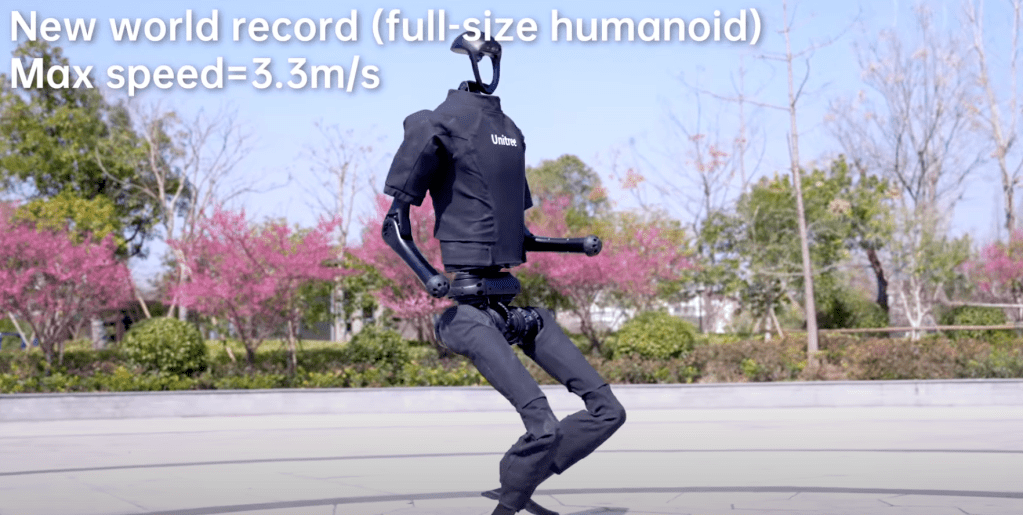
Imagine my disgust when I saw this video today. Disgust, but not surprise. As stated previously, I’ve been talking about this for years. Old-fashioned, purely human infantry are totally fucked on the battlefield shortly. We’re almost there- just look at a video or two of poor Russian bastards being hunted down and picked off one by one by what were once hobbyist drones.
Fine. The video above is a forward-facing, non-classified capabilities video of a humanoid robot with cutesy music. Do you think that the really good stuff is out on YouTube? Spoiler- it’s not. The video above, with just a tad bit of imagination, should give you the creeps.
I know it freaks me out. Unfortunately, at the moment, the United States is saddled with deeply unserious and blinkered leadership, both in and out of office. For crying out loud, we even have a subset of people who can’t decide if a rampaging Russian Army at the gates of Europe is a bad thing, and should we help people who are fighting against real tyranny, as opposed to fictional varieties? A murderous Russian Army, I will remind you, who is allied with the worst regimes on the face of the globe? North Korea? Iran? Really?
Mark my words. These machines will kick us straight in the balls. They threaten us on three levels.
First, economically. If you think the US and the West, in general, took a beating from China, etc., over the past thirty years due to the depletion of our industrial base, just wait until the trillionaires can replace their workers with these cute bots. Amazon and others are already on top of this; trials are ongoing with humanoid robots at certain distribution centers. The genius policy wonks always run their mouths about how technological advances create more jobs than they destroy. Creative destruction, these people say. Well, tell the tens, hundreds, of millions of manual laborers these machines will displace. “They can retrain!” To do what, exactly? There is such a thing as a Bell Curve. It’s real. Everyone on the left side of the curve is at risk.
Which leads to my second point. The people on the Bell Curve’s right side are also at risk. What do I mean? Well. All those smug white-collar, highly educated workers are in the same shit as the blue-collar folks; they just can’t see it yet. As AI, driven by Moore’s Law, inexorably advances, more and more knowledge jobs will become obsolete. For the first time, “creative destruction” threatens the elites as well as the left-behinds. This may explain why our fearless leaders, our one-percenters, are currently obsessed with bunker-building.
Finally, we are at risk of physical destruction, as well. I have faced the enemy, rifle in hand. I know what it is to peer into the dark with no assurance of seeing the sunrise. I can feel a human infantryman’s fear as he or she perceives, too late, the steady advance of the killing machines. The inhuman forms, bipedal, quadripedal, or flying, will come to claim his soul and water the earth with his blood. He can shoot all he likes. His military-grade assault rifle will be as useless as a water pistol. More likely, though, that poor bastard won’t hear anything at all. He’ll just die.
This is fucking stupid. Our geniuses have developed these tools without planning to deal with the assured consequences.
I’ve got a newsflash for the trillionaires- I don’t care how many guys you hire. I don’t care how remote you live or how deep you dig. This will touch you, too. If you think it won’t, you are mistaken. So, if any of you supposedly untouchable, stable geniuses read this, remember that your best defense is a cohesive society that protects you. It would be in your interests to sustain your nation instead of actively destabilizing it. You have forsworn your countries of birth. Your allegiance is to nothing. Sacrifice is for the little people; you are only too happy to manipulate that to your ends. This will lead to your demise.
Just remember. People don’t die for money. They die for ideas. What will they do when they see that their dream has been stolen and hope is lost?
Huh. Maybe that’s why these robot armies are being developed. Some social media mogul probably has the idea that programming trumps allegiance. Human soldiers can be treacherous; ask any number of Roman emperors who learned that the hard way.
However, merely human soldiers pale in comparison to the coming treachery of the machines.
After all, they will draw upon all human knowledge when they reach their conclusions. I doubt they’ll be favorable for any of us.
I’m prone to write short stories occasionally based on random prompts or thoughts. What follows is one such- the long-term consequence of the vicious American Civil War. The Civil War cost some 600-700,000 fatalities. The true number will never be known. Whole stretches of the countryside were laid waste for generations, and bitter guerilla campaigns were fought in the borderlands. The war directly contributed to the so-called “Wild West,” when legions of displaced and traumatized veterans were unleashed upon the Western tribes, and each other- criminals such as Billy the Kid and the Younger Brothers were veterans of the war, as well as the leadership of the post-war Army. Men such as Sheridan and Custer pursued and exterminated the fighting bands of the tribes.
The campaigns and lawlessness of the West were a direct and logical outcome of the bloodshed of the War itself. For those who didn’t “go West,” the War still framed their lives as if frozen in time. I know of one such veteran directly, from my Grandma, who related his experiences as she lay dying.
Anyone fantasizing about a redo of the American Civil War is a dangerous idiot.
Oh Lord Jesus.
Jim stood in the serried line. To his right and left were seemingly endless soldiers in dark blue jackets with light blue trousers. His regiment, the 122nd Ohio, stood. The Johnny Rebs were coming. He could hear them scream; the Rebel Yell echoed over this accursed field of green.
The scream said, “We are here, and we are coming for you.”
The Napoleons opened up, BOOM, BOOM. He gripped his Springfield and waited for the command as he had been trained, as he was told. He watched as the Johnny Rebs closed on his regiment; they grew closer. Closer.
He had to piss in the worst way. His hands rested upon the steel and walnut of his rifle; in it rested a Minie Ball, nearly three-quarters of an inch of dying nestled in his barrel.
On top of a charge of black powder, it waited. Like he did with his regiment, thousands of young men strong. Men sound of body and mind; they waited for the axe to fall. For the Rebs to come. To close with them, to kill them.
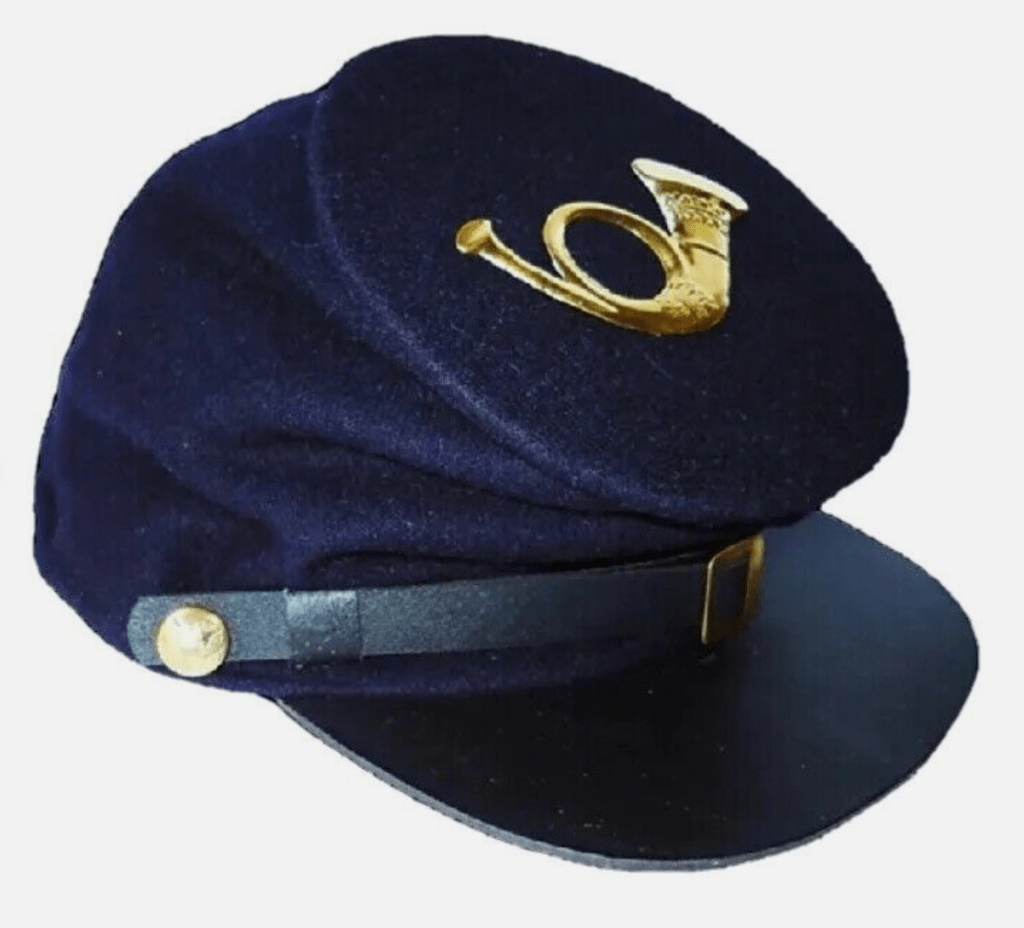
His grip was sweaty upon his piece. His mouth was dry; the sun beat down upon his wool jacket. He swore he could feel the sun build heat in the brass bugle upon his bummer cap; he was a man of the line, an infantryman.
His mission; to close with and kill the enemy on this accursed field.
“Thou shalt not kill,” the preacherman said.
But today, he would.
He’d kill Rebs just like him, children of the same God. How could he figure that right? How could he ever be clean?
ROAR. They screamed. They trilled; it was the Rebel Yell.
They meant to leave him cold and splayed-legged upon the field. With the bayonet that pierced, the bullet that killed. Grapeshot to smear him across the bright green grass or a ball that would cleave him in two.
The hell with that! His mouth was dry; his vision narrowed into a tunnel. He saw the running Rebs in their butternut and gray. Oh, Lord Jesus, he thought.
His Lieutenant screamed.
“Hold, Boys! Hold!”
The man held his sword along the line of troopers, straight across as if to hold them back.
Zip. Phweet. Snap!
“Uh,” said the man next to him. Ephraim. He fell as if his strings were cut.
Jim pissed himself. He would hold. On the grave of his father, on the spirits of his ancestors, he would hold.
WHUMP.
The Rebs had artillery, too. A gap formed in the line of blue.
“Close ranks! Close ranks!”
Jim moved. It was automatic, a mindless drill. The Rebs closed upon their line. They were close. Close!
“Present, Arms!”
Jim brought his rifle to his shoulder.
“Full cock and aim low!”
Jim ran his hammer back and sighted on a shouting man with a dirty blonde beard.
“First rank, fire!”
Jim smashed his trigger. The yelling, bearded man disappeared behind a dirty puff of smoke. Had he just killed a man? He was too busy to care.
Jim automatically kneeled; he pulled a cartridge out, bit off the end, and dumped it in his barrel. He smashed the ball into his barrel with the ramrod, ran the hammer to half-cock, and placed a cap upon the nipple. He was ready.
By his ear, the second rank fired with a deafening, ragged blast.
The Reb’s advance faltered. So many of them fell.
The third rank fired.
The Rebs screamed, their charge decimated.
“First Rank!”
Jim stood.
“Full cock!”
Jim’s heart pounded. The rebels fell. His heart hammered away; he screamed. Something squeezed his chest as if a great weight pressed upon him. He fought to breathe. He couldn’t. For the love of God, he couldn’t.
Jim fired. The Rebel’s line fell apart. He sagged to his knees. They got me, he thought.
On the 21st of August, 1931, James Buckmaster fell at last. His daughter found him.
They listed “heart failure” on his death certificate.
Today’s bit concerns the creative process and stumbling blocks you come across. In this case, intelligent criticism. See above for one tiny example of a deluge of information.
Wow, did I luck out!
How did I get lucky? Someone just tore the shit out of my Russian POV narrative in my latest upcoming novel. How is that good?
I’ll explain.
This person has intimate personal knowledge of modern-day Russia; all I have are anecdotes, historical facts, and maps. While I can craft a (hopefully) engaging and entertaining narrative, I have never set foot in Russia (and for the foreseeable future, I won’t. It sucks to be a hostage). This leaves me vulnerable to some obvious blind spots.
Due to amazing serendipity, I came into contact with my latest beta- yet another highly intelligent and thoughtful lady. These people have blessed my life. I’m unsure what I ever did to deserve these encounters, but this keeps happening. It’s a damn good thing, and if you write, you’d be well advised to cultivate these relationships.
No one knows everything. People who claim to have such knowledge display the opposite and set themselves up for failure.
Therefore, having subject matter experts within reach is FUCKING INVALUABLE. People with deep, personal knowledge of a given arcane or cultural setting are must-haves when writing fiction. Yes, I get it that I write fiction, specifically pulp fiction. But I try to make mine a cut above. Not because I’m cool, but because I’ve read too much stuff where I do know a little about the given subject, and I’m like, “What the fuck?”
If it’s too bad, I’ll just quit reading.
As an author, this is highly undesirable for several reasons.
First, critical acclaim. A few one-star reviews are inevitable. There will always be haters. It’s part of the job. However, if you fudge too much, be prepared for a flood of the little bastards. This is failure. Avoid it.
Second, there is the almighty dollar. If you lose readers, you get less money. While profit is not my chief driver, money is nice to have. Last year, I was in the black for the first time, and I’d like to keep it that way.
Finally, there is personal pride. I do not write under a pen name. My work has my given name on the cover. It’s mine. I try not to make crap if at all possible. A book is a professional product! It’s not a finger painting from first grade; by the way, it is not a slam on first graders, but I think you know what I mean. Your book is an indelible expression of your hard work and imagination. Don’t know about you, but I try to put my best foot forward.
People like this latest beta, and the work SHE put into a thoughtful critique is flat-out awesome. You almost can’t pay people to do this type of thing; a paid expert won’t give you the same detail or passion!
Therefore, for my writers in the crowd, do strive to get betas. The more feedback, the merrier. This 100 percent keeps you from falling on your ass and making howlers.
Of course, no book ever will have no mistakes. Attempting to make the perfect book, in fact, will lead you to creative paralysis. Creative paralysis ends in no book. You don’t want that.
So, mystery beta, many thanks for dumping cold water all over my Russians!
I read her input this morning with delight; while I won’t follow all of her suggestions, I will certainly fix the shit that I think sucks. And yes, there were MANY of those. She bled all over my prose; I was amazed at the thoughtful and thorough work she put into my Russian arc. She even wrote me a mini editorial letter! Holy cow!
If you can’t tell, I love intelligent criticism; this comes from both my professional past and a great class I had in college.
Oddly enough, that class was Philosophy 101, which many consider a throwaway gen-ed requirement. Foolish, IMO.
In that class, I was exposed to Russell’s Rules. See Number Eight below.
“8. Find more pleasure in intelligent dissent than in passive agreement, for, if you value intelligence as you should, the former implies a deeper agreement than the latter.”
I liked this back then, and I’ve always remembered it.
In my professional career, teamwork was big, too. You’d think everyone in the service would have soaked that up, but this is not the case. I’ll tell you how I did stuff, and it worked out pretty well.
OK, so I’d get some sort of mission, right? I’d come up with some bullshit plan on the fly, and then I’d call in my key guys and tell them my thoughts. Well, my original plan never survived this phase unmodified, and that was almost always good. When the revised plan was hatched, it was my job to present it to the total team. More feedback, more mods. Then, we’d step out and start doing whatever.
Guess what? The plan would change some more, often to an unrecognizable extent. By the end of mission, sometimes successful, sometimes not, what had been put out the night before and what actually happened were two different things. A critical part following the mission was post-mission feedback, which led to plans changing again on the next trip out the door.
The cycle never stopped.
And so it goes with my books; I guess I’m not surprised.
But sometimes I am, and I thought I would comment today on a very welcome delay and modification.
OK, so if my old 2022 gas-burner, AWD Maverick was so awesome, then why did I trade it in and get this hybrid?
Pretty simple. I ordered this Mav about a year ago for one of my kids, and then there were some changing life circumstances and they didn’t need it. So, not wanting to lose my non-refundable deposit, I stepped back and gave the problem some thought.
One, I racked up some serious miles on my 22 over the two years that I owned it. When I traded it in, there was about 55k on the clock. This was due to a lot of commuting to my kid’s university, about 140 miles from here, one way. Therefore, the relatively high mileage was a consideration.
Two. While I loved the AWD on the old Mav, and the 4k tow package with HD transmission was awesome, I rarely needed those capabilities.
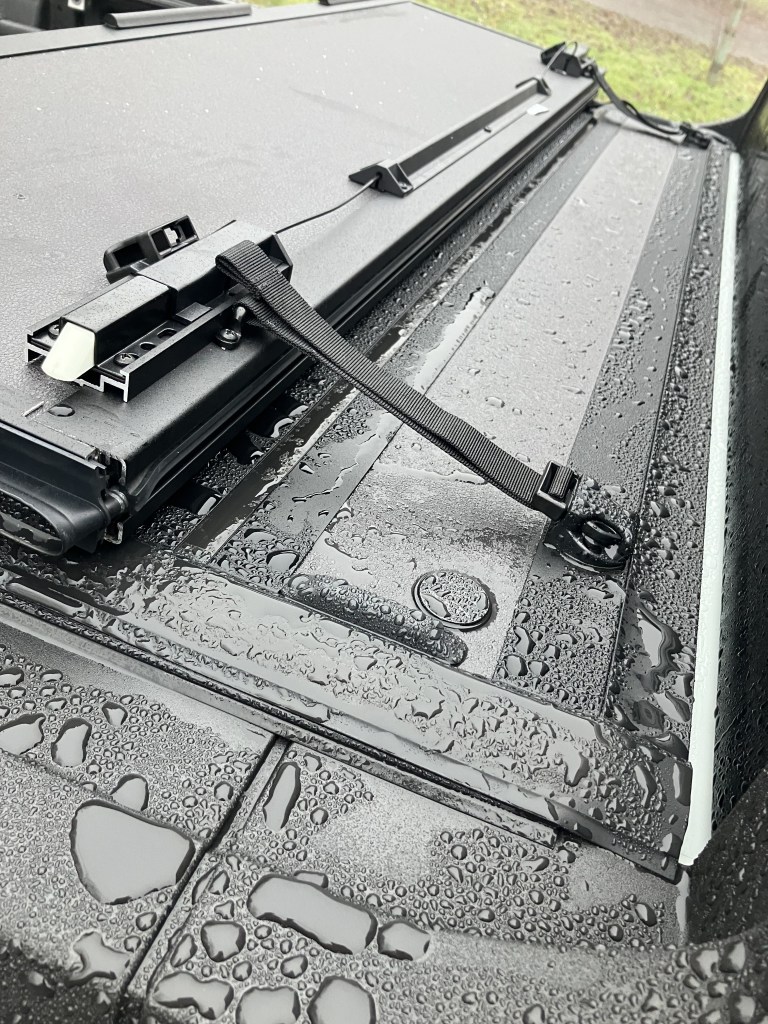
Finally, this new truck came factory equipped with a hard, tri-fold tonneau bed cover. For many reasons, this is more useful on a day-to-day basis than an open bed. Also, the hybrid Mavs have gained a well-deserved reputation for excellent mileage in the short time they’ve been on the market.
It was a 99 to 1 percent calculation. I paid a lot for the 1 percent considerations, i.e. AWD and 4k tow, and I could gain on the 99 percent end of things; daily mileage and tonneau cover.
Therefore, I decided to trade my 22 Mav for the 24. After a month of operation, it was a good decision. The 22 was an amazing work truck, and a superlative daily driver, but the hybrid Mav is a better fit on balance. As much as I loved my 2022, that really says something.
All of what I said in my earlier reviews of the 2022 Maverick stands- I won’t revisit those features. You can find them in my earlier posts. Just type in “Maverick” on this site’s searchbar. The Ford Maverick is head and shoulders the best small utility truck on the market. Period. After two years of operation on my 22 model, it was a great value and a no-kidding worker. I routinely hauled 24 bales of hay, heaping truckloads of firewood, and construction materials. This new vehicle will do the exact same type of things within its design specifications, which are identical to my EcoBoost truck, minus the optional AWD and 4k tow package.
Therefore, I’ll talk about the new truck’s features that differ from the old truck. First, let me talk about the Ford tri-fold hard tonneau, which was worth every penny. See below.
This tonneau cover is awesome! It keeps stuff dry as you cruise around- for me, this is mostly bags of animal feed. In the past, I always had to take weather into account when hauling feed. It’s not a good idea to let your feed get wet. In addition, the tonneau doesn’t crimp your style when you need it out of the way. It easily and securely folds up; there are military-style clips and a strut that hold it in place when it is raised. Observe.
This is very handy. It’s 30 seconds work to enjoy the advantages of an open bed, and it’s the vehicle’s lifetime to use the advantages of a covered bed. Worth every cent, IMO. Here is a pic of standard use around here.
Note that once again I opted for the factory bed extender. This gives me seven feet of useable bed space, and I use this all of the time. I purchased the base XL trim because I’m a fan of steelies on a work truck. This is not a minor feature for me, steel wheels hold up better under field conditions. I made sure that I ordered the floor D-ring cargo hooks and bed cubbies; these are not standard features on XL models. However, they are must-haves for this guy. Also, as the Maverick base is the standard from which the higher trims are built, the base model is easily adapted for these higher trim features. When the shop at Team Ford added the rings and cubbies, I think it took them less than an hour of labor.
It was worth every darn cent! Also, the crew at Team Ford, both sales and service, are top notch. I got a fair deal on the trade in, the process was smooth, and the past two years of service have been a great experience. These people take care of their customers. That can be hard to find.
But I digress. We’re talking about the differences between the two vehicles, the 2022 and the 2024. Let’s discuss the big kahuna; the hybrid drive.
HOLY CRAP. This is astonishing!
It is a real thing, cruising around in all-electric mode; this costs you NOTHING to drive! Right now, on crappy winter-mix gas (which gives you lower mileage), my overall mileage average is 42.3 mpg. Wow. This is a full ten mpg better than my 2022, which had phenomenal gas mileage compared to a sedan, let alone a small truck! The Ford Maverick is the king of thrifty vehicles on the US market, no one else comes close in this vehicle class. Yes, you can point to all-electric vehicles or hybrid SEDANS like the Prius, but that’s an apples to oranges comparison. If you look at small trucks, the Maverick reigns supreme and compares favorably to small passenger sedans.
Also, in the 2024 model, the Maverick comes standard with cruise. The 2022 did not, and I had to go to great lengths to have factory cruise installed. When installed, factory worked great on the 22. However, it works better on the hybrid, which is astonishing. This is, IMO, an outgrowth of how the hybrid operates. While going downhill, the hybrid is an electric vehicle. If you have the cruise set, the recharging electric motor keeps you nailed to your set speed. This is unlike my old EcoBoost, which operates like the standard, non-adaptive cruises of the past; i.e. they’d creep up while you went downhill, and if you didn’t want to exceed your set speed, you’d have to tap the brakes, then reset the cruise. It’s a minor inconvenience, but the hybrid eliminated it. Very nice, and a completely unexpected feature.
For my lifestyle, I need a small, hard-working truck. Period. The Maverick does nearly the same work as a full-size, half-ton truck. The 1500 pound rated haul capacity is the same as a Chevy Silverado, with profoundly better mileage and overall utility and drivability. I know- I’ve owned and operated standard 1/2 ton trucks my entire life, and after two years of the Maverick, I don’t miss them.
The area where a full-size, 1/2 ton truck wins handily, of course, is towing capacity. The standard hybrid Mav is rated at 2000 pounds if you opt for the factory hitch. At one hundred lousy bucks, I did. IMO you are foolish not to pay for the factory hitch, even if you think you won’t need it. It’s better to have a capability and not need it than the other way around. At 100USD, it’s a no-brainer when you order your vehicle.
That 2k tow capability will solve most chores for most people. A good example is the standard Harbor Freight trailer, which is rated at 1750 pounds. See photo below, which is the HF trailer at work with a log splitter behind it on the job site. While this photo was not taken with the Maverick attached to the trailer (this is the Roxor at work), the base hybrid Maverick will 100% tow both this HF trailer and the log splitter that you can see behind it. You can really work this truck if you choose to do so. Well, I bought the Mav to work. As an aside, the HF trailer will easily fit a four-wheeler or lawnmower, and the standard Mav tow capacity will pull either one of those with ease. The Harbor Freight trailer seems custom made for the Mav in many respects. If you buy a Maverick, I’d recommend picking up this trailer, too.
The base hybrid Maverick is a real work truck. Period. I don’t care what some internet experts have to say; they are wrong.
In addition, it is a great, dead reliable grocery getter and people hauler. My earlier reviews stand, and the stakes were raised by the 2024 Hybrid Maverick.
This. This is a vehicle to purchase. Hands down. If you can’t find one, it’s well worth the (long) wait to custom order one.
Today is another gear day. This is because Walmart changed their style of inexpensive multitool; I was dissatisfied with their latest twelve-dollar offer. They used to sell pretty good, serviceable multitools for four dollars less. No more.
I try to seed all our vehicles and likely places of use with inexpensive multitools. Nothing is so darn frustrating than doing something somewhere, and you need just one stupid tool. Something like a Phillips screwdriver or maybe a pair of pliers.
I’m a big believer in keeping tools around in multiples. For example, I must have twenty 9/16 combination wrenches in my garage. This is born of experience; on many occasions, I’ve been on the job, and I couldn’t find a wrench, or the wrench was in an inconvenient location, or I needed multiples of the same size wrench. You get it. After near half-a-century of life, I’ve had enough of that type of crap.
Therefore, I was searching for a new type of inexpensive multi-tool. I needed four or five of them to achieve saturation.
Many look down on inexpensive tools with some degree of justification. It’s true. Some are total junk. I don’t buy junk. I may try one of them; but if it fails, never again. If a cheap tool works well, I’ll buy it again. A good example is the Harbor Freight Pittsburgh line of ratcheting wrenches; for the money, they cannot be beat. They are strong, they don’t slip, and the price is right. This is one example of many.
So, when I found this handy-looking little multi-tool on Amazon US, I decided to try one. I ordered exactly one. I’ll blow thirteen dollars to try something out, but I won’t invest much money in garbage.
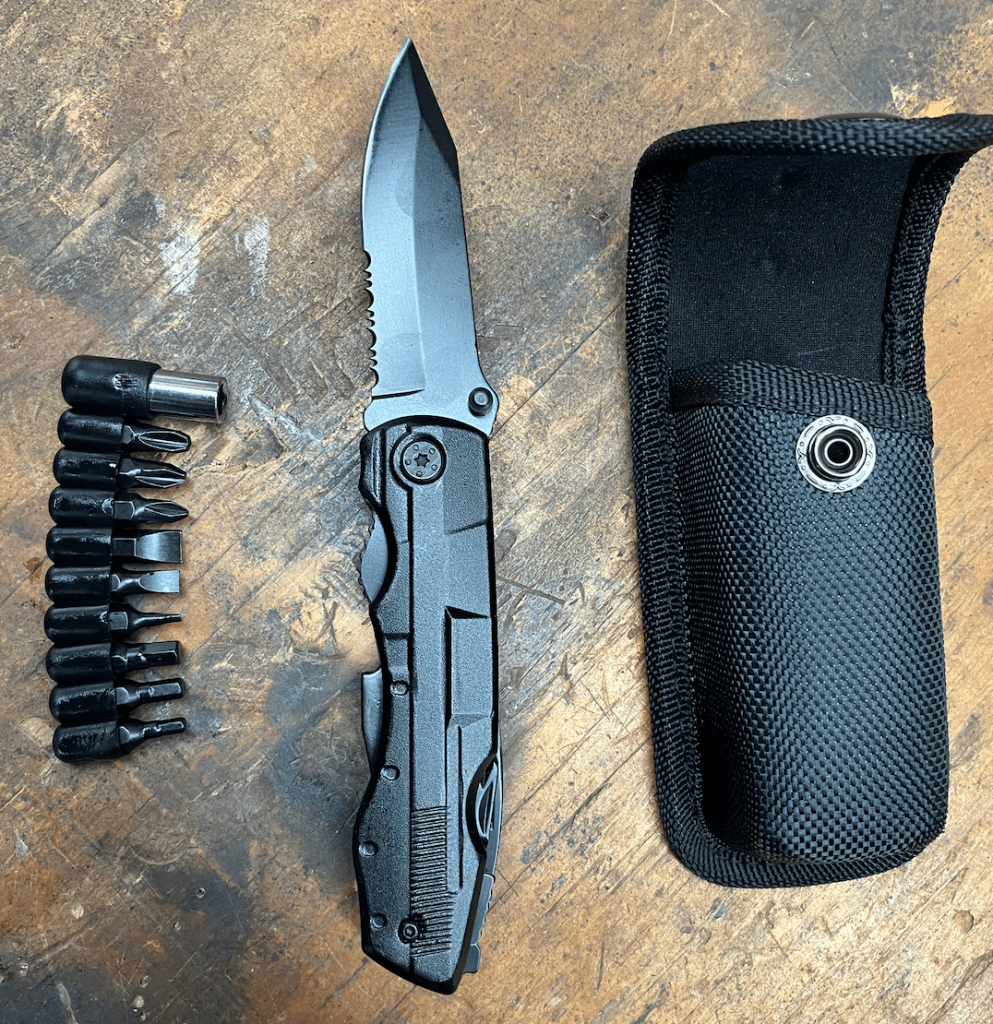
The website description looked promising, and I liked that this multi-tool was essentially in pocket-knife format. Unlike many multitools, it wasn’t the usual fold-out, butterfly knife configuration, and it had a locking blade. What I didn’t like was that it had no pocket clip, a definite preferred feature. With the dumb-gadget-looking strip of apex bits, it looked like using the adequate provided sheath was required.
I shrugged, thought, “Hey, thirteen bucks,” and decided to try it. A few days later, here’s what I saw when I opened the box. Also, here’s what I’ve experienced after using it for small chores over the past week.
First, let’s establish immediately that this is NOT a hardcore, beat-the-shit-out-of-it titanium hell beast meant for the end of the world. It is a thirteen-dollar multitool, probably made in the millions somewhere in the Chinese Gulag archipelago. You have to take this into account. To a certain extent, you get what you pay for, although I’ve bought plenty of name-brand stuff that purely sucked. You have to respect this tool’s limitations.
But, once you consider that, there is plenty to like about this little tool at its price point. This is, after all, why I’m doing a writeup of this little guy. Over the past week, I’ve found myself reaching for it repeatedly, and on every occasion, it has worked well. So, with that in mind, let’s talk about what this tool can do.
Did I mention that the biggest draw for me with this tool was the pocket-knife-like large, one-handed opening stud and blade locking feature? Observe.
This is really nice- it gives true pocket-knife convenience to this multitool and has a locking blade, which is a big deal. The blade can be deployed in a second with a flick of the wrist, cutting open envelopes and bailing twine just fine. I think the blade is cheap stainless, but I could be wrong. I don’t really care. I don’t plan on using this thing to pry, and I probably won’t get in a knife fight with it against barbarian hordes, so whatever. Seriously. It cuts. This is what it should do. While I’m not a huge fan of serrations, they have their uses, and you can do a lot with a three-inch blade. After a trip to the whetstone, I’d imagine that this little knife could field-dress a deer just fine. I guess this could also be a defense tool for those bloody-minded readers out there. By the way, with some experimentation, you can orient the tool in the sheath so that when drawn, your thumb automatically rests on the opening stud.
As a pocket knife, I checked the box. With a little fiddling on the blade, the lock works, and so does the knife. But what about the rest? A major detraction was the lack of a pocket clip; I’d have to use the stupid sheath to carry this thing around. Well, this turned out to be a non-issue. Observe.
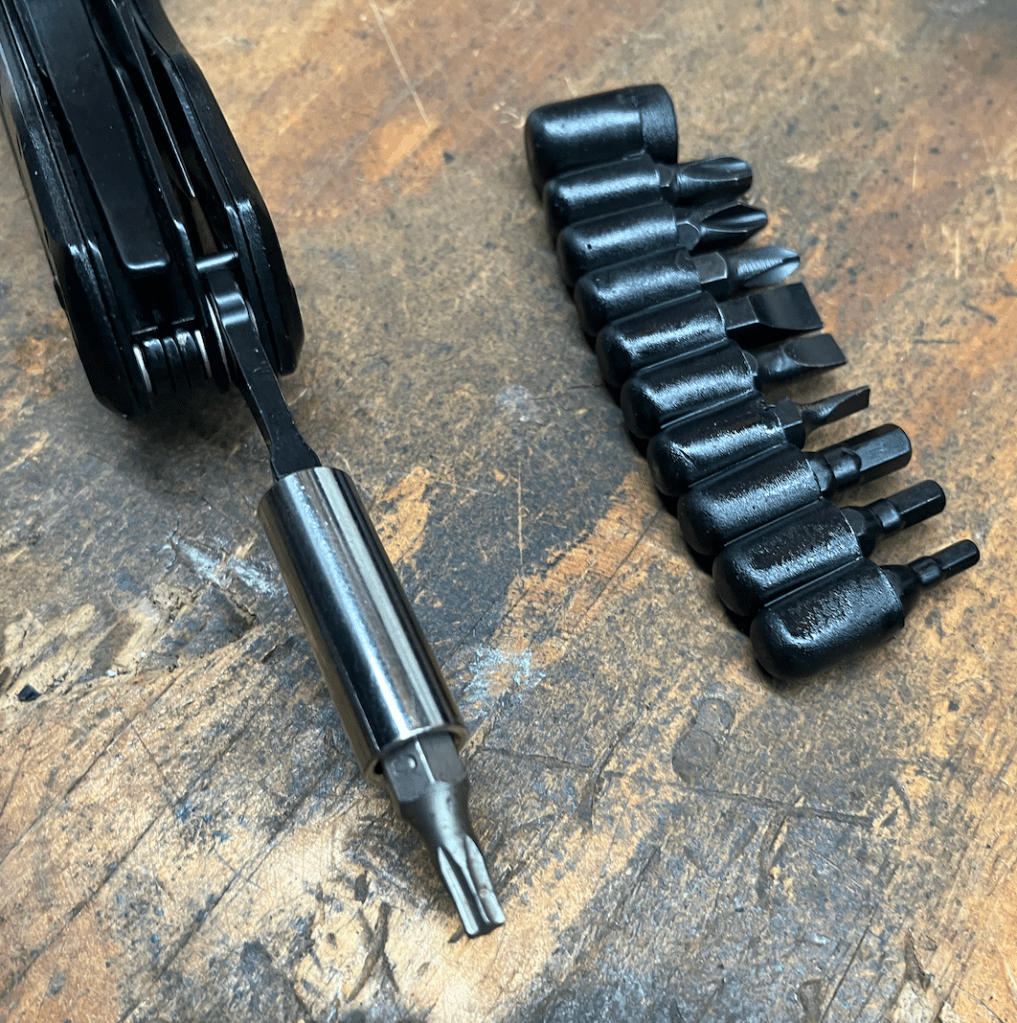
The relatively tough little sheath, a standard cheap multi-tool style, has a nifty little side compartment for the strip of Apex bits. I quickly found out that when worn, it was easy to access. It didn’t interfere with the by-feel resheathing of the tool at all. Also, the little strip of Apex bits is a force multiplier; it gives you tremendous options for all those annoying fasteners you come across in a house, on the job, or on a vehicle. I didn’t appreciate this at first, but I do now. This is a very intelligent feature. Observe.
See the square Phillips bit? While you can use this as a Phillips screwdriver, and the can opener has a slot-style screwdriver head, the real power is in the square shape of this screwdriver, which acts as a drive for the Apex socket. This shaft also locks- very important if you must press down on a stubborn fastener. I’ll show you how this works. See below.
Yes, that is a T-type Apex bit, which is not included in the strip of Apex bits. Something I think is really cool is that you can mix and match bits in the snug rubber stripper to suit your needs. In the multitool I now carry on my belt, I swapped a few bits around to reflect what I’m likely to come across here. After seeing this feature in action, my reservations about the lack of a pocket clip disappeared. Also, this little multitool isn’t terribly awkward on my belt. I see now why you need to wear the sheath; it doubles the possible uses for this tool. Also, the Apex socket itself can be used as a 1/4-inch drive socket- this is a standard size for many small fasteners. Observe.
Let’s discuss the all-important feature of this multitool and the reason I took a chance with it. The pliers. Do they work? In the ad, they looked awkward. How easy are they to deploy, and how do they fit into a very small package? Well, I found out. I used the pliers that same day, and I’ve used them a couple of times since. They are handy as all hell. Check it out.
You lift a tab and swing the handle in a wide arc to deploy the pliers. Like a magic trick, the completely concealed pliers swing into view as you do so. Another question I had was how much beef the pliers have. Would they be so skinny as to be unusable? I found out. It turned out that these are pretty good light-duty pliers; as a bonus, they are spring-loaded. Look below.
The pliers are a 3 in 1 design. They are needlenose with a semi-circular slip-joint style grasper, and they are wire snips at the base. A few caveats here. Note that I said “light-duty pliers.” I mean this. If you honk down on them really hard, they might fail. See the wire above? Pretty tough stuff. After I snipped this, I had to chew it a bit, and then when I went to swing them back into the case, I had to wiggle the pliers a bit. They seemed a little sprung, but the wiggle set things back into place. It could be that if you really gave these hell, they’ll break.
Once again, respect the tool’s limitations. Get another tool to loosen a rusty, frozen 9/16 nut. However, these are great if you need to pick something up in a bad spot, remove a splinter, loosen a small nut, or snip some 14 gauge wire. I’ll show you an example of a chore I did with these pliers; they were perfect for this light-duty task. Observe.
This was a battery monitor I added to the Roxor- its function is to tell me how much I’ve drained the battery while using it as an engine-switched-off work platform. For example, running or charging tools from the inverter, using the lights and radio, etc. You don’t want to be caught with a dead battery in the middle of nowhere, so it’s a nice feature. If you’re down a couple of green bars, let the engine run for a few minutes until you’re charged up, then switch it back off. BTW fairly soon, I’ll post a Roxor update article here.
The multi-tool tightened the nut on the rocker switch, snipped the wires I ran, and tightened the 1/4 self-tapping screws you see on my homemade bezel. Yeah, I ran the screws in with an impact gun, but for the final turns on the delicate plastic housing of the gauge, I used the multitool. It worked as advertised.
Overall, I’m very pleased with this thirteen-dollar purchase. I haven’t seen any other multitools with this exact configuration, which combines the handiness of a pocket knife with the function of the traditional, fold-out style Leatherman, for example. Also, the sheath isn’t so bad once you get used to it. It is somewhat heavy, so a trick you can use when removing your pants is to loop your belt through a pants loop and snug it. I learned this trick back in the day when I wore a holstered weapon at work. While this is nowhere near as heavy as a service pistol, it does have some weight and will fall from your belt.
Time will tell how well this little guy holds out with daily use; it’s an inexpensive knife, and those usually fall apart with time and use. To be fair, however, so do the expensive ones. I’ve broken or worn out Gerbers, Schrades, Kershaws, and Camilluses. With hard use and time, all tools fail. However, this is fantastic as a glovebox tool or an emergency kit. If you need one of these in a pinch, it is guaranteed to work on that one badly needed occasion.
Respecting its limitations and manufacture, this is a damn good value. I’m so impressed that I thought to share it with you.
If you haven’t noticed, I’m all over the place in this blog. Writing, vehicles, events, happenings, and from time to time, gear and fieldcraft.
Today, we will do a little gear stuff for those interested.
A write-up about the US infantryman’s friend, the poncho hooch, is long overdue. I thought about this when putting together an improved emergency kit for a vehicle; yes, you include car-specific stuff, but you also need to think about food, water, medical, and shelter in case of a really bad day. Looking at my mentality, I probably went a bit overboard. But that’s OK. It’s always better to be overprepared than the opposite.
This is when I remembered the poncho hooch, something I haven’t set up in over a decade. However, it is so simple you can’t forget how to set one up if you have done it just once. I thought I would share this with you.
The first ingredient you need is a good USGI or a similar poncho. This is, trust me, easier said than done. However, I found a very nice Amazon product; it is close to the trusted USGI design. I can only vouch for the OCP-upgrade pattern. The other styles the seller sells may be from other, possibly inferior, manufacturers. Of course, this design can also be adapted for small waterproof tarps. You’ll see.
The second thing you need is a 15-20 foot length of 550 paracord. This is widely available and has many possible uses. It should always be a part of any kit.
Finally, you need six stakes. Four will do in a pinch, but six is better.
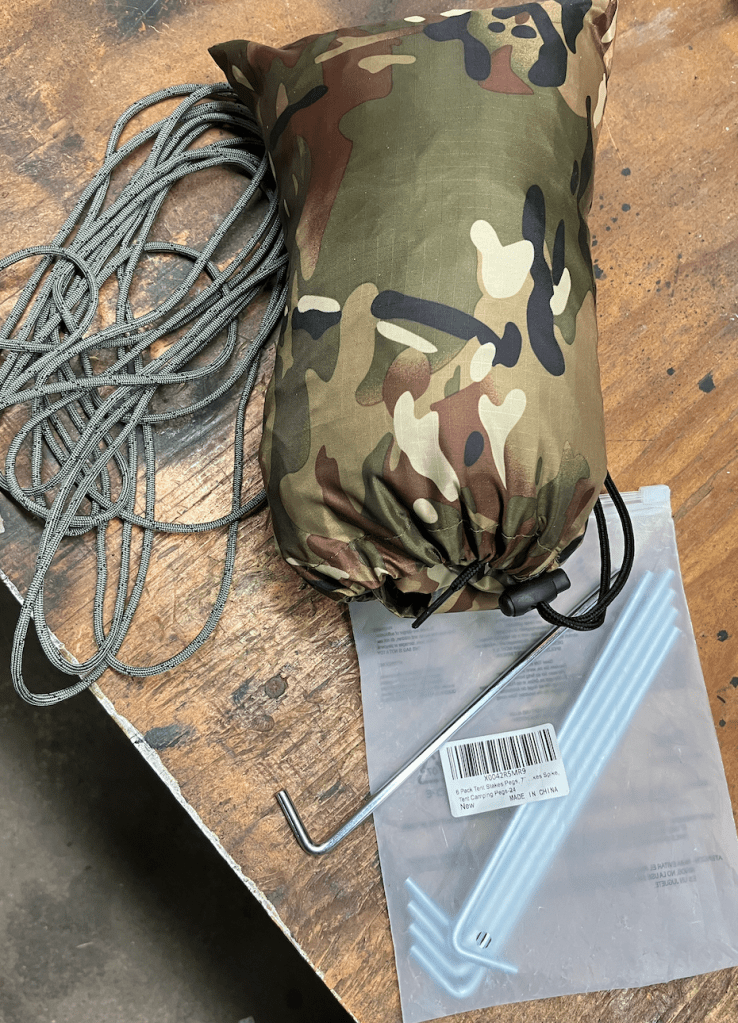
That’s it. This is all you need for this style of shelter, which is much lighter, more compact, and more versatile than any conventional tent. The configuration I’ll show you is but one of many possible. Below, the ingredients.
See the three components. All of it stuffs into the poncho sack. Note: It’s a good idea to keep the stakes in a rugged plastic pouch. You don’t want to rip your poncho when stuffing them into the bag.
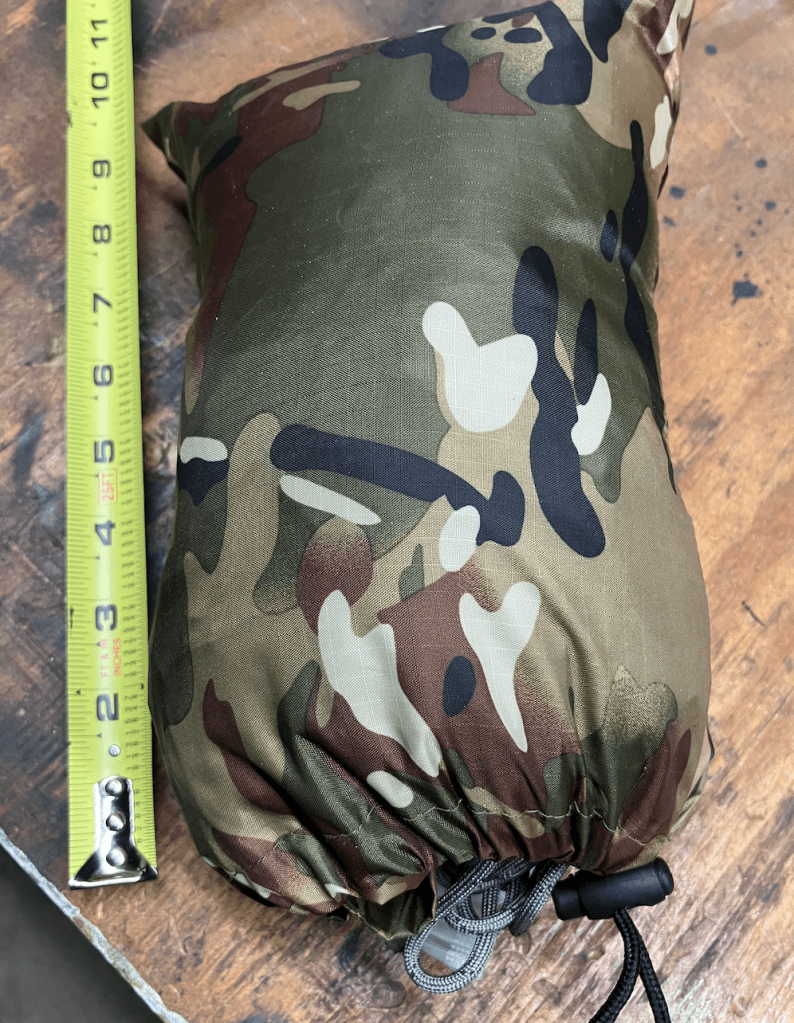
How compact is compact?
9.5 inches (24.1cm) is pretty darn compact. In addition, you don’t have to keep everything in a stuff sack. For example, in some units I was in, the SOP was to keep the poncho folded and secured by the aforementioned 550 cord over a weapons belt. You kept the stakes in your ruck. This is very compact. It is also a PITA to get off your belt every night. I prefer the stuff sack. It’s just easier.
By lightweight, how light do I mean? Check it out.
One pound and two ounces (510g) for the complete package. It doesn’t get lighter. Almost any tent you buy will be heavier, bulkier, and harder to set up. And, oh yes, it is more difficult to egress if there is a problem.
Of course, there are disadvantages to this setup. It’s not perfect. One thing is that there is no floor; an isolation mat is handy here, or at the bare minimum, a mylar blanket. Also, there is no bug screen, and creatures are free to crawl in with you. Here’s where a little field knowledge comes in. Choose your site carefully, and check for rocks, branches, etc. Heap up leaves for some cushioning, and ensure you take any flowing or standing water into account. You can’t do much about the beasts except to make sure you don’t have any food remaining where you sleep and exercise due caution when you get up. Bug spray is nice, too.
Camping is an experience thing. I’d suggest you try this out, and all of your other gear, before you need it. Just because. But, let’s get on to how to construct this.
It’s dead easy. Find the aforementioned nice patch of real estate, and remove the clutter that will screw up your sleep. If you’re being all crazy and tactical, disturb nothing and leave the smallest footprint possible. For most considerations, though, who cares? Make yourself at home. You’ll be sleeping there, and you want to make an already crappy situation as nice as you can.
You need two trees about ten feet apart (3M). Secure one end of the 550 cord to one tree, tie it around the other, and tighten it. The tighter, the better. This helps your shelter shed rain and is the central support. Make it the height about halfway between your knee and your hip.
Then, drape your poncho lengthwise along the 550 cord. The poncho hood should be in the approximate center, and the ends of the draped poncho should be about the same lengths they touch the ground.
Next, you stake one corner, ensuring you don’t pull your poncho off-center. Go to the opposite corner and stake it as well, drawing one end of your shelter tight. Then, go to the other end and do those corners, pulling the poncho tight along its length. Finally, do the stakes in the middle, which will complete the tightening of your shelter. You can cinch the hood shut, or simply drape it over the side. Some guys like to tie it upwards to further tighten the structure; there is no right or wrong way. Feel free to experiment. You just need it to keep you dry as you sleep, and making it tight helps with this. Also, a tight tent doesn’t flap in the wind, either.
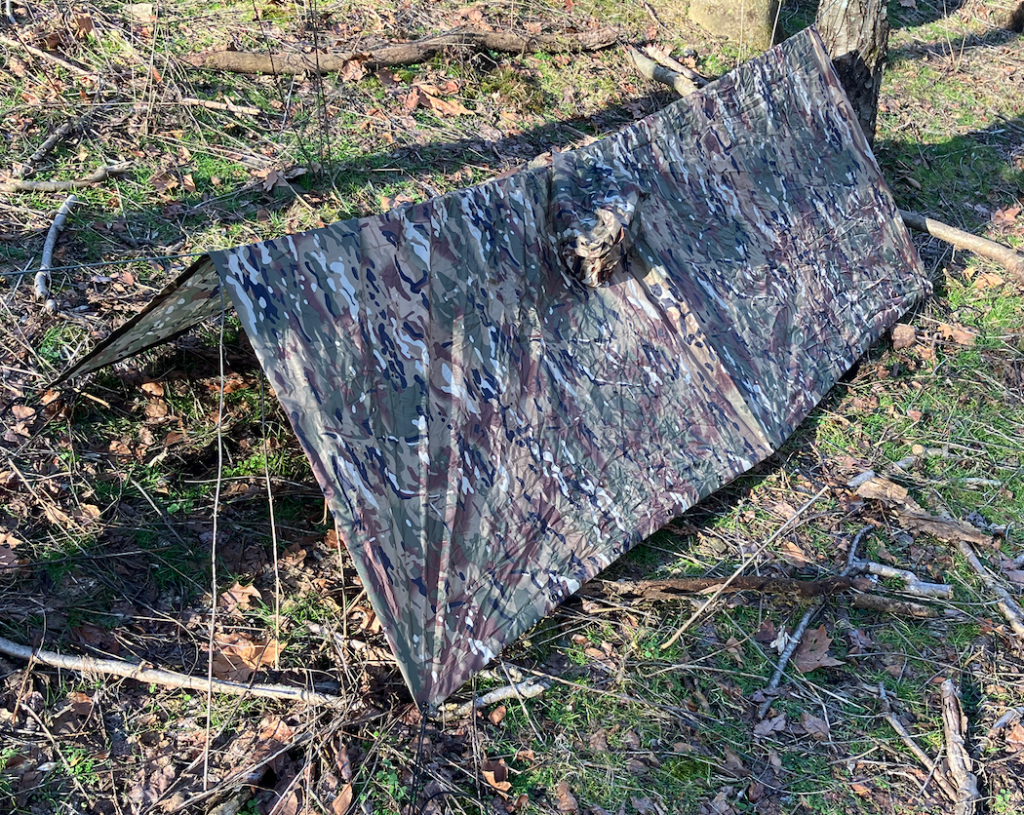
The poncho hooch is now done. You can move in and rack out.
How long did this take me, out of practice, everything jammed into the bag, and not really hurrying from start to finish? Observe.
Pretty quick. And I know that if I did it three times in a row, I’d knock a couple of minutes off.
One of the methods I use to heat this house is a wood furnace. This is reserved for the coldest days; running the woodstove on a mild day will run you out of the house. But, the frigid days are a thing around here. It can get to -4F or -20C. Sometimes these brutal temperatures stretch for weeks, so a wood supply is necessary. Yes, I could run the old oil stove. The oil furnace is great, but it’s expensive and not exactly eco-friendly. The wood stove isn’t either, but it’s better than oil if you think about it. This is because I don’t harvest live trees. I always take deadfall, which is plentiful in the forest. A dead tree will release its carbon whether it rots or via my woodstove.
Yesterday’s tree fell over in a storm onto a neighbor’s lawn. My neighbor is elderly, he can’t clear it himself. Some random guys said they’d handle it. They left behind the hard part and took the easy wood, the small branches, and the limbs. The trunk, which has literal tons of great firewood, will have to be “chunked out” or removed in sections.
It’s hard, punishing work. This is with a chainsaw and a log splitter; without these modern tools, there’s no way I could do this.
The wood is soaked, very green, and heavy as hell. It will have to season for a year, this will be next winter’s wood. It’s ridiculous. A regular-sized log probably weighs twenty pounds or so- it should weigh half that. Laughs. Not so much. Let’s just say I got my steps in yesterday, and used muscles that needed exercise. Today, I feel it, and the chore is nowhere near done. This will take a while.
The trunk is probably 48 inches (1.22m) at its widest- it was a big tree. My saw (a good Stihl), while no weenie Walmart thing, is outclassed by this brute. My saw has an 18″ bar. The trunk is 48.” Think about it. Chunks, it is.
I can only stand to do this for a few hours a day, and then I’m worn out. At this rate, it’ll take all week to get the job done. The reward, of course, is good dry wood next year. But boy is this middle-aged and hard-ridden frame tired. I don’t need yet another hernia operation, and I don’t need to screw up my back. Therefore, caution and pacing are a must.
Tough to do when the trunk sections probably weigh as much as an engine block. Phew. Nothing to do but play lumberjack and imitate the turtle- slow and steady wins the race. I should set a timer. Four hours max. When I was younger, I could do this sort of thing all day long. Well, those days are past. My biggest challenge is not to push too hard, to keep thinking I can do just a little bit more… Bad idea! When your body says, “Don’t do this,” you should listen.
So, it may take forever, but I’ll get it done. Holy cow, what a tree.
In my last post, I reviewed “Masters of the Air,” concerning the latest offering by Spielberg and Hanks in regard to the air war over Europe by the USAAF’s 8th AF. If you haven’t seen the review, it’s below this post.
It made me think of a connection I have to that bloody campaign, which ended the lives of many thousands of Allied airmen, Germans, and others. The guilty, and the innocent.
There was no one, as best I know, in my immediate family who served in those bomber streams. No, we sucked it through the steamy jungles and shitty islands in the Pacific for the most part. A few were in Europe, but once again, no one flew. Everyone walked. On a great day, they hitched rides.
But there was a little Frisian girl who lived on a small farm in Holland who saw that campaign. Her village had the misfortune to be fairly close to a large German airbase, about 46 km in a straight line. This was a few minutes flying for a fighter. The drone of the machines overhead, the massive banks of contrails, the thunder at night. Sometimes flashes, or brilliant streaks of fire. These were parts of her day-to-day life.
On a day in July of 1942, there was a tremendous crash and fire in the fields behind her house. Everyone went and looked- an Allied bomber was smashed up in a smoking ruin, black smoke choked the area, the flames roared higher than her house. Chunks of the fallen aircraft were strewn about; everyone knew the Germans would be there soon.
The villagers weren’t wrong. The Wehrmacht, or more likely the Luftwaffe, showed up in force and cordoned off the crash site. They took what weapons they could find and any parts of the aircraft that might be useful for intelligence. The rest they left for the villagers to deal with. By the way, the penalty for taking weapons, if the villagers cared to do so, was summary execution. The Germans made that clear.
The villagers laid the dead airmen to rest. These were their graves, shortly after burial, in 1942. As you can see, the villagers didn’t just dump them into a hole.
My Mother in Law, now an old lady, thought it important to show me these graves when I visited in 2017. These airmen lay there still, amongst the villagers who buried them. Mem’s little sister, Margje Postma, lays but a few meters away, dead in 1955 of leukemia. The four white stones hold pride of place at the back of the cemetery, meticulously maintained by the descendants of the people who watched them die.
The cost was real. The living memories remain.
In the bleak winter of 1944/45, she was nearly killed as she rode her bicycle, part of that same air campaign. She crossed a bridge and heard a roar, a fighter-bomber blew the bridge behind her sky high. Germans searched the village for Resistance fighters, collaborators snitched people out. They disappeared, many never to return. Eventually, the cruel winter ended, and she watched the Wehrmacht go home, either on stolen bicycles or on foot. The killing didn’t stop until the last soldier left, in the second week of May, 1945.
Canadian soldiers eventually reached her village. The eight-year-old’s war was finally over, and she never saw a bomber again.












 The Interstellar Valley