You may have noticed that I’ve gone a bit dark around here lately.
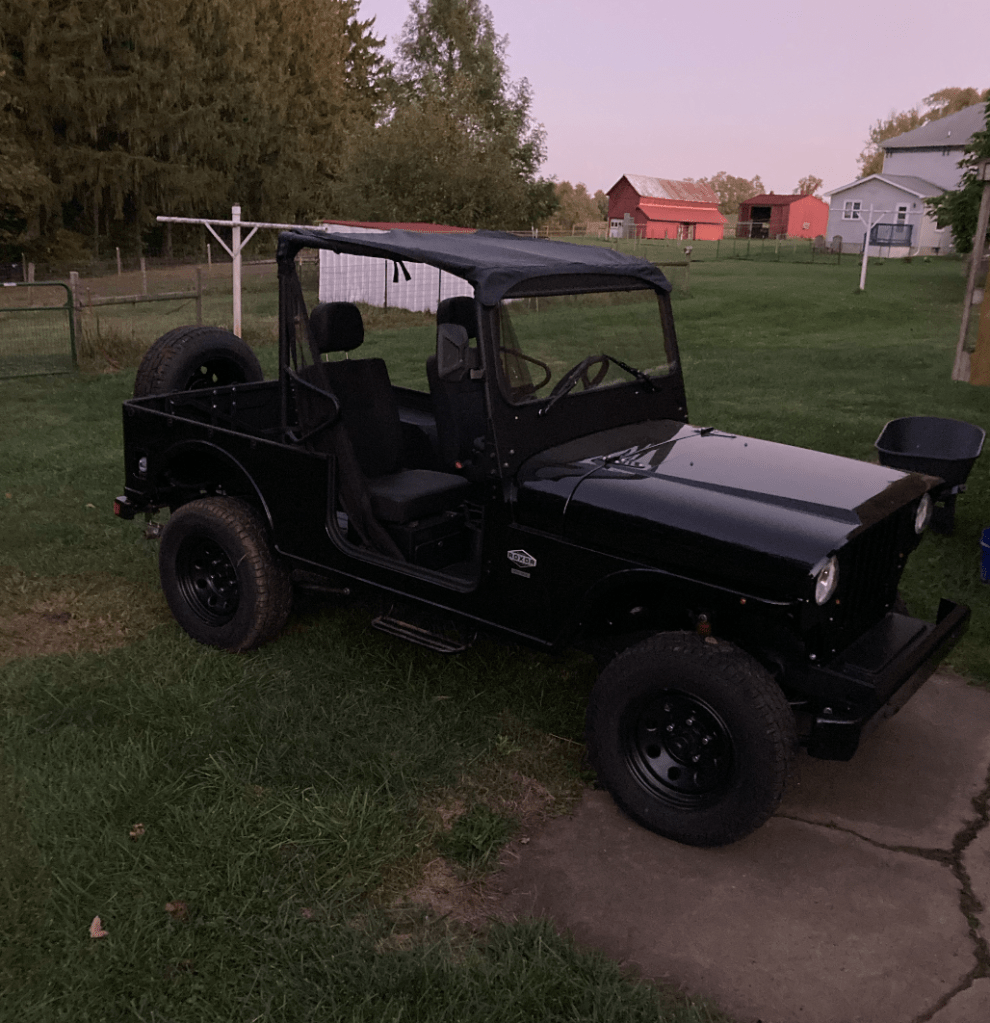
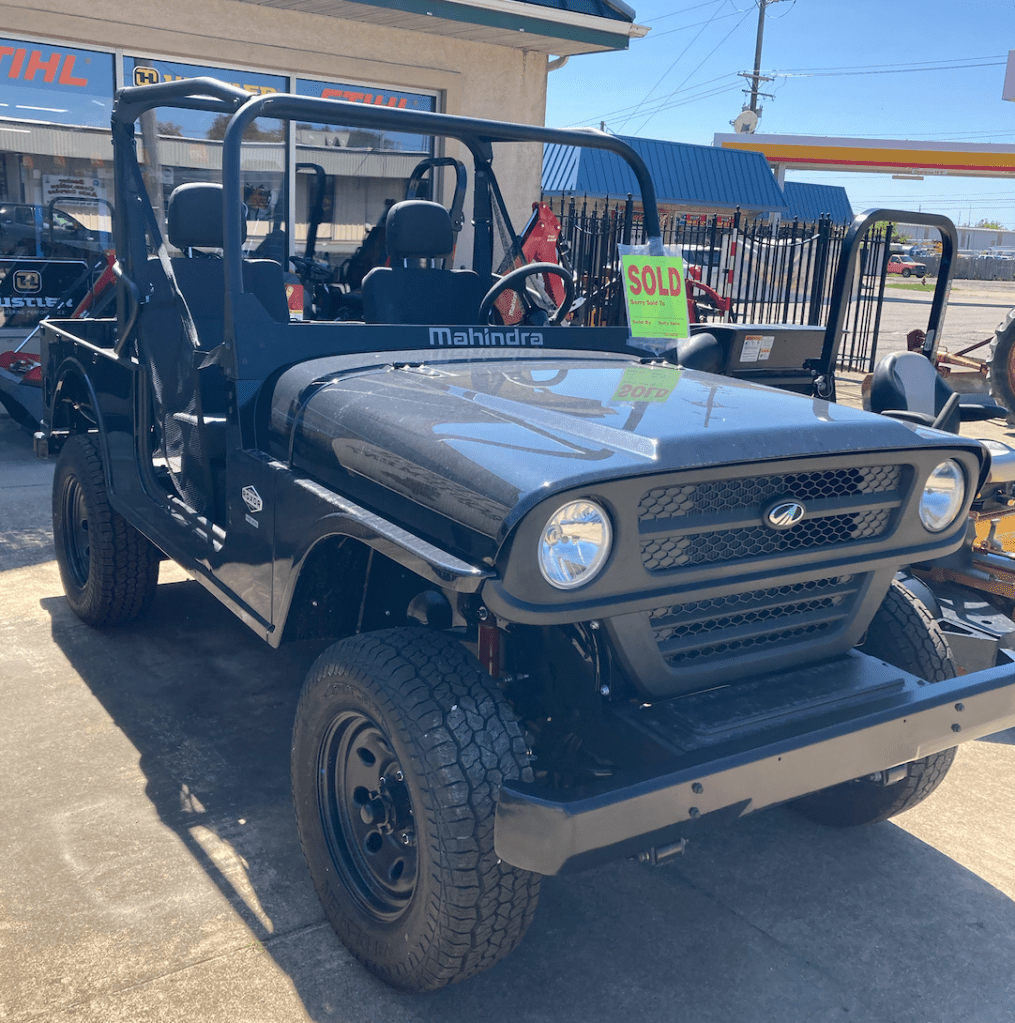
Don’t worry, I haven’t forgotten about you. It’s just that a long-awaited reality has finally come to fruition- the arrival of my very own fully operational Death Star, in the form of a pattern true Indian Jeep, otherwise known as the Mahindra Roxor.
I bought a base model and had the dealer install a few options. Trivial things such as a windscreen, a trailer hitch, and wipers. I splurged and even got a wiper wash motor.
When Mahindra means a base model, they mean a base model. You get a functional off-road vehicle with tail/brake lights and headlights. That’s about it. You must either pay someone to do everything else, or you do it yourself.
The wipers, hitch, and windshield were a bit much, so I paid for the installation. However, I left plenty of work aside for myself. I’ve been busy with these additional mods over the past week. The mods are creature comforts and safety features. They were largely inexpensive, thanks to Amazon, but labor-intensive work.
What did I do? I added turn signals. This was a real chore- you must drill holes in brand-new, freshly painted sheet metal. It’s not for the faint of heart. If you are a few millimeters off, it will look like crap. You only get one chance to get it right. Therefore, a good layout is a must. It’s time-consuming. Also, I added a radio and a license plate bracket. This needed correct, properly routed wiring and a new dedicated fuse box.
I don’t know if you’ve ever installed a car radio, but it involves contorting yourself under the dash to route wires and make connections. And BTW, the Roxor had zero provisions for mounting said radio and speakers. Therefore, more holes had to be drilled while I was already in what amounted to a stress position.
Guys, I’m sore as hell.
However, all the crawling on the ground and being jammed under the dash bullshit is done, and everything works.
I wanted to really press on this past week because we had lovely weather, some of the last of the year. This makes life a lot better when you’re doing work outdoors.
Something had to give, and that happened to be writing. However, it’s all over but the crying. The Jeep is now roadworthy, and I still have some mods to do to make it trail-worthy. However, that’s what I know of as “gentleman’s work,” it doesn’t involve me stuffing my body into unfriendly and unyielding spaces. And the hell of it is that the Roxor is an easy vehicle to work on, with plenty of space. You should try doing wiring on a subcompact- it’s a special breed of hell, and my hat is off to the peeps who do it, day in and day out.
Today, all, is the day of days. A long-awaited moment has arrived- John Birmingham’s follow-up to his alternate-history Axis of Time series has hit over on the Beast. If you’ve anticipated this event like me, you’ll smash the link above and score your copy posthaste.
What a journey this has been, following JB along on his Patreon site as this monster worked its way into a real, breathing thing.
The story starts much earlier for me, 2011, to be precise. Back when the only writing I did was this:
In those days, deep in a dive bar stuck in the Hindu Kush, I only wrote operations orders and the occasional letter home. My Valley Series wasn’t on the radar, and the real Valley lay before me, a crummy, darkness-shrouded place tucked between the snow-capped mountains.
I carried JB’s original Axis of Time novels into combat, and my faithful Sony eReader was KIA on a shitty hill in late September 2011. After that, I was out of luck, at least in terms of reading. However, before then I had read his novels so often that I nearly had them memorized and I could just zone out while eating a delicious MRE burger, slathered in GI BBQ sauce and squish-tube jalapeno cheese, lost in my head in his universe. Between drags on my Pakistani L&M and swigs of water, I fought the Japanese Army like my grandfather, except in my internal dialogue, I was born in the seventies, just like his books.
Powerful stuff.
Later, when I wrote my own book, I stumbled across JB’s website and shot him an email on the general freq. He was cool enough to respond (this rarely happens), and we came into contact. With time, I joined his beta reader crew and did some odd jobs for him. He talked about revisiting the AoT universe, and I was excited, along with legions of his other regulars.
Work progressed, and was delayed by various factors, which are discussed in depth on his sites. I won’t go into detail. If you are interested, there’s a lot about this at his free site.
But now, the moment has arrived, and his newest baby is on the shelves.
If you are as big of a fan as I am, you’ll smash the “buy”button so hard you fear that a trip to the Apple Store may be in your future.
I can’t wait to read this! What’s even better is that there are two more in the pipeline- this is like Black Friday in Walmart! Very exciting.
All right, so you guys know by now that I’m all over the place on this website.
Future warfare developments, science fiction, books, and reviews of products and cool stuff. Today I’m doing a review of an add-on automotive turn signal kit that I ordered from the beast for 129.99.
As you may know, I recently unloaded the Jeep project from hell, an antique 1955 Willys CJ-5 that was a lot of fun, but it ended up giving me endless grief. ‘Nuff said. I replaced it with a brand-new Mahindra Roxor, a fairly faithful WW2 Jeep clone. I ditched the antique hassle for the same vehicle without the old-stuff headaches.
The vehicle I bought was an HD Base model. By base, Mahindra means very, very basic. Zero creature comforts, but an astounding off-road machine. I had to add protection from the elements equipment, such as a windshield with wipers, a cloth top, and a hitch. This has slowed delivery a bit as the shop must install my add-ons. But that’s OK, because it’s given me time to think about what else the vehicle needs.
All right. The Roxor is legal to drive on the road where I live, with some restrictions. I discussed this with the county sheriff and highway patrol and covered my bases. The Roxor is good as long as I don’t operate it on the interstate or limited-access highways (think freeways). They also advised me not to race it or operate it while drunk. This strikes me as reasonable, sound advice.
But the Roxor I ordered, the base, doesn’t have turn signals installed, and you need those if you are going to share the road with traffic, even over limited distances, to reach the riding trails.
The dealer lady advised me she be happy to sell me an awesome recommended turn-signal kit for between 600-700 dollars.
Guys, this is a bit steep. So, I decided to see what Amazon had as an alternative. There were many kits, from very stripped-down models for about sixty bucks, all the way up to the 600-700 dollar range that I was quoted at the dealership.
Yes, I am sure that the 600 dollar kit is amazing. No, I don’t want to spend that kind of money. But what I also didn’t want to do was to buy a kit and be pissed off because it was shoddy- this would defeat my purpose- saving money. I’ve learned that you don’t want to buy just anything from Amazon because they sell junk and quality products together. Let the buyer beware.
So, after a lot of thought and searching, I settled upon the Kemimoto turn signal kit. It had a good balance of 4 and 5 star reviews, about 70 percent, and from the pictures and descriptions it seemed to be what I needed. I ordered it, fingers crossed. Two days later, it showed up. I unboxed it, curious as to what I would find.
I was impressed. Everything was neatly packaged and labeled, and the instructions weren’t pure garbage.
I decided to test the unit in my basement to do a dry run before installation. I grabbed a spare 12v lawnmower battery to simulate an automotive power source and started hooking things up.
Guys, it was childishly easy. Seriously, if you know that red is “power,” and black is “ground,” you can make this work. Everything, including the very loud add-on horn, worked as advertised without any tinkering, thought, or real effort. I have a fair bit of experience with automotive wiring harnesses. Usually, you really have to think to make things like the turn signals and horn work.
This is not the case with the Kemimoto kit. It really is a case of sticking the red wire on hot, and the black on ground, and everything works the first time. I’ll install this kit the next day when my vehicle is delivered. The biggest obstacle will be routing the wires along the chassis and locating the lights, which has nothing to do with the function of this kit, which is flawless.
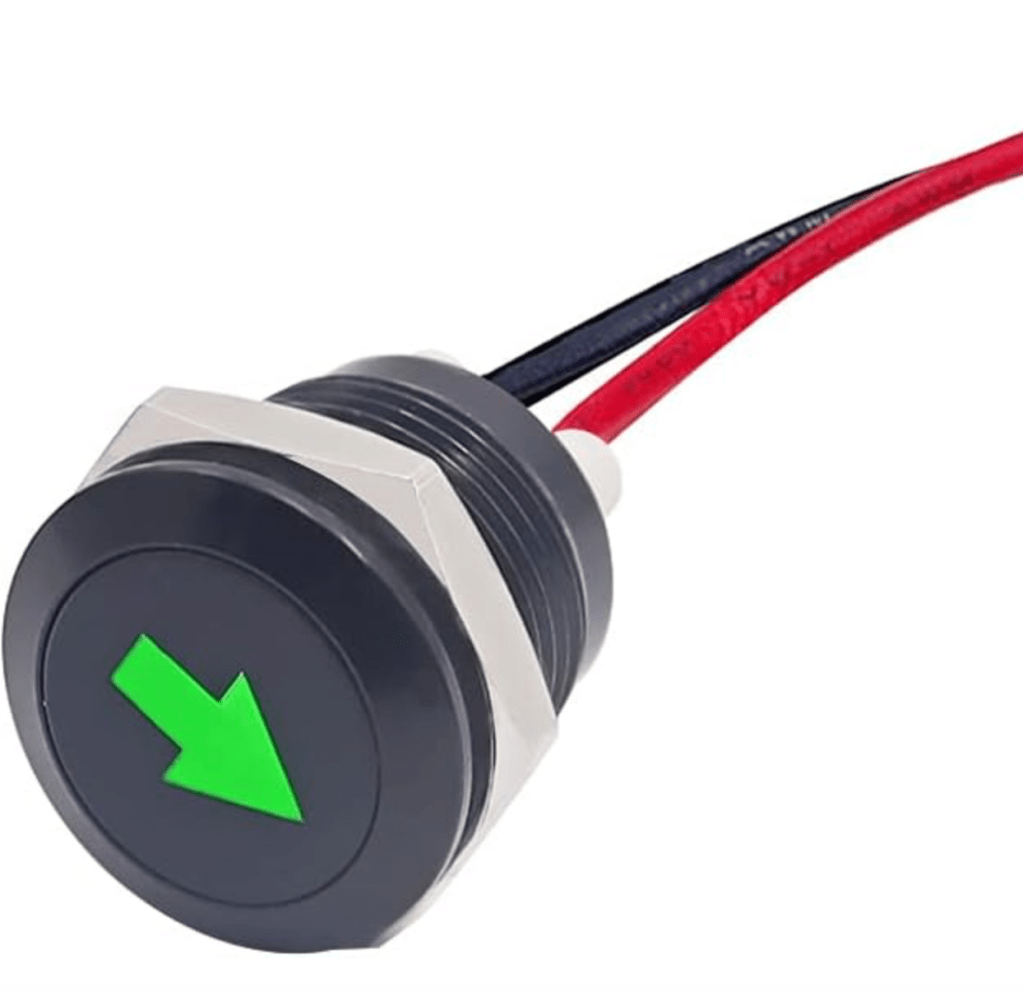
One area I do think is a little dumb. The wires for the interior indicator lights use a standard marker light. Yeah, you can do this, but if you place a standard marker light on your dash, you’ll blind yourself! Of course, you won’t forget to turn off your signal with the standard old-school non-self-operating hot rod turn signal control, but those marker lights on your dash would be a bit much.
I ordered these to replace the marker lights, and I’ll use the spare marker lights elsewhere.
A much better look, IMO. When doing such mods to a vehicle, you should always strive for a “factory” look. The green arrows give you that.
Besides that, I can’t find much fault with this kit. I also disassembled the JC Whitney-style turn signal control assembly just to see the quality control on the internals. Everything was soldered in tight, and the hot-rod style unit worked as advertised. It did differ from the old 1950’s and 60’s units in that there is a plunger switch on the turn signal lever which controls the horn, and the body of the assembly doesn’t have the old “jewels” that light up when the turn signals are flashing.
But that’s OK. I know those old units are dead reliable, if clunky, and I was gratified to see that whoever made this loom used one.
For the money, this harness cannot be beat. Period.
Here is the mock-up I made. You can see all the components in the harness, and how they function. This took me about ten minutes to figure out, right out of the box! Very nice, very easy.
So. This will absolutely work on my Roxor, but it has all kinds of applications. Crappy cars whose turn signals died. ATVs. Antiques with no turn signals. The list goes on.
And I wouldn’t describe myself as such. However, if even a washed-up combat-arms ex-company-grade-officer can spot this trend, then you’d think the geniuses at the Pentagon or national leadership can.
National leadership. OK, I said it. Right now, we’ve got a choice between a fella who got into politics before I was born and another who wants the job, again, but is so compromised that I have no words for it. But still, the current President’s subordinates have to point out that what we are doing now doesn’t make sense. I don’t know if they are, and the Ukraine War has put our broken procurement process into an ugly spotlight.
What am I talking about.
I’ve been discussing this subject for years on this site, and was an overarching theme in my first series of books, the Valley Trilogy. We’re talking about drone warfare and its effect on the modern and future battlefields. It all started overseas when I was still employed by the Army. Many a night, I’d be in shithole-somewhere, and we’d get drone intel, or we could even hear them far overhead, depending on the platform. The capabilities were godlike, and it made me feel almost sorry for the a-holes that wanted us dead.
OK, maybe I wouldn’t go that far. But still.
When I came home, a friend showed me a toy his son had. It was a half-dollar-sized mini drone that could do all sorts of amazing tricks. Immediately, I recognized the military applications of this “toy.” Give every soldier on the battlefield his/her own drone, and it would remove a lot of the fear factor as you head into combat. Also, you could tailor-target the bad guys without throwing around one hell of a lot of ordnance, most of which either doesn’t hit anything or hits the wrong thing.
Later, a friend told me vignettes from Syria, where a-holes had been taping old-school grenades to drones and dropping shit onto guy’s heads. This simply reinforced my earlier thoughts, and lent credence to the future combat I described in Valley.
I don’t know if you all have been following developments on the ground in Ukraine, but it’s borderline unsurvivable over there. There are several factors here. One is the implacable enmity between the foes. I’ll bet it’s tough to surrender to a guy whose home village was overrun and his friends and family were tortured, deported, or thrown down a well or some shit. Another has been the profligate use of mines. The world is re-learning the lesson that if you really want to stop an attacking army, simply sow treacherous high explosives into the ground with abandon. If you are Russia, you do not give a fuck if there is no accurate reporting, and you have rendered just about everything unusable for a generation.
A quick aside. What do I mean, rendered unusable? Easy. Land mines from the Vietnam War, over fifty years ago, still kill and maim in Southeast Asia. Now, air or artillery deliver millions of plastic, non-detectable mines willy-nilly through fields and forests, and you can see what I mean by “unusable.” When this war eventually ends, because they all do, people will die daily from shitty modern Bouncing Betties (POM2 and 3), and farmers will die as their tractors hit anti-tank mines. Kids playing in the woods will pick up a seemingly harmless chunk of plastic, and BOOM, their lives change.
These things really suck.
Another factor that makes Ukraine a living hell has been the extensive use of old-fashioned artillery, which is no longer old-fashioned. The stocks of 155 and 152 shells worldwide have been draining toward Ukraine like a funnel, and both sides still need more and more. I remember when we destroyed the massive stocks of shells the Iraqi Army had early in the war. I’ll bet the Pentagon wishes they hadn’t been so hasty in that regard. But hey, those numbskulls screwed up so much over there that that oversight is small potatoes.
But finally, the shittiest thing about the Ukraine War is the pervasive feeling of utter nakedness among the guys up front. It’s the endless clouds of cheap kid’s drones put to lethal use.
It’s bad enough as it is, sitting in a position and knowing that someone could be sighting in on your head at any time.
It’s even worse when you know that ducking behind a tree or into a hole doesn’t help one lousy bit.
Welcome, welcome everybody, to modern warfare. Where you can’t even take a crap without some f’d up Chinese drone coming to pay you a visit. The damn things are everywhere over there. Frontline reports are chock-full of tales in regards to drones, and it’s the stuff of nightmares for both sides.
Hate to say it, but I told you so on this site years ago. Go back through my archives if you don’t believe me.
Drones spotting for artillery. Drones carrying grenades. Drones working with sniper teams. Drones taking out all kinds of very expensive equipment. Drones plowing into apartment blocks. The list goes on.
Oh, and drones delivering serious hits to the Black Sea Fleet and infrastructure in the Crimea. Word has it that Ukraine had a really big hit planned against the Russian fleet at Sevastopol, but General Musk, a paid US defense contractor, unilaterally called it off mid-operation by denying Starlink coverage for the operation. Seriously, Elon, lay off the ketamine. You’ve been doing some really dumb stuff lately.
But back to drones, and eventually AI, which is a separate subject and also one I’ve written about in my books.
Right now, drones are making life very difficult for the combatants in Ukraine. Uncomfortable is actually an inappropriate word that does not capture the horror of the threat from the sky. It’s bordering on the unsurvivable. This will not get better as time goes on; this war, while massive and deadly, is not a global conflagration between peers. That type of war, which will happen eventually, will be a horror show of drone swarms and cutting-edge tech.
When, and not if, this happens, watch out USN and USAF. You folks, with your billion-dollar white elephants, will get seriously messed up by 1500-dollar drones.
I’ve said this before, and I’ll say it again. The time is NOW to defend against these threats.
The Ukrainians are doing us favors. There’s that whole defend Europe thing, which is real. If the Ukrainians had folded, can anyone cast creditable doubt that Russia would be threatening NATO right now? Also, they remind us again that words cannot stop aggression. Their courage was an example for the entire world when we had blithely assumed valor was a thing of the past. Their example also shows us the folly of anti-mine treaties that are only honored in the breach by bad actors. What use are such agreements when the very people most likely to use them laugh at such accords? Mines have, and will have, a distasteful place in our arsenals. Like nerve gas or nukes, if only to discourage the enemy from reaching for such tools first. Finally, the Ukraine War has shown us in living color that we need to develop defenses immediately for drone swarms and eventual AI threats, and the sooner, the better.
Do you want to see the Gerald Ford go down like the Moskva?
It’s coming. Flag rank officers of the United States, do your fucking jobs. Politicians, do yours.
Quit wasting money on bullshit politically favored pork projects and put the tools our people need on the line. Yesterday.
Among other things, I’d suggest an armored fighting suit, augmented by AI, and not designed by Microsoft or Lockheed Martin.
It does feel as if I’m pissing into the wind because I don’t think reimagining our defense posture will happen. Non-trust fund poor boys like me will die in droves in the next war, their boondoggle war machines scattered across the landscape or resting at the bottom of the sea.
Hey, all. As you know, I jump all over the place on this site. Science fiction, my writing and interests, book launches, and product reviews.
Today I’m going to talk lights. Specifically, lights I found on Amazon that do everything- replace burned up units, save electricity, are easy to install, and work really flippin’ well.
While often overlooked, lights are a really big deal. Until you upgrade, a lot of times you don’t even notice how inadequate your old ones were. This was certainly the case with me a few days ago when I had enough of the dim lighting in my dingy basement.
I’ve put off the chore of replacing a few burned-up fluorescents for quite a while. They are expensive to replace, and a big pain in the butt to install. Finally, the loudly buzzing unit over my workbench died, and the situation became intolerable. Enter Amazon, where it seems you can find almost anything.
I knew that a single fluorescent shop light at my local DIY costs about forty USD, and that’s before you buy the delicate and failure-prone bulbs. You can get LED replacement bulbs, but the unit is problematic. Once, I had a ballast resistor catch on fire for no apparent reason. It was good that I was close by and had time to turn off the switch, or it could have been a major disaster.
I’m not a fan of old fluorescent fixtures. They had their use in the past, but they are now obsolete. Here’s why.
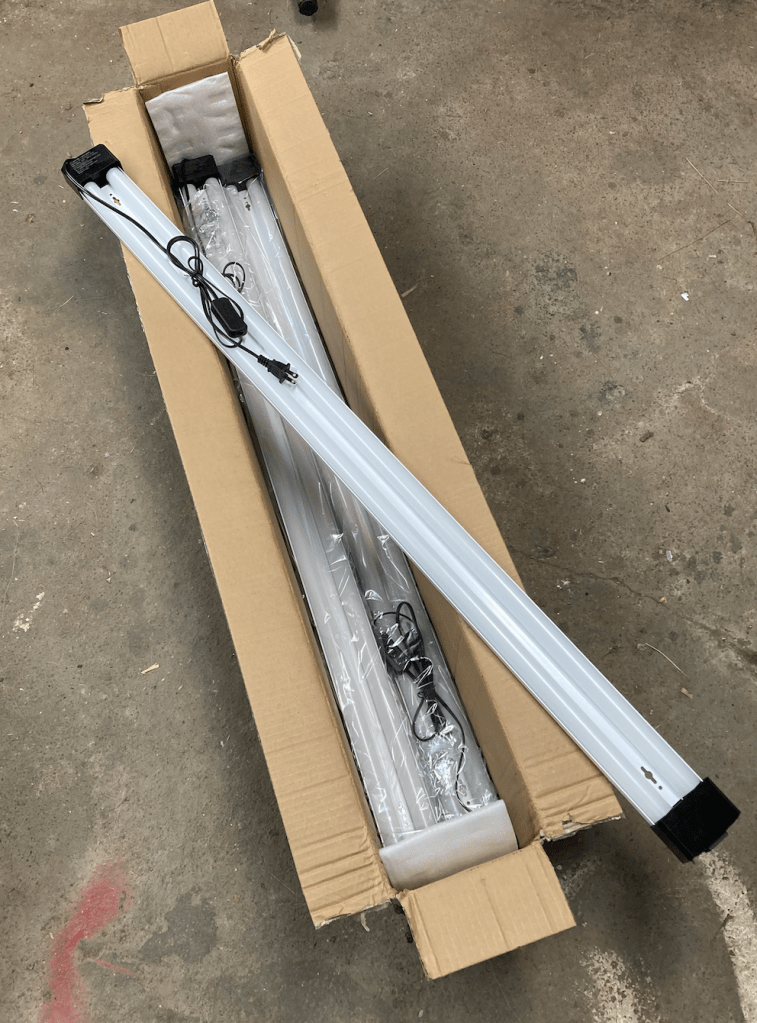
I found an amazing deal on Amazon, a 12-pack of fluorescent-style lights for just 96 dollars. The price increased slightly to 104, but it’s still a great deal. Also, the price fluctuates, so keep an eye out; the price may go down again, especially around Prime Day.
How much savings are these lights compared to traditional fluorescents? If you do the math, you get 12 lighting fixtures for 2 1/2 old-style lights. This alone represents massive savings, not to mention that the energy use is about half the old light’s power requirement.
Is it an apples to apples comparison, though?
Yes. Both fixtures, the traditional vs. the LED, are two-bulb units. Also, both are the standard four feet, and both have the same lighting intensity. Actually, I think the LEDs are brighter than the fluorescents.
And the installation of the new LEDs, as opposed to the old-style lights? Totally easy. After I did the first one, it took about three minutes per fixture. Each light comes complete with screws, anchors, and leveling chains. I didn’t need the anchors for my application, a dark, dungeon-like 110-year-old basement.
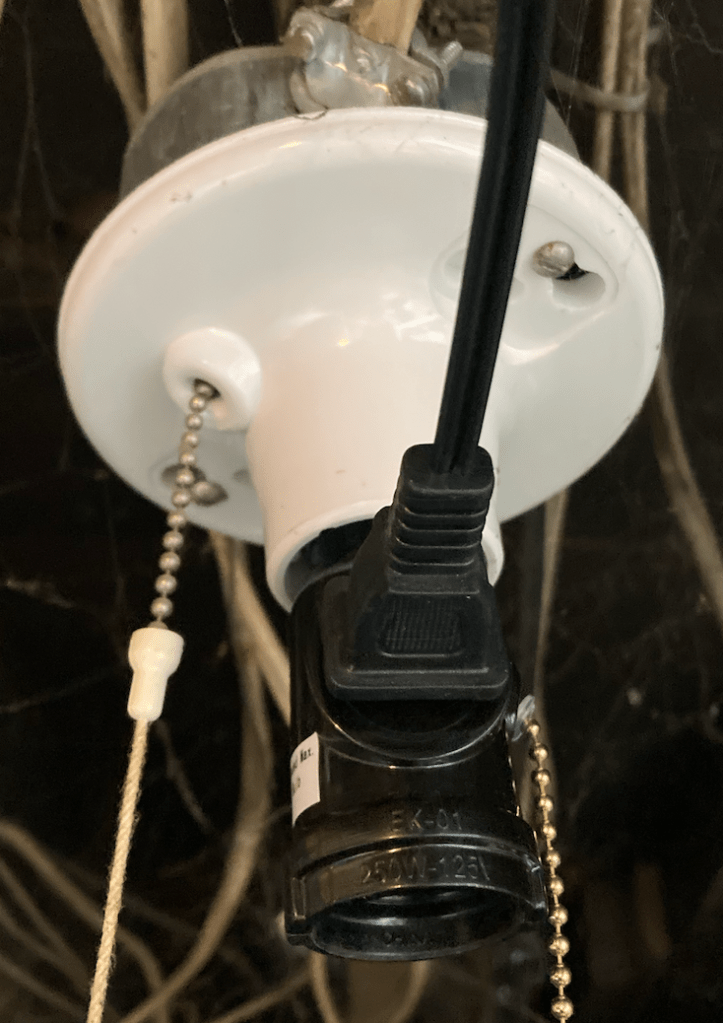
And in some cases, I didn’t need the chains or screws, either. I’ll explain that in a bit. First, I’ll talk about the easiest installs, the chains screwed directly to the floor joists, with the power supplied by old incandescent keyless fixtures. See the illustration below.
This type of installation was very simple. I unscrewed the old bulb and screwed in a readily available adaptor with female plugs to the keyless fixture. Then, I fastened the chains to the closest available floor joist and hung up the new light. I plugged the new fixture into the keyless adaptor, and it worked. Much better, I might add, than the old bulb alone, and at half the power usage of a traditional incandescent. Success!
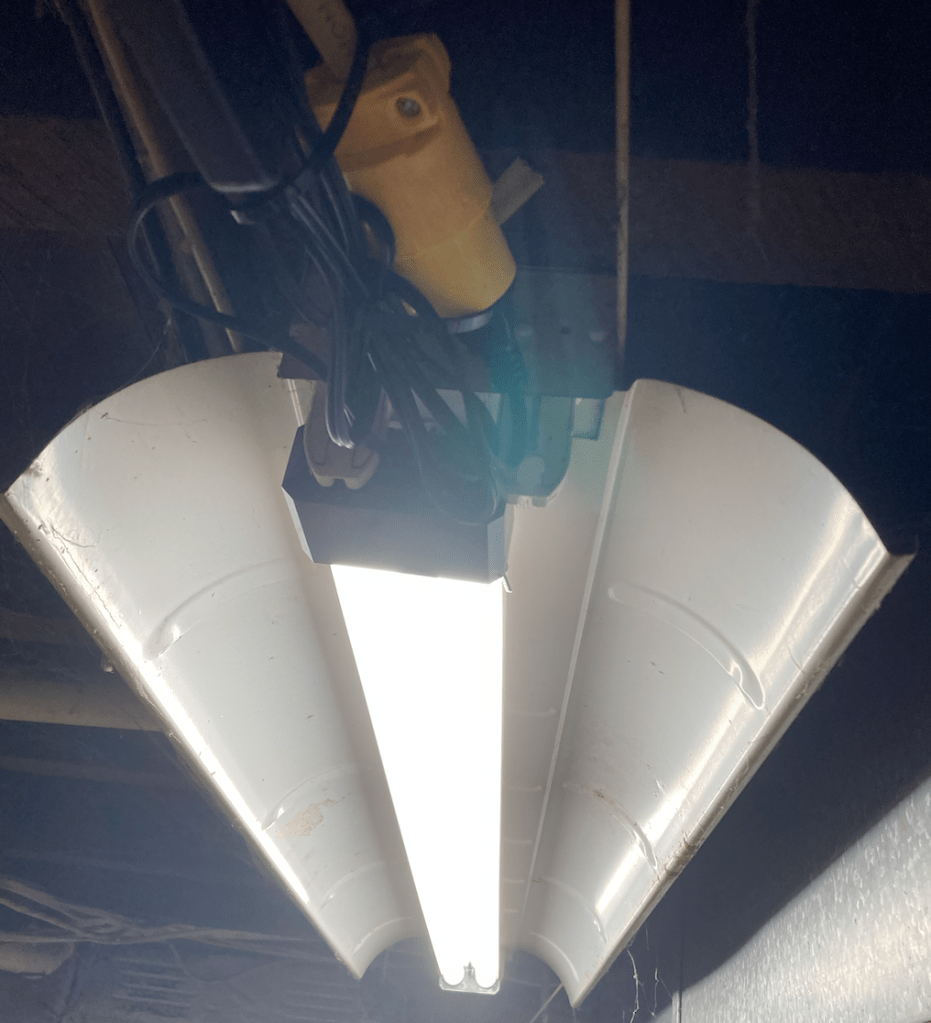
The other type of installation I did occurred to me as I contemplated removing the old, burned-out fluorescent fixtures. Guys, those old fixtures are a real pain to remove. As I looked at those ancient steel beasts, I had an idea. First, I removed the old fluorescent bulbs. Then, I grabbed one of the replacement fixtures, and held it up to the old steel housing. As I suspected, the new fixture fit neatly inside the old housing. I had an idea.
Why not jam the replacement inside the old housing? I had planned on wiring the replacement to the existing circuit already via cutting the existing romex wire and wiring a female plus to the end anyhow; the existing fixture would be dead as a stone as soon as I cut the wires. Why not reuse it?
Note: If you don’t know what you’re doing, hire someone who does to cut live wires and install plugs! In my case, I was confident that the existing circuit was properly wired and that if the switch was turned off, there would be no residual voltage in the wire. This might not always be the case, so proceed with extreme caution when dealing with electricity! At a bare minimum, ensure the circuit is switched off and the appropriate breaker is pulled. Once again, hire an electrician if you are not 100% confident in the job. It’s too late if you take a pair of cutters to a wire and get a nasty shock!
Alright, now that that’s been said, I did exactly as stated above. I de-energized the circuit and cut the wires. Then, I installed a female plug for the light. You could get fancy here and install a work box and hardwire the light’s cord, but for me, this was unnecessary. I jammed the replacement inside the now-dead old steel fixture and zip-tied it into place. I plugged it in, and it looked as if it had been made that way. Behold.
I was particularly pleased by this- it looked factory, and I didn’t have to pull the heavy old steel fixture from the ceiling.
Within an hour, maybe an hour and a half, I installed eight fixtures in my poorly lit basement.
With all of the lights installed, it made a major difference! When my wife came to look, she squinted. This, for me, was real success. Also, it was pretty painless and I still have four lights left over. I plan to use them in the garage (to replace a failed unit), and in the barn.
Pretty awesome. Highly recommend, five flippin’ stars!
The only drawback is that now I can really see how badly I need to clean down there. So, if you plan to do this to your basement, you might want to do like me and buy a shop-vac, as well.
Later in the month a full review about the Mahindra Roxor, one of which I just purchased.
Also heavily involved with writing.
So. After a busy last month, I’ll be spending some more time here.
Here we are, deep into the dog days of August. Well. It’s been a busy time for me, both personally and professionally. There are a lot of moving pieces in my life, but I have not neglected writing. No, I have not. I was particularly pleased with this latest chapter that I posted to my paywall site, so I decided to put it here, free of context. BTW, behind the wall, there’s a ton of stuff for those who would do me the honor of shelling out three bucks a month- jump aboard, and we’ll talk!
This piece is from my latest novel, my take on the sci-fi alien invasion trope.
Cheers, J
Hey, all. There’s a lot cooking with me right now, so I thought to push a bit and get this next installment out. Because I’ve got a MS to fire off to my editor.
“So, we have commo?”
“Yes, ma’am, my shit checks out, but so far, I haven’t gotten much back.”
The command team, Anika’s mouth twisted downward as she thought of the phrase, was seated on a picnic table in the clearing. The staff sergeant, an eighteen echo, or a Special Forces-qualified radio dude, sat and messed with his high-end radio set. Above them, the skies glowed a lurid green from the not-so-northern lights.
Cooley spoke. “So, nothing from Cheyenne?”
Bill the Staff Sergeant looked at him. “No, sir.”
Cooley closed his eyes briefly, his face awash in the sickly green light. He spoke.
“Who have you communicated with?”
“No one.”
“You’re sure the set is working?”
“It is. Sir.”
“Then what is the issue? Sergeant, this is of critical importance.”
“Sir, I know. The problem isn’t the radio. The problem is the fill and key.”
“The encryption?”
“Yes. Worldwide, the fill, or the data downloaded to our secure comms, changes daily. It is transmitted via satellite uplink. When you get the fill, it governs both decryption and the key, or the frequency sequence that changes during freq hop. Not only can you not decode the encryption without the fill, but you aren’t even following the correct frequency sequence. A listener, even if their radios aren’t fried, isn’t going to pay any attention to a transmission broadcast in the clear. In fact, we are taught not to trust a single damn thing that arrives via unsecured commo.”
Anika spoke. “Shit.”
Cooley nodded. “Concise, Madam President.” He paused. “Isn’t there a manual system, some kind of workaround?”
“There was, back before I enlisted. Actually, around the time my dad enlisted. It was called an SOI, or signal and operating instructions. It was a big fat book full of codes and challenges, and I guess it was a real pain in the ass to use. Plus, it was a vulnerable point. If the SOI was captured, your commo was compromised. So, it hasn’t been used for ages.” He paused. “I had a fifteen-minute class about it once. Some guy held up this thick-ass thing and said, “You’ll never see one of these in the field. Just a museum.”
Master Sergeant Knowles spat and spoke. “N is for Nowledge.”
Anika laughed. “Good one, Sergeant.”
Cooley furrowed his brow. “This is hardly the time for levity, Sergeant Knowles.”
The NCO regarded the NatSec in the ghostly light, his face blank.
“Sir, I’ve been in some tight spots, and I disagree.” He paused. “This is exactly the time for a joke.”
Cooley looked at him like he had two heads.
The NCO smiled.
“Because otherwise, you’ll curl up in a ball and fucking die.” He paused and spat out brown fluid and a single word.
“Sir.”
***
John panted and sweated at the top of the hill by Anne’s apartment. He was too worn to light up a smoke, and the ghastly green lights in the sky were getting on his nerves. Fuck, he thought. It was as if God put up a beacon that said, “Hey, I’ve decided to totally kick off this End Times thing.” He shook his head. He wished he hadn’t thought of that.
The walk back to the apartment had sucked moose nuts. No two ways about it. At least her housing complex hadn’t caught on fire, which seemed to be a small miracle. From their vantage point, John could see at least a dozen blazes with not a firetruck in sight. The pair hadn’t seen a single functioning vehicle on the two-hour walk along what should have been the busy, divided highway leading toward Athens.
No, they had passed dozens of stranded motorists or guttering wrecks. Some people were in dire need of medical attention. But what were they supposed to do? It wasn’t as if they were EMTs or had a mountain of supplies. They didn’t. So, as much as John would have liked to have helped, they kept walking. In a couple of cases, John had promised to send for help if he saw someone. But even as the words left his mouth, he guessed that he was full of shit. No one was coming.
He looked towards Athens, the scene illuminated by the ghostly light of the Aurora Borealis and fires.
“Ain’t this some shit, Anne.”
“Yeah. What the hell happened?”
He shrugged. His shirt felt cool and clammy. He wiped his forehead with his hat. He shook his head.
“I don’t know. Maybe it was that solar flare.” He shrugged. “Whatever it was, it whumped the shit out of our electronics.”
Anne looked into the distance, and her educated voice fell back into the cadence of her childhood. She whistled and spoke.
“No lie, Goddammit.”
John’s breathing and heart had calmed a bit. It seemed to be the perfect time for a smoke. A few students were milling around, pointing and exclaiming. John lit up as the youths jabbered away and inhaled a lungful of smoke. He needed this.
Anne coughed and waved.
“Really, dad?”
“Is the smoke getting on you?”
“Yes!”
John shifted positions. “Is this better?”
Anne stood, her arms crossed, her face lit green and flickering orange. She looked into the distance. “I guess.” She paused. “What will we do now?”
John dragged in. “I guess first, maybe grab some food, get some sleep. We’ll figure out tomorrow, tomorrow.”
“Yeah. Should we head up?”
John took another hit. “Lemme finish my smoke.”
“Ok.”
“I wish there was a way of calling your sister.”
“Shit. Yeah.”
“We should have been home by now.”
Anne shrugged.
“Goddammit.” He threw down his smoked-out butt. “Well, let’s go upstairs.” The two walked to the staircase and ascended to the second floor. John feared that he would have to use his lighter to see enough to get the key in the slot, but the green glow from the heavens was sufficient for the task. Anne let them in.
She called out. “Hello! Anyone here?” There was no answer. She spoke. “Well, I guess everyone left.”
“Yeah. Boy, could I use a shower.”
“Have fun taking one in the pitch dark.”
“Good thing you love candles. Hey, why don’t you light a few?” John handed her his lighter, and she put flame to watermelon-acai scented wax. Within seconds, the little shared student room came into gentle view. John snorted. “About time those damn things had a use.”
“I love my candles.”
“Good you have them. Something tells me they’ll be a popular item before long. And not just for the mood lighting.”
Anne just looked at him. “Why don’t you get a shower, stinky?”
“I’ll do that. I haven’t walked so far since I was in the Army.”
Anne walked into the pitch-black bathroom, lighter in hand, and John watched as the space lit up with a comfortable glow. She called out. “Come on, Dad. You can see now. There’s a towel in here somewhere.”
“Ok.” Anne left her room and flopped onto the couch. John went into her suite and closed the door, then he stripped. He wrinkled his brow; would there be any water pressure? He decided to turn on the shower, be doused with cold water for a moment, and get the job done quickly so Anne could get a shower, too.
He did so and almost yelped when the cold water hit him. He lathered as if he was back in basic training, rinsed, and shut off the tap. It could have been his imagination, but it felt as if the pressure had dropped off in the last few seconds. He dried, dressed, and called out.
“You better shower, too, Anne, before the water pressure is gone.”
“Good idea.”
After she was done, they relaxed in the common room and ate snack food by candlelight.
It was almost cheery.
***
What the fuck, Caitriona thought. She looked into the heavens and beheld the pulsing, sickly green glow. She had heard of the Northern Lights but had never seen them. This freaked her out, and random strangers walking by in the dark freaked her out, too. She was somewhere south of Belpre and north of the Parkersburg bridge.
In short, her car had died a couple of miles from anything. She sighed. It could have been worse. She could have been stuck around the Wayne National Forest further north, a very long way from anything. At least here there was…
What? She asked herself. Several dozen confused and aimless travelers, and someone, somewhere, was screaming about something. Maybe they were injured. She was no expert, but it didn’t sound good. And she didn’t like random people walking by her in the dark.
She was thirsty and hungry. She planned earlier to grab a bite at a burger joint in Marietta, but as far as she could tell, the power was out everywhere, and Marietta was about twenty miles away. She had half a bottle of soda but kept from drinking from it. Who knew when she’d come across something else to drink? The sky was clear. It wouldn’t rain anytime soon, and she didn’t feel like drinking from a ditch or something.
Could she even do that? She had always heard you could get sick from drinking untreated water, but she knew that dogs always did it.
Shit! Dogs! Who would let Bowser out? There was no way she would make it home tonight. He would lose his mind and tear shit apart. She frowned. He’d shit on the floor, too.
This weird power outage had killed every car in sight. What the hell would do that, she wondered. Growing up in the Ohio Valley, she lived through dozens of power outages, which never affected vehicles. She put her hands on her hips and shook her head. She felt like screaming or crying, maybe both.
Instead, she set her jaw. It was clear that no one would bail her out. She’d have to do that herself.
There was nothing that she needed in her car. Her purse held her few possessions. She had a small can of pepper spray, a pair of scissors, the bottle of Coke, a hairbrush, a few maxi pads, and her wallet with fourteen bucks in cash and two cards. She sighed. It would have to do.
Caitriona wrapped her light jacket around her waist, tied a knot with the sleeves, and started walking north.
***
It was 2:30 in the afternoon, and Aurora was hungry. The staff was making some sandwiches from the stuff in the refrigerators in the kitchen. They were chill about it because it had to be eaten anyway. The power was definitely out. On everything.
Deaglan bitched. “There goes my pint back at the Prairie tonight.”
“Oh, quit it, will you? I’m sure someone will be out to check on us when we don’t return this afternoon.”
“Yeah, if this weird power outage hasn’t hit Parachilna, too.”
Aurora shivered. It was a cool day, but he voiced her nagging concern. What if no one came for them? It was a long walk to Parachilna, let alone to Adelaide. Their parents would be worried sick, she knew. She spoke.
“Don’t say that.”
“Well, why not, Aurora? This isn’t some magical thinking rubbish; it’s not as if I manifest this problem if we speak of it.”
“I’m sure the authorities will send a new bus. We will surely be missed.”
Both of them looked at Sausage Roll man, whose name was Chad. The thin man who had clashed earlier with him spoke as well. His name was Nigel.
“They’ll send a new bus if they can. If they can’t, we gather as much water as we can, then walk.”
“Ridiculous!”
“Gentlemen.” Laura the tour guide looked at them then spoke. “Our utes aren’t working. We have checked. As you know, nothing electric or electronic is, either. Nigel may have a point, but let’s wait until tomorrow before we do something rash.” She paused. “The Outback does not reward hasty decisions.”
The local guide, seated upon his haunches, spoke. “No, you’re right, Laura. The yarta doesn’t forgive. If you choose bad, you choose real bad.”
Chad grimaced and looked away from the local man with coal-black eyes. The Admyamathantha man ignored him and spoke to Aurora.
“You don’t worry. Plenty of food and water for now, and if we walk, we walk.” He shrugged.
Chad looked back at the man. “Stupid. There will be a bus.”
The guide, who went by Ira, regarded the Sausage Roll Man with his pool-deep eyes and spoke.
“Sure, mate.”
***
Bill Slocum was pissed. For years he had planned for just this moment. Since forever, he had predicted this. The day that the modern age would come screeching to a halt, and he would finally have his shot at being king.
He had done everything. Everything. He bought a place in the mountains and stocked it with rations, gear, and weapons. He had a stack of gold and cash. He had placed all his electronics and commo gear in a Faraday cage, which proved worthless, and his bug-out vehicle was EMP-proof. It was a well-maintained four-wheel drive 1971 Chevrolet truck with a points ignition system and zero electronics, and it was staged with a full tank and carefully selected equipment.
It mattered not.
He swore as he stared at the slagged mess of the fuse block in the Chevy. This shit Should. Not. Have. Happened. A fucking truck was going exactly nowhere with a melted fuse block. To change it, you needed almost to rewire the truck, and he didn’t have a spare fuse block. Fuses, yes. But who ever heard of a voltage load that melted the Goddamn block?
“Fuck! Fuck! Fuck!”
The neighbors across the way in his shitty subdivision of Boise, Idaho, looked at him from the windows. When they made eye contact from afar, their curtains closed. For a brief moment, Bill almost grabbed the AK from his seat to teach those cucks a lesson.
He breathed out. The sun would rise soon, and he needed to get a grip. But how would he evac to the redoubt if he couldn’t drive? He knew damn well he wouldn’t make it far if he walked and would have to leave ninety-nine percent of his carefully hoarded shit behind.
He ran a hand through his thinning hair.
Motherfucker!
***
“Sir, every single fucking vehicle in the battalion is deadlined. We have no commo with the rear or Range Control. We are short on water and rations. This is my plan.”
Lieutenant Colonel Bates shook his head and spoke.
“Your plan sucks, Major Muzby. We can’t just leave all of these sensitive items and vehicles sitting out here on the range. I, personally, am signed for millions of dollars worth of shit in the property book, which these vehicles, no matter how FUBAR, are entered into. Millions.” He paused. “Millions of dollars. Of shit. Under my name. Not to mention the ordnance and other supplies. The weapons. Good God, the weapons!” LTC Bates threw up his hands. “Muzby, you are proposing to just leave this shit sit!”
Having survived a wire-brushing or two from higher over the years, the Major stood impassively.
The Colonel glowered at him.
Daniel didn’t care. He was supposed to be in bed with his wife, with the prospect of a couple of days off. Instead, he had spent the night in a GP Tiny and shaved from a crusty canteen cup at the crack of dawn. Fuck this guy, Daniel thought.
“Well, Major? What do you say to that?”
“Sir, I say that we have heard nothing from Range Control since yesterday at about 1710. No one has driven to this location, no aircraft have been spotted, and we were alerted for some damn good reason shortly before our vehicles burned, along with our phones and everything else electronic. Something big and fucked up is going on, sir.” He paused. “What does the Army always say? “Our people are our greatest asset.” Sir, we are running short on water and food. Throw the shit we can’t carry into the vehicles, lock the damn trucks, and start walking toward cantonment. It’ll take about three hours to get there with a full combat load and individual and man-portable crew-served weapons.”
The LTC closed his eyes. Major Muzby steeled himself for what he was about to receive. It wouldn’t be pretty.
The Battalion Sergeant Major cleared his throat.
LTC Bates looked over at him. “Sergeant Major?”
“If I may, sir.”
“Go.”
“Sir, he’s right. I don’t like leaving this shit sitting on the range any more than you, and Brigade will own my ass, too. But if we have a medical thing with no medevac, we have a problem. Rather leave a bunch of burned-out shit sitting to rust than to lose a soldier because of the fucking property book. Sir.”
The Colonel just looked at him. “Anything else, Sergeant Major?”
“We’ll lock everything down tight, sir. We need to get moving before the sun starts to bake our guys.” He paused. “Water, sir. There’s none out here.”
Lieutenant Colonel Bates rubbed his face.
“Fuck.” He paused and looked at the lightening sky. “Fuck! Get ‘em moving, Sergeant Major. I want to step in an hour.” He paused and looked at Daniel. “Alert my commanders, Major.”
Major Muzby closed his eyes and exhaled.
“Yes, sir.”
***
The machine spoke through the Chief Decider’s interface.
“Chief Decider. The electronic emissions from our planet have reached the approved threshold.”
She knew that number was a 99.9 percent reduction. She spoke.
“Excellent.”
“The next phase of this operation is ready, Chief Decider.”
“Then I decide, in the name of the Queen.”
“And your order?”
“A time on target simple bombardment of all settlements exceeding the standard parameter.”
“Millilustre?”
“Effect immediate. No lustre gap desired.”
“It is done.” The ship didn’t so much as shudder as it rained down ruin.
The Chief Decider thought a simple graphic into being. It appeared upon her ommatidia. There were a series of stylized tracks from the Queen’s ships to the planet below, along with data available upon focus and desire.
She had no desire. She had seen this before in other places, other times. The results were always the same.
Ruin for the savages, glory for the Queen.
Every settlement exceeding the standard mortality parameter of 103,673 lifeforms would receive a large iron projectile from space traveling approximately 30 kilometers per second.
The Chief Decider began to chant, and the clutch joined in.
This morning I crossed a threshold, as you can see. Over a half a million pages of my books read on Amazon’s book lending service, the equivalent to 1200 books sold. I never thought I’d get this far, and as you can see 2022-23 have been pretty good years so far.
Twelve hundred books you say, not exactly best-selling craziness. Who f’n cares, I reply. Guys, I never figured I’d sell more than a hundred, way back in 2014. As it is, between print, ebook and the Kindle lending thing it’s been about 6k copies total, worldwide.
Not bad for a venture that started as an exercise to stave off insanity while trapped in the US Army medical boarding process, a three year psychological and physical torture session as I recovered from bad stuff in Afghanistan. In my book, this has been a real success, between producing novels and maintaining two websites, this one and my paywall site.
It hasn’t been the money, although that is nice. The take-home for me has been the cool people I’ve met, friends I’ve never seen, and may never see. It doesn’t matter. One of the blessings, and at times a curse of this age, is the ability to instantaneously connect with people worldwide at random moments. This has livened up an otherwise drab retirement that could have taken a turn toward the grim.
But as it is, I’ve had a chance to tell my tales. To entertain, perhaps to inform. To give my view on possible developments in future tech and warfare, to look at things that may have happened in the past if we had chosen other paths. This is the fascination.
I’m not done for this year, although I’ve published two titles so far. The next book to be released, hopefully within thirty days or so, is the second in the Promised Land series, it’s called “The Storyteller’s World.” The manuscript is written, I need to polish it and shoot it off the my editor, LeAnna.
The next book, hopefully released by Christmas 2023, will be the kickoff novel in a new trilogy concerning an alien invasion. Yes, this is a tired trope in sci-fi, but I’m taking my twist on the subject. I’m in the process of writing it for my fans in serial fashion over on Patreon, and it’s going pretty well, although as usual the book is taking on a life of its own.
So. Four published titles this year, and probably three next year. Along with joint ventures elsewhere, I’m staying busy. And this doesn’t take into account what’s happening with my other hobbies and pastimes.
As many of you know, I’m busy with writing the debut novel in a forthcoming alien invasion series over on my paywall site.
Yes, I know this is as tired of a trope in the sci-fi world as they come. However, this will be my take on an alien invasion series- I’m looking to switch it up, to do something fresh.
There will be no little green men. There will be no Will Smith riding to the rescue. There will be no convenient virus that wipes out the strangely human-like alien hordes. Nobody in a lizard suit, although that would be fun, admittedly. No vast, coordinated, and heroic military response.
Nope. None of that.
I’ve given this some thought. If for some reason an “alien” spacefaring civilization happens upon us right now, and they have the same biological imperatives that we have (i.e. kill anything that looks like a threat), then we are totally screwed. After all, the killer app in warfare for thousands of years has been holding the high ground, and space is the ultimate high ground.
At present, we are defenseless against any attack from space.
Also, why would any aliens ever want this planet? Especially if they could roam the cosmos at will with notional FTL travel? There are few attractive reasons to come here.
First, just because conditions on Earth are suited to us, this does not say that they would be suited to aliens. In fact, it’s quite likely that they do not. Also, one could hardly say that this planet is pristine. It is contaminated and is becoming more so by the day. Of course, this could be attractive to our aliens- maybe they love a CO2 choked atmosphere. One never knows.
Second, the argument that Earth could be exploited for mineral wealth is also a NOGO. Our alien miners would do far better digging around in the asteroid belt, or, if they need water, head to one of the numerous moons with thin atmospheres throughout the solar system. Most of the easily recovered mineral wealth of this planet has already been exploited, and there is that small matter of having to escape Earth’s gravity well to get the goodies, which will be scant, to the mother ship.
Also, an advanced civilization would probably not stop by for a snack. If they can fly using FTL, I doubt they need to procure alien protein of dubious nutritional value for sustenance. If protein is a part of their diet, this can be derived from its base components, or grown in a tank. Even we have managed this, let alone a culture thousands, if not millions, of years in advance.
Finally, why would anyone come here to subjugate us and make us part of some stupid empire or something? To plant the flag? This makes zero sense. With our crude tools, we can see hundreds of exoplanets fairly close by. This spacefaring civilization would have millions of planets to choose from. Why should we get the dubious honor of being chosen for conquest? We wouldn’t.
So, why would I write an alien invasion novel, when I think most of the reasons for a typical invasion don’t make sense?
Because I have chosen a reason that doesn’t have to make sense. That has nothing to do with logic. Right now, even my hardcore readers over on my site are clueless, and I mean to keep it that way for a while.
This is great fun. Whether it sells when I launch in December remains to be seen. However, it’s keeping me entertained in this early, unplanned retirement.
Like my violins.
Guys, I blew the “cheap” violin that I wrote up yesterday apart, and modified it. I knew that with some tweaks it would be a solid instrument, and I was right. Behold, the Witek violin‘s new look!
I left it with the factory furniture, but I gave it some much-needed performance mods.
First, I carefully sanded the dreadful black paint from the fingerboard and nut. There was honest Asian hardwood of some sort under there, and once sanded, it turned a rich dark brown color with a very light coat of olive oil. What maniac would want to spray shitty flat black paint over that?
(As an aside- be very careful when sanding a fingerboard. It is supposed to be .7mm concave from front to rear for resonance purposes. You can destroy that quickly with aggressive sanding.)
Second, I adjusted the spacing and height of the nut. It was usable as-it-was, but it’s much better now. I soaped and fitted the pegs, and I trimmed and relocated the sound post. Where it was from the factory was sub-optimal at best. Also, I sanded the bridge feet to entirely contact the upper plate’s surface. I applied a light coat of bearing grease to the fine adjusters- this is a detail that is often overlooked, but it makes the adjusters a lot more user friendly.
Finally, I took off the awful strings that came from the factory and replaced them with a used set of D’Addario Preludes I had laying around.
Then I played the transformed fiddle.
Guys, it made for a powerful difference! This is actually a pretty nice instrument, and I’m shaking my head that I have less than a hundred dollars invested in this. No 69 USD instrument has any business being this darned good!
Alright, now it’s time to write once more, as the alien bastards devastate our world.
Lest you think that this site has become a violin hangout, be advised that my next post will concern my latest writing venture. This is happening in real-time over on my paywall site; I’m releasing my new alien invasion series in serial form over there.
But for now, let’s talk violins. For those whose eyes haven’t glazed over, read on.
Guys, I’ve been furiously combing local antique stores and the flea markets looking for quality, repairable violins. I’ve had pretty good success in returning these instruments to service. A few have proven to be nothing short of remarkable in terms of quality and tone. There’s a reason they weren’t thrown away decades ago, although the people who sold them to me thought they were junk, worth maybe a few twenties. Such as the violin below. Observe.
This violin was a real find. It’s probably a German copy of a Gagliano violin, my best bet is that it’s a mid-nineteenth century stunner. It has excellent tone and first class wood. My instructor loves it! I was perfectly happy to save it, and it didn’t need a ton of work. By the way, it’s for sale, as I have a number of others at the moment. It comes complete with a wooden coffin case, which I also repaired.
But I digress.
Today I’d like to talk about the astonishing Witek violin, available on Amazon for 79 bucks. I got mine on a Prime Day sale for 69, and my expectations were really low. I’ve never seen a sub 125 dollar violin that was worth a darn, and the reason I’ve been buying these ultra cheap violins is that I can’t get separate cases and appropriate shipping boxes for a simliar amount of money- so why not order an entire set up, and then I get extra stuff for free? Things like new pegs, furniture, sometimes tuners and rosin, as well as a new bow of admittedly mediocre quality.
At first I thought to simply chuck the cheap violin bodies. But I really hate waste. My instructor suggested donating the extra instruments to a local school, and it struck me that I could use the new parts from the cheap fiddles to restore the old ones, and I could re-use the cast off, but still usable, parts to make the terrible Chinese plywood veneer bodies playable.
It seems to be a win-win. The local school doesn’t have a lot of cash for their stringed instruments program, and I am happy to see these discarded instruments go to a good home. Yes, they will never be awesome. There is only so much you can do with a plywood, painted, and shoddily constructed violin body. However, with some effort you can make them as good as possible, and certainly good enough for an indifferent seventh grader who may or may not be interested in learning to play.
The above is what I expect to get with a sub 100 dollar violin. I believe I paid something like 53 dollars for this one- I wanted the case, etc., and the violin was consigned to donor status.
Usually when you buy a flea market fiddle, it comes with heavily worn or damaged parts, a trashed out case, and some damage to the instrument itself as well as a few bows, salvageable or not, with their rotten hair scattered about with dead bugs and the dust of ages.
Here’s a secret- most of it can be reused if you don’t mind some ugly factor. The donor violin above, along with its decidedly inferior strings, is brand new. Everything else has been repurposed, and is close to a century old, if not older. There are no parts I’d sell to someone- but for the aforementioned student, it is 100 percent useable, serviceable. Also, the flea market cases can usually be saved (the one picutred above need a LOT of glue)- but they will never be pretty. Did I mention the indifferent seventh grader? A kick, fall, or graffiti will not harm those scuffed, worn cases. In the donor pile, they work.
I had planned to do this with the Witek unit I received a few days ago. I was going to steal its furniture, case, shipping box, etc. without qualm and use those parts to bring a better violin back to life.
Imagine my holy-shit surprise when I opened the case and saw this:
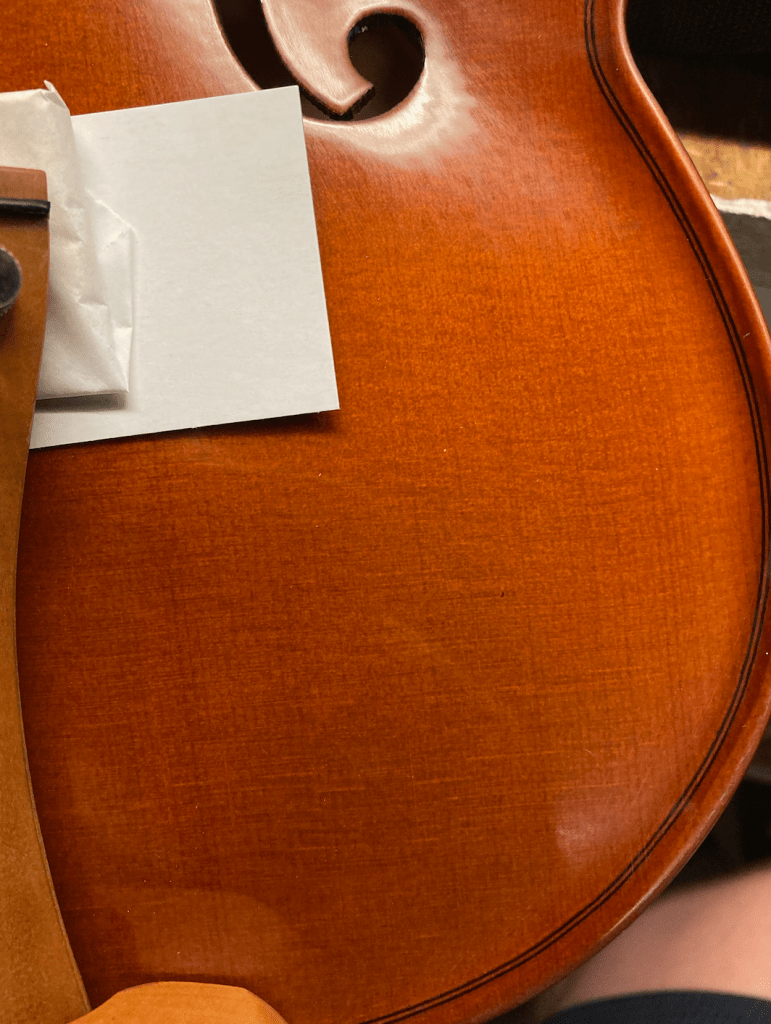
Guys, this is decent quality maple with real inlaid purfling. Was it plywood with a pretty veneer?
Tight grain spruce top- I looked in the f-hole expecting to see the white ply of death. Instead, I saw honest matching maple grain on the bottom plate- it is actual carved maple, not plywood as expected. The wood isn’t fancy, but it’s quality. WTF? I paid like sixty bucks for this thing on the Prime Day deal- a sub hundred dollar violin has NO business having this quality material.
The surprises kept coming.
Usually, a sub 150 instrument’s set up will be horrible. Abysmal nut spacing, a comical, horribly fitted bridge, wildly inaccurate sound post placement, and a terrible bass bar, not to mention the WORST STRINGS EVER. Most of this can be remedied- but you have to have specialized tools and a little know-how.
For most, this means a trip to the luthier, and who wants to spend over a hundred bucks to make an inferior sixty dollar fiddle useable? This is not something I’d recommend; you are usually better off spending the extra bucks for a decent instrument.
Darn it, this Witek, by fluke or design, is a very inexpensive instrument that confounded my expectations.
By a lot.
Now, I will say that it could use some help to make it much better. As a first step, it needs new strings. If you buy one of these and you are on a budget, just pick up some Red Labels. They ain’t awesome, but they are light years better than the horrible things the violin arrived with. Yes, the sound post is poorly positioned, and the bridge and nut could use some work for sure.
However…
I decided to tune it up with what it came from the factory with, and see how it worked out.
This violin is useable as is, which is a real surprise. The bridge, while no work of art, is pre-cut, serviceable, and for a factory fiddle, not a terrible fit. The nut is functional if too high, and they actually seemed to have used a string gauge when they cut the grooves. The pegs work and hold tune- I would suggest picking up some peg soap, too. It’ll make tuning a lot easier. The chief problem is the strings- they are terrible and make the violin sound brassy. Swap them, it’s not hard, and while you’re at it, soap the pegs.
The accessories, while pedestrian, work. The snazzy little tuner was my favorite. The rosin does what rosin does, and the bow tightens and plays. It does help to lightly grease the screw threads. Yes, the bow smells like an AK-47. Those are probably made on the next line over at the plant, so cut the thing some slack. The case is fine.
In short, with no specialized effort and maybe watching a youtube video or two, the Witek sub eighty dollar violin is a player. With just a little extra effort and new strings, it will probably be pretty nice!
This was astonishing to me.
Guys, it’s no prize winner, but I think I have found the perfect camping/vacation fiddle. Something you could keep in a tent or a hot car; something I would never do to one of my antiques.
For everyone else, this is the perfect starter fiddle.
Within a few days I plan to blow the Witek apart and work it over hardcore- starting with the terrible sound post placement. But I thought to give it an out of the box tune-up and play.
Long story short, you can buy one of these with confidence, along with a decent set of strings, and play it as-is out of the box for less than one-hundred. I actually plan on doing an Amazon review on this, something I usually don’t bother with on cheap violins.
I can’t speak for all Witek products, but this particular model has real potential.
For what it is, five-flippin’-stars!
I thought to edit this post, as it seems to have generated some attention from people out there.
True, you can find out what happened with the Witek violin if you look at my next post, but some may not see this, so I decided to attach a short blurb of what happened when I worked the nice little Witek over for its transformation into my vacation fiddle. See below.
In the image above, you can see what I did with the factory Witek. It needed some work, but it was worth it. I’ll tell you what I did.
First, I stripped the instrument naked. Everything came off, including the end pin. This was necessary for my improvements.
Then, I removed the awful factory paint on the fingerboard- what maniac covers honest wood with cheap black paint? First things first- be very careful when removing the paint from the fingerboard! A properly shaped violin fingerboard is not flat- it is slightly concave. This is to allow for resonance in the strings as the instrument is played. The standard concavity is .7mm– incredibly easy to ruin with careless sanding! So, if you choose to remove the crappy paint (I did), go very easy with fine sandpaper and don’t cut into the underlying wood. Keep checking with a quality steel straightedge as you sand to ensure that you don’t make the fingerboard flat. If you lay the edge of a steel ruler along the tip and the base of the fingerboard, you will see a fine gap in the space that you play. This is the concavity. Don’t ruin it.
Alright, once the awful black paint was gone, I gently rubbed a few fingertips of olive oil into the raw, unknown type hardwood. Never overdo this- the fingerboard should feel dry, and never get oil onto the surface of the violin body. It turned a wonderful chocolate color- what maniac conceals an otherwise honest wood just to get a faux ebony effect? I’m still looking for an answer here. A note: when exposing or re-working the nut and fingerboard on an inexpensive violin, it is not uncommon to encounter wood filler. This is a sure sign of really slipshod work. At the factory, someone said “good enough” and slapped putty on the nut/fingerboard interface, a critical area. I didn’t encounter this on the Witek I worked on.
After I was satisfied with the fingerboard, my attention turned to the nut. The factory cuts, while adequate, were too high and I didn’t love the spacing. So, I carefully reshaped the nut with a fine machinist’s file, then I recut the string grooves using a guage and a v-file. It’s difficult to describe how nerve-wracking this process can be. It must be precisely right, both the spacing and the groove depth. The G string should be the highest, at .4mm above the fingerboard surface, descending in height along the D and A to the ideal of .3mm for the E.
Do you have any idea of how thin .3mm is? It’s thinner than a hair. One stroke too many with the file and the E string will rest on the fingerboard when tuned. This is undesirable, and the nut will need to be replaced. The method I use to get this close is to continually check the groove depth with a scrap E string I keep around for just this operation. I cut, lay the E string in the groove tightly, and look hard to see if there is a gap. Adjust, keep going until I barely see a gap. Stop! It’s better to be a hair too high than to ruin the nut.
The nut on the Witek was made of the same Asian hardwood as the fingerboard- really handsome dark brown wood, and hard. Perfect, IMO, but I enjoy non-traditional woods on violins. Ebony, while handsome and the standard worldwide, can be a bit dull. I like rosewood, tamarind, and whatever the heck this hardwood is on the Witek. Sometimes maple is cool, too. But I digress.
After the fingerboard and nut were addressed, I moved to the soundpost. Who put the soundpost in this violin, I wondered. It’s not hard to get close; but the factory person at Witek didn’t even try. The crazy thing was nearly in the arch- totally wrong! I kicked the post out, recovered it with my special clamp tool, and took a look. The soundpost was made of OK material, not the best, but serviceable. And because it was too long, I was able to reuse it- the spot that it needed to go was tighter than the original, badly flawed, placement.
I do sound posts by first marking where the treble foot (the right foot) of the bridge is supposed to be. Be sure not to use a marking method that mars the finish. I use a tiny piece of quality masking tape. This makes it much easier to place the soundpost. Then, I use a tool that measures approximately how long the post should be at the correct placement location. I then shape the soundpost, paying attention to the fact that the soundpost grain should be perpendicular to the grain of the upper plate. I slightly bevel the upper and lower contact surfaces of the post with an exacto knife, then I firmly place the soundpost either into my fancy tool, or I jab the soundpost deeply with the hooked end of a machinist’s scribe.
Then, carefully, you maneuver the trimmed post into the right f-hole. Using the marked area of the treble foot of the bridge, place the soundpost in its desired location- slightly aft and outboard of the treble foot. No two luthiers will do this the same, but all will get it close to this exact spot. There’s a dark art here- move it around, change the tone. Some violins have a movable sound post because some players can do this with a length of string to change the sound of their instrument on the fly- those people are total badasses, and it’s a feature that you don’t see often. The vast majority of players leave the soundpost where it is, for good reason.
When you see that the soundpost is close, pull it outboard, gently, and it will lock in place. Do not yank! Then, look through the end pin hole to check that it is straight. I guarantee you that it won’t be, no matter how straight it looks through the f-hole. Use either the hooked end of a machinist’s scribe or a dedicated luthier’s soundpost tool to straighten the ends. If it feels stiff, stop. Kick the soundpost back out, trim, try again. A note: this is where it is childishly easy to trim too much from the post. Always keep a few soundpost blanks handy- for screwups. I’ve done more than a few sound posts, and I screw them up routinely.
On this day I was lucky and didn’t have to fight too much. The soundpost was in its right spot, and it was a perfect 90 degrees with both the upper and lower plates. It was ready to do its job- both to transmit sound into the instrument’s cavity, and provide structural support to the bridge as the strings are tightened.
Then, it was time to work the bridge, an honest but sloppily fitted maple unit. The profile was OK. I left it alone, although I did do some work on the bridge with a file and an exacto knife. The important part was fitting and shaping the feet.
Guys, this is easy to screw up. I use a dedicated bridge shaping tool for this step, a clamp with a wheel, although it takes trial and error to learn how to use it properly. All I’ll say about doing the bridge feet is that it’s desirable to get them thin, and that they make complete contact with the upper plate when the instrument is tuned. If they are sanded or shaved crooked, the bridge will not be a perfect 90 degrees with the upper plate when tuned. Not cool. A crooked bridge under pressure will pop out of place, and you risk damaging the bridge or upper plate of the instrument.
If fitted correctly, you don’t have this problem. Best to leave the factory bridge alone, with its noticeable tiny gaps. Of course, you can try to fit the bridge, but I’d recommend having a few spare bridges laying around. It’s easy to screw up, and very difficult to get right by hand, going from 200-400-600 paper. It can be done, but you’re asking for pain.
OK, the fitment issues were addressed on this violin. Then, it was time to restring it and tune.
Right off the bat, I soaped the pegs. This makes a world of difference, and I greased the fine adjusters with a tiny deb of high-quality bearing grease on the threads. If you can see the color of the grease (in my case, red), it’s too much!
Then I stringed the instrument with a used set of D’Addario Preludes. They’re OK, and I didn’t want to spend big bucks on this fiddle. While stringing, I paid constant attention to the bridge, which I prepped by neatly marking each string slot with pencil lead, along with the grooves on the nut. Why did I do this? It’s not cosmetic. The tiny bit of graphite lubricates the strings as they move, helping the bridge not to tip as you tune.
Let me emphasize this. The bridge must always be perfectly 90 degrees with the top plate of the violin, and the feet must be centered on the f-hole notches. You can move the bridge by grasping it firmly with your fingers on the feet and nudging it. Be careful! I mentioned before about the bridge popping- this is undesirable. Careful, gentle adjustments are the rule here.
Also, when you wind the new strings, take care to wind them properly. There is only one right method. The string must be wound so that it tightens when the peg is turned counter-clockwise, and the strings should be neat and tight against the walls of the box. You can help this process along using the aforementioned machinist’s scribe, the indespensible do-all tool. If your pegs are soaped and properly trimmed (which they almost always are with a factory-fresh instrument, even fifty-dollar ones), they shouldn’t pop, or lose tune. If they do, gentle inward pressure on the peg will solve the problem. Don’t go crazy here, it’s not necessary.
Finally, your strings are tuned, and your bridge is straight. Walk away. Come back a couple of hours later, and your instrument is badly out of tune. What happened? The strings stretched. This is normal. Retune, paying close attention to the bridge. Depending on the strings, this process can go on for days. With Red Labels or Preludes, it will settle pretty quick.
Now, the instrument is ready to play. Reinstall the chinrest.
Hey, we all need a break at times. So I took one these past few weeks. We traveled to the Upper Peninsula of Michigan and relaxed for a bit.
The UP is truly an underrated vacation destination in the US. Everything has a small town feel and there are no crowds to speak of. It’s a bit of a mystery to me because the beaches beat the hell out of the East Coast.
No idiots, empty sand beaches, crystal clear freshwater swimming in Lake Superior. Yeah, the water is a tad on the chilly side, but once you get used to it its great. We camped to save some money and just generally kicked back.
I was up early every day. I went down to the lake at the campsite and drank coffee as the sun came up. Pretty nice, especially when the rest of the US was gripped by hellish heat. Here’s a pic of one of the prettier places.
This is Trout Cove on Grand Island off the coast of Munising, Michigan. Yes, it was as amazing as it looked and we had the whole place to ourselves. There was a pontoon boat in the distance, but that was it.
Pretty awesome. But now we are back in the steamy south, although we don’t have it nearly as bad as those poor bastards in Arizona.
Which means its time to get to work.
I still plan on releasing the second book in the Storyteller series in September, and I am on track to kick out the debut novel in the alien invasion series before Christmas. This will be four releases this year, my highest production ever. Because hey, I found out that in order to make a little cabbage at publishing you need to publish. A lot. So, I’m doing just that.
For my peeps over on Patreon, expect a new chapter today.












 The Interstellar Valley