My Strange Passion, Cheap Amazon Violins.

Long-time readers will know that I have an odd hobby: I work on violins. I’ve done almost everything to them, except a sound post crack repair, which is very difficult. I’ve had old violins in many pieces on my bench; to date, I haven’t destroyed one. There is a dark art to repairing them, which I enjoy. I’d like to think that I’m improving with time. Perhaps.

An outgrowth of these repairs is a minor passion for selecting cheap instruments on Amazon and seeing what I can do to improve them. One model that I’m very familiar with is the Cecilio MV300; it’s cheap, and the fundamentals are solid. I’ve also tried others. Some were good, some were worthy only of donations to local schools. You can make many improvements to help an inexpensive violin, but some things are a no-go.

I’m referring to paint, as opposed to varnish. I’m also talking about plywood plates: those are terrible. In addition, false beautifications such as painted purfling (the wood inlay around the edge), false character added to the wood (think airbrushed tiger striping on the belly and ribs), and anything that detracts from the natural beauty of the honest wood.

I’d rather plain-Jane but honest spruce and maple. You must have a spruce top plate and a maple body. It’s not just aesthetic; it’s about the violin’s performance. There are good reasons why violin makers have used those woods since the late Middle Ages! I say this to establish that ALL cheap violins I buy on Amazon have these basic materials and construction. They also must have full-length bass bars with an OK profile. You can see them through the left F-hole. It’s a performance thing. You can’t compromise here.

I’m astonished that you can find violins for less than 100 USD with everything I require. In addition, these violins come with a case, a bow, usually a polishing cloth with rosin, and they throw in a cheap tuner, too.

But here’s a cautionary note: these violins are seldom ready to play.

What do I mean? They come with everything you need, right? They do. However, the fitting and strings are terrible in most cases; I’ve seen exceptions, but as a rule, this is a fact.

If you don’t want to mess around with the fitting, spend some money and get this model or this one. These violins are ready to play out of the box. These are made by the same company as the violin I’m reviewing today, but they’re MUCH HIGHER GRADE. I know- I own one of each, and they are easily equal in quality to 1800 dollar violins that I’ve purchased from a well-known US-based violin specialty store. These are Cadillac, traditionally manufactured instruments! The catch is that they come all the way from China, and you may wait a while to receive one. However, it’s worth it, I assure you. While you must be judicious, Yinfente is a legit manufacturer, and their products, while not well known, can be great if you shop carefully.

But I’m not talking about those violins today. I’m talking about the “Yinfente 4/4 Acoustic Violin Kit,” which, after checking the well-known online violin retailer, I suspect is the exact same model as one of their low-end fiddles. Of course, the well-known retailer’s offering has a nicer case and is probably warmed over by their in-house luthier. Still, upon close examination, I believe it is the same base instrument for three hundred dollars more.

But I digress.

I had experience with Yinfente and came away impressed, so I decided to try their lowest grade offering for 100 USD. As is frequently the case with cheap Amazon fiddles, you get it all. A bow, a tuner, a case, rosin, etc. How can you go wrong? Well, you can if you order from the wrong company or the wrong model—many terrible instruments are available at this price point. Caveat Emptor, and all of that. But the models I’ve linked to above are OK with varying degrees of elbow grease. The Cecilio lots, the high-end Yinfentes almost none. How would this low-end Yinfente be, I wondered? I ordered it, and it came in faster than I expected—one must have been hanging around in a Stateside warehouse. This is not always the case; I’ve waited up to five weeks.

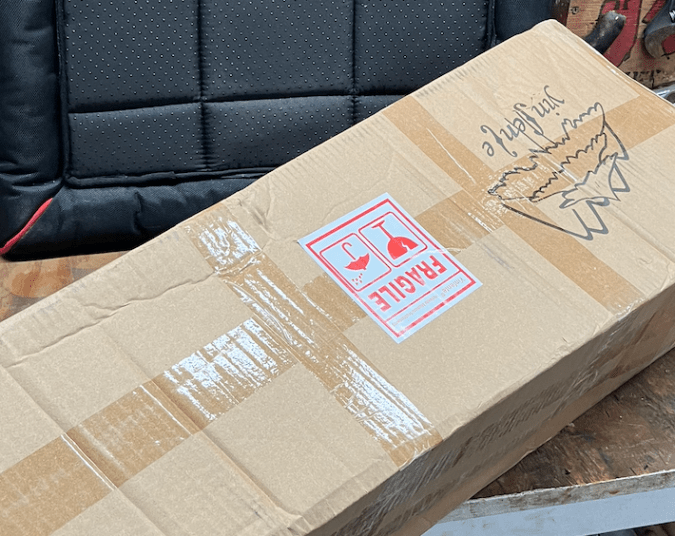
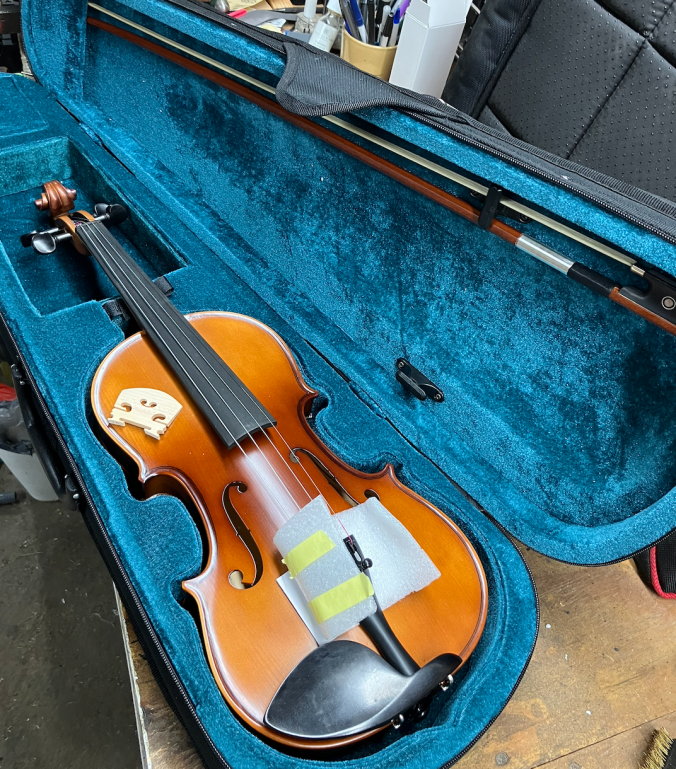
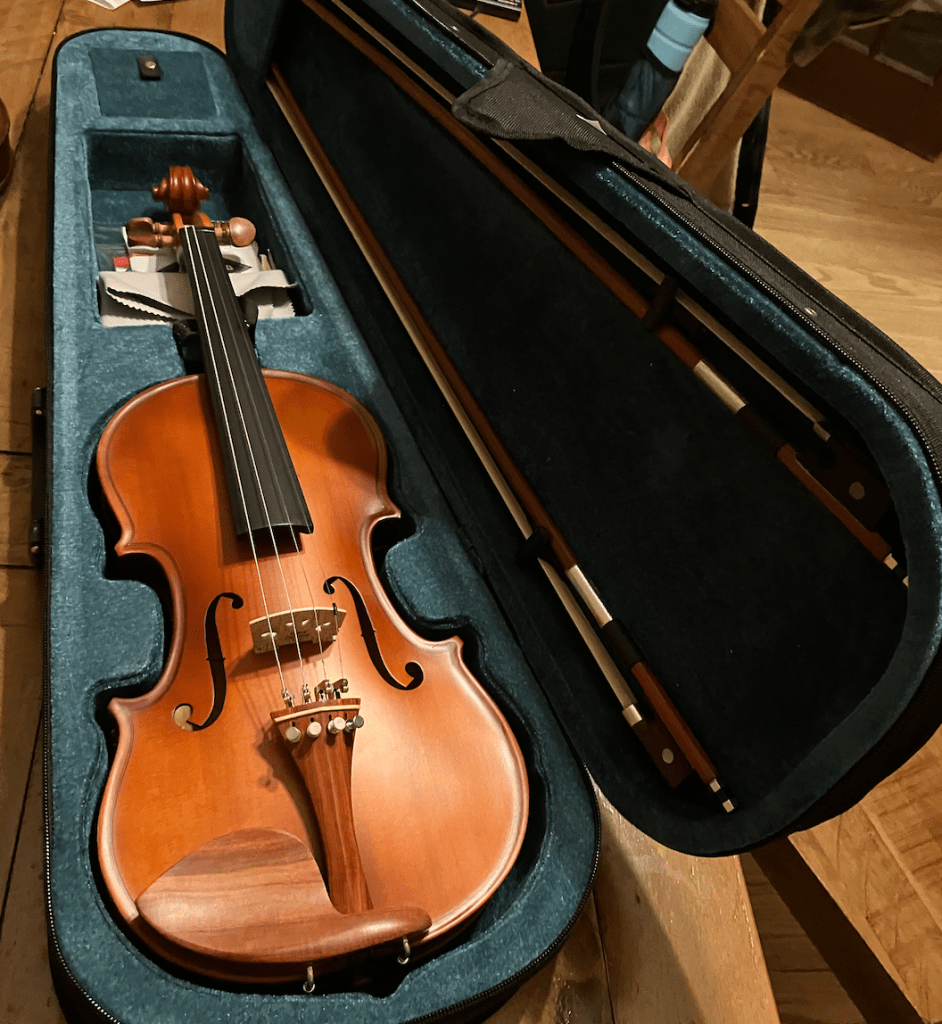
The big box arrived. This is always a moment with a tingle of excitement for me. What will I get? I busted open the box and opened the case. Here’s what I saw.

At first glance, it was a pedestrian instrument. I noted its genuine ebony furniture; violins at this price point usually have painted wood. The top was spruce. Before I flipped it over to check the belly, I looked at the bow, which was surprisingly nice. Actually, I shouldn’t have been surprised; just about all of the bows I’ve received from this manufacturer have been good. At this price point, you usually receive what I lovingly call AK-47 bows; they can charitably be called serviceable. Yes, the fiddle came with rosin, a tuner, extra strings, etc. They said it was a complete setup, it was. I didn’t like the bridge however, and I noticed the grooves on the nut would have to be deepened. However, the pattern was good, so that was a plus. It was time to flip it over and look at the belly.

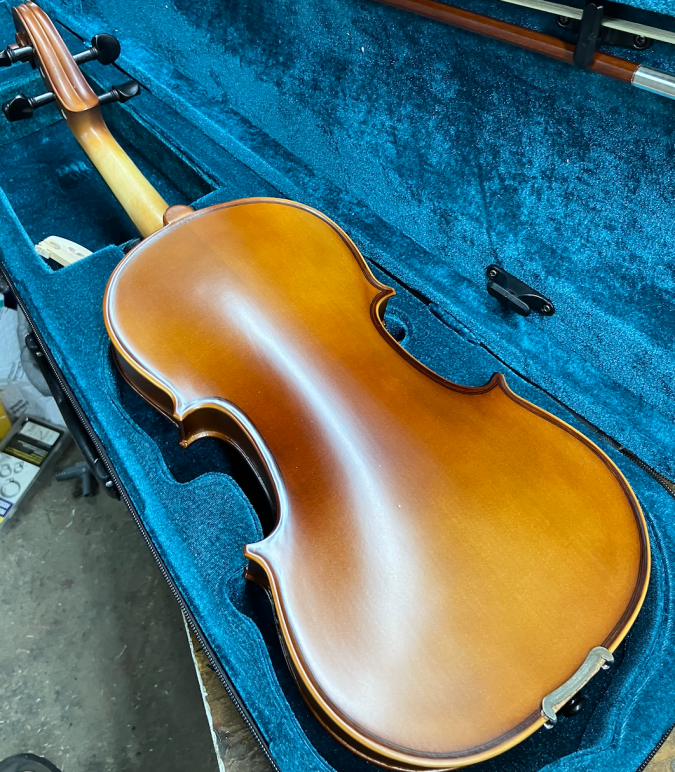
I have to say I was disappointed; I’d hoped for at least a little figure or flaming. Sometimes even the cheap Cecilios have that; this one just looked ugly and brown. However, it was maple, and that is what matters. While I was at it, I checked the position of the sound post and was annoyed again. The stupid thing was in the arch; it was badly misplaced. This, of course, meant more work for me. A sound post must be placed just aft of the treble side of the bridge foot, preferably a bit toward the F-hole. This one was waaaaaay off! I shook my head, put away the case, and started the process. I knew what I needed to do.

And by the way, the strings were the standard Chinese factory junk. Chinese strings can be good—higher grades exist. These were not. I’ve learned the hard way to dump them in the trash immediately. I’m not sure why they even bother- it’s like playing on a cattle fence, and I’m hardly an elitist.

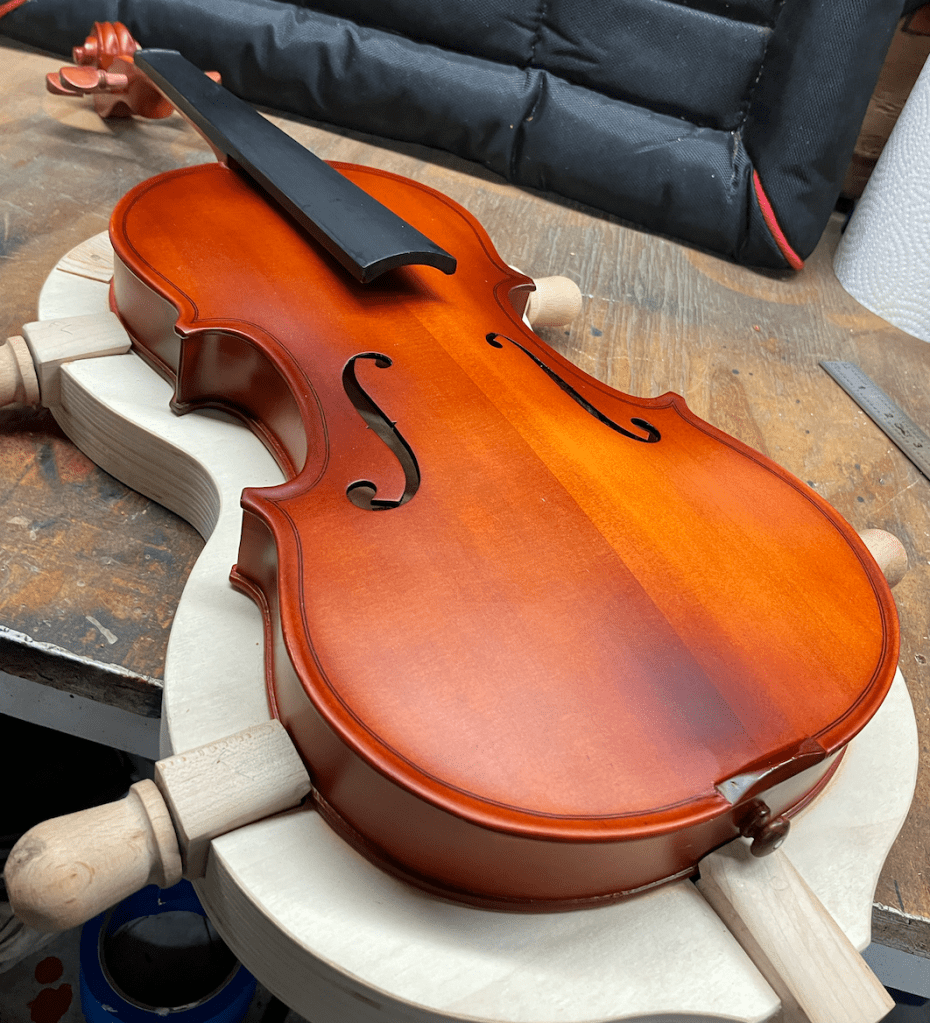
It was time to get out The Clamp- the indispensable tool for violin maintenance. Observe.

I stripped the fiddle down; you must remove the chinrest to put it into the clamp. Also, if you’re doing a bridge, you must remove the strings and tailpiece. Note, I removed the end pin as well; you have to if you reposition the sound post (GRRRR). You need to look through the end pin hole to see if you’ve set it straight, which is easier said than done. What should have been an easy job was complicated by carelessness; the sound post dude must have been in a rush to go on tea break or something. The piece of tape on the top plate is a visual aid I use; it indicates where the sound post SHOULD go, which was not how it arrived. Obviously.

I did the part I hate worst first, the sound post. See below.

These are the required tools. The weird cloverleaf thing moves the post around once it’s jammed in. It’s a friction fit. The clamp thing is the sound post retriever. You need it when you remove the post by knocking it over, and you need it some more when you inevitably mess up. The machinist’s scribe jams into the post; you need to stick it into the post when you install it. And all of this needs to be done through the treble side F hole. Does it sound like a pain? It is. And then, when you think it’s great, you look through the end pin hole and see…that it’s crooked AF and you need to adjust it, again.

Sometimes, it’s easy. Sometimes, it’s not. But I got it done.

It was time to move to the bridge. I selected a bridge from my handy stack of bridges, which I scored for fifty cents a piece. I fished through and found one with good wood grain (the long grains must go toward the player), then I gave it the bounce test to see how it sounded. This sounds stupid, but it’s not. You want dense wood in a bridge. Dense wood has a different sound from lighter, looser grain.

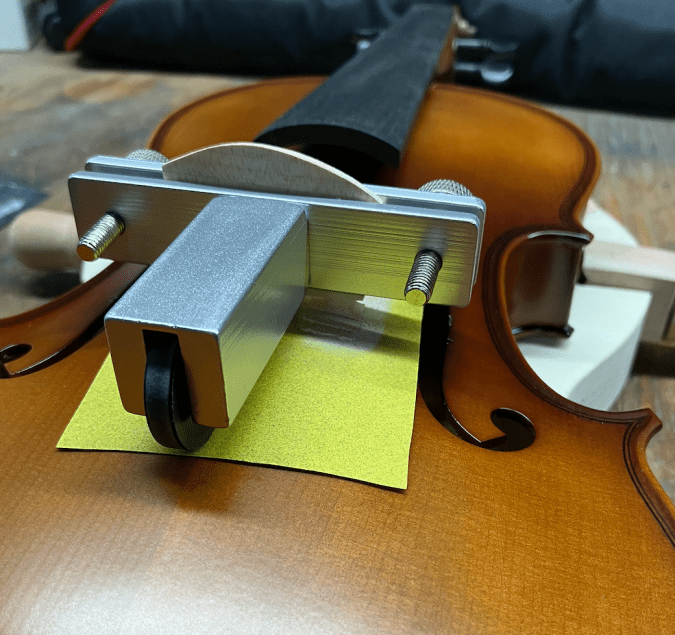
Bridges are an art form; I’m still unsatisfied with my bridges, but I’m improving. First, you must fit the bridge to the top plate. I use yet another special tool for this, which requires practice.

Ideally, the feet of the bridge should be about one millimeter thick and perfectly formed to the lid. You do that by clamping the bridge in this tool and then you move it back and forth upon a piece of 220 sandpaper until it’s close. Then, you switch to 600, and finish it off with 1000. Note: when done, the bridge must be at a ninety degree angle to the top plate, or you’re going to have trouble when you tune. In this case, all was well, and I moved on to carving and profiling.

Carving can be intricate; the point is both beauty and mass. The less mass, the better the resonance. I could go into detail, but I won’t. Suffice it to say that you have to work on the “ankles” of the bridge, and enlarge both the “hearts” and the “kidneys” of the bridge, and then make a few cuts with a razor knife. And of course, you must not weaken the bridge. Practice makes perfect, I guess.

I could point out a few less-than-perfect spots on this bridge, but I won’t bother. This is after I strung the instrument; it’s good enough, I suppose. Next time, it will be better, but it has improved much over what I received.

I did a bunch of other stuff, too. I wasn’t a fan of the rough texture of the fingerboard, so I sanded it lightly with 600 grit. Lightly! Fingerboards have a “hollow” of .7mm, you do not want to screw that up. A flat fingerboard isn’t good, it’s a resonance issue. After smoothing out the tooling marks, I added a very light coat of olive oil to the fingerboard only—so light, that it is dry to the touch. Then, I carefully deepened the string grooves for playablity, and penciled the grooves for lubrication.

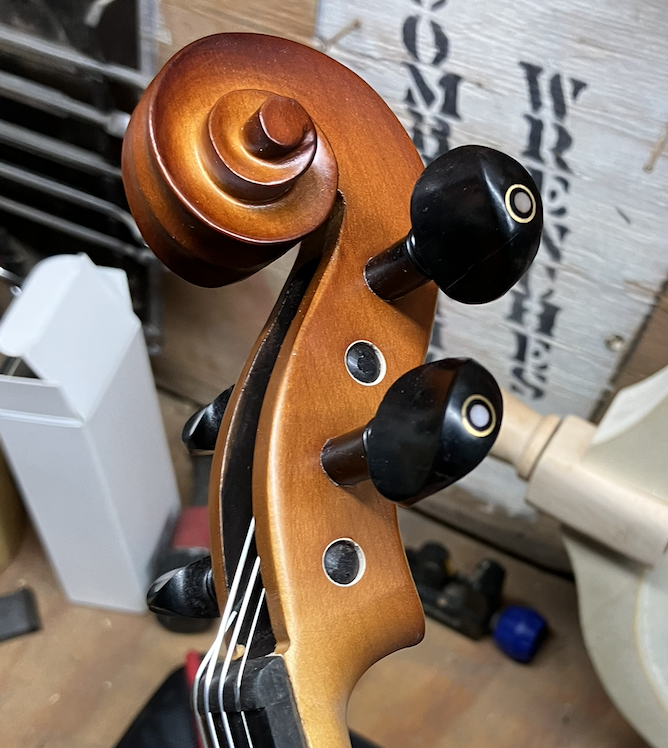
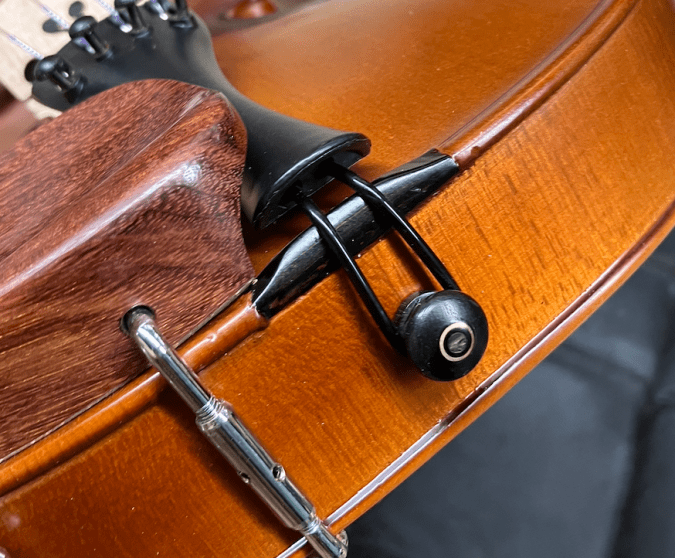
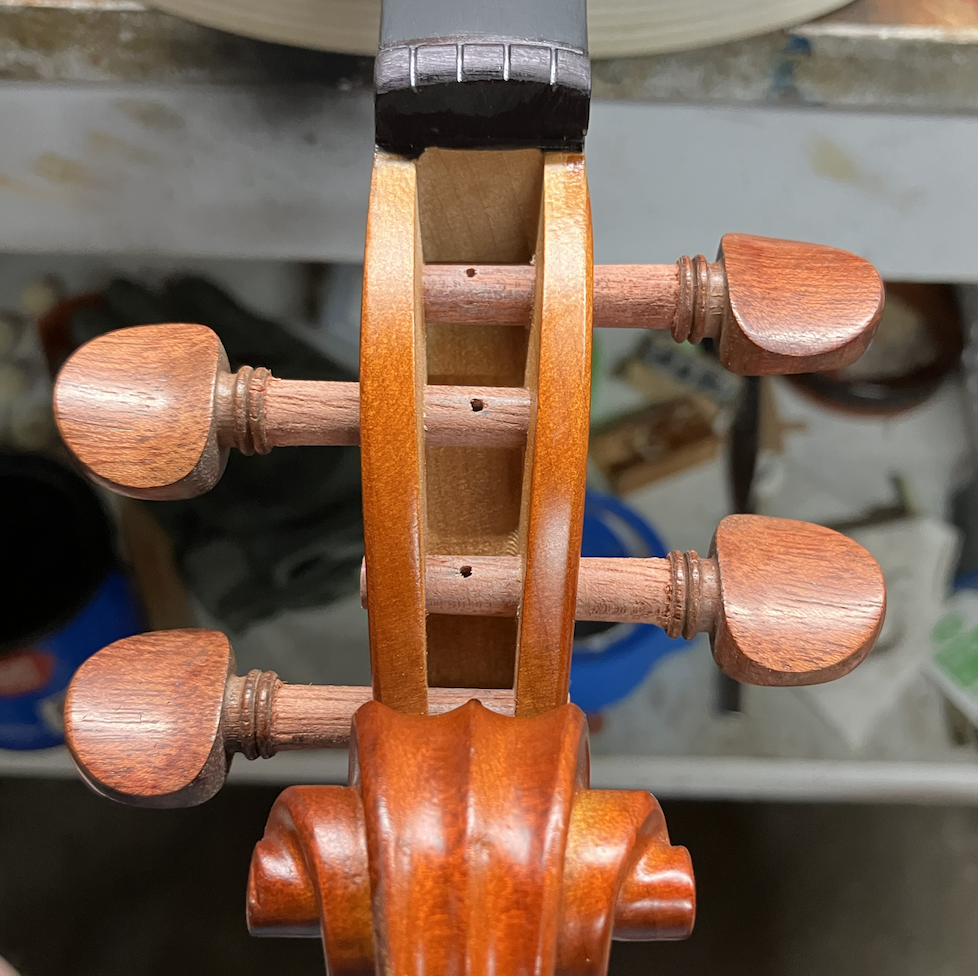
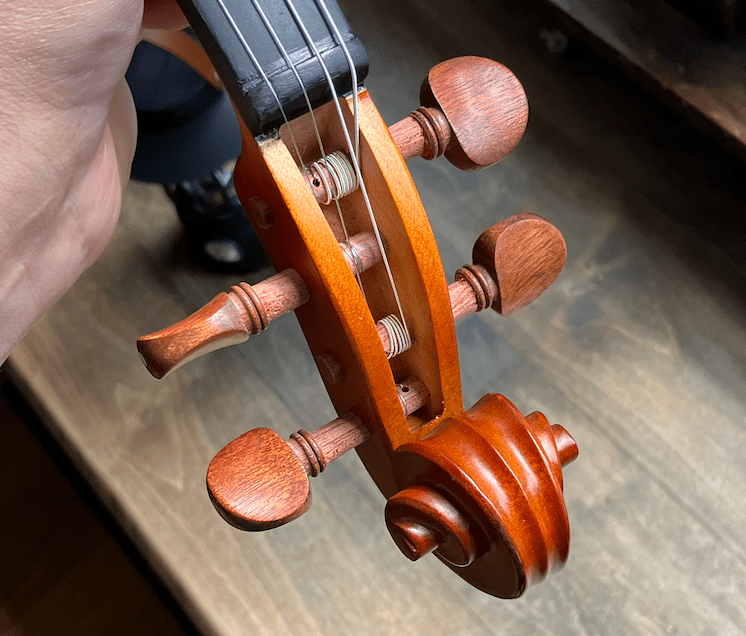
The tailpiece was fine. It was a plastic student piece. If it were one of the cast aluminum ones, you’d be better off throwing it away; they are junk and will break every time. The saddle and endpin were good, too. I was impressed by the work on the peg box—the good-quality pegs were well-fitted, which is rarely the case at this price point. All I did was to add some peg soap and they were ready to string. Observe.

This is pretty nice for a hundred-dollar fiddle box! I also liked the end pin. I made an aesthetic choice to replace the perfectly good ebony chinrest with a rosewood unit. I think this adds a splash of color, and you may agree. See below.

I chose Fiddlerman strings because they’re what I have at the moment. These are good strings. While I wouldn’t go with expensive strings on this instrument (like Dominants), you can’t go wrong with a string upgrade here. Don’t spend more than about thirty bucks, however. Pirastros or Ascentes would be great too.

After prepping the tailpiece screws with a very light coat of bearing grease, I strung the instrument, taking care not to pop the new bridge (as you tighten the strings, the bridge will begin to lean forward). As usual, I took it easy and let the strings stretch as I went. After a few hours, it held tune and was ready for pics and a little play.

Of course, when the instrument was naked, I polished it with Supertonic, my personal fav.

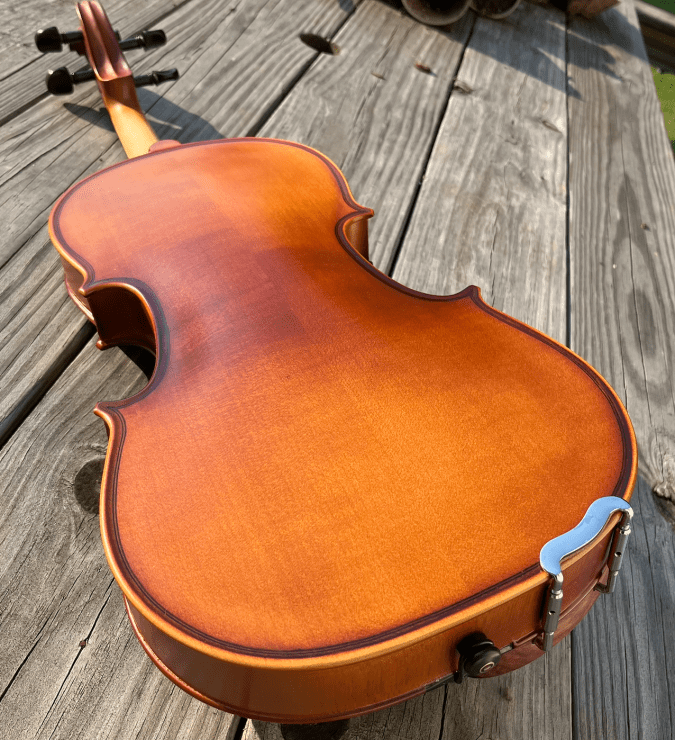
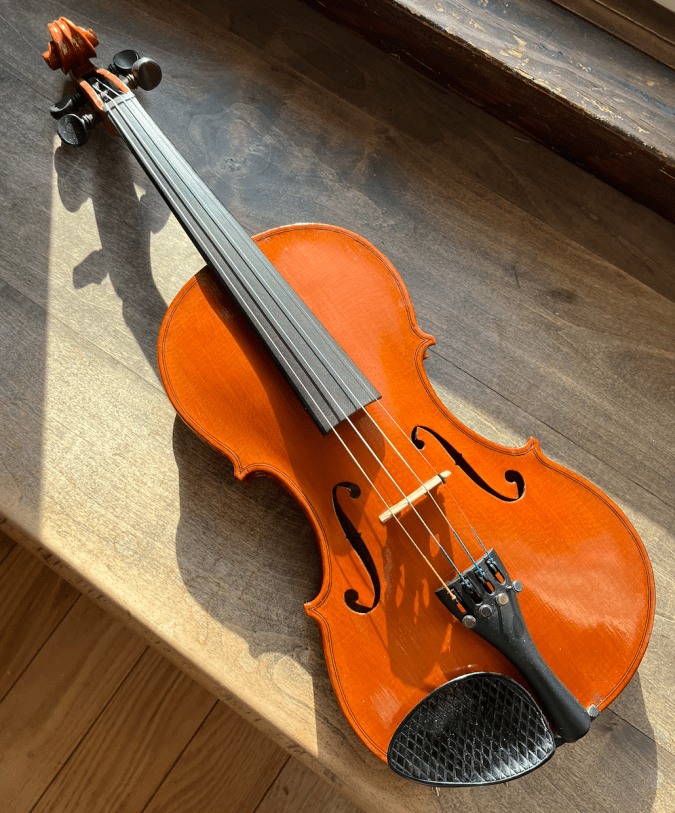
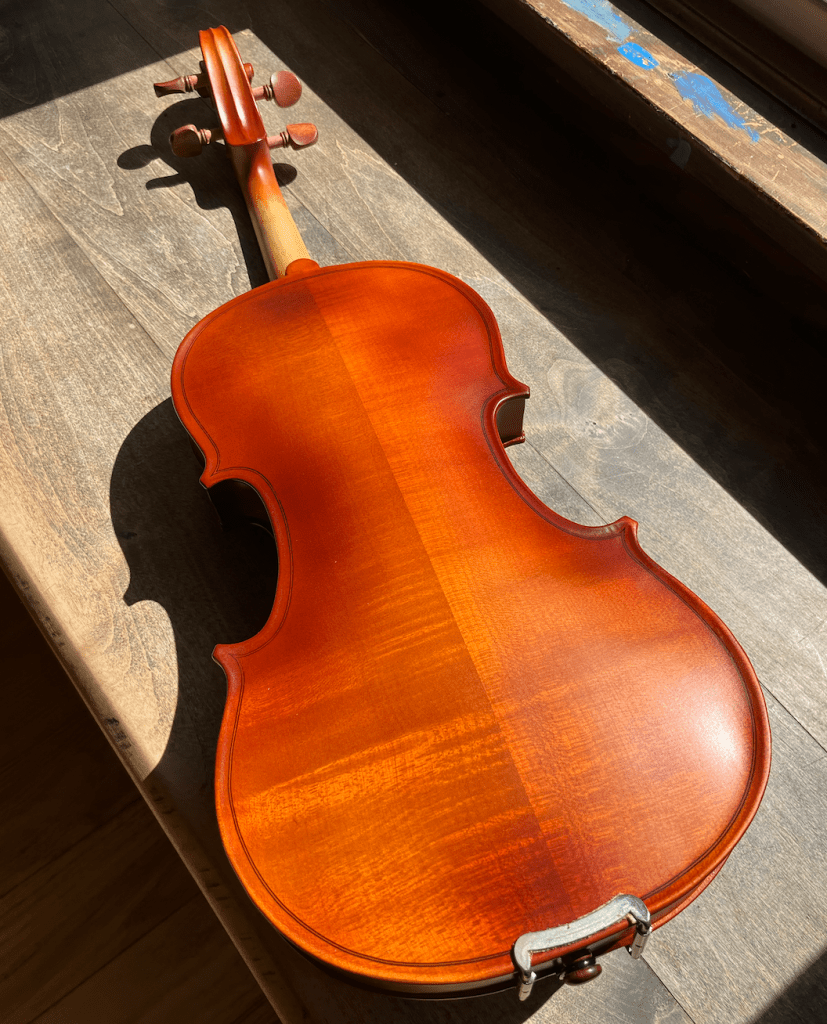
This fiddle surprised me a bit; I think it dressed up fairly well. See the belly in sunlight, polished.

Huh. There is some faint figure to the wood. Amazing what different lighting and polish will do!

But the looks aren’t what makes a fiddle; it’s how it plays.

This fiddle plays pretty well; I took it for a stroll this morning. In addition, because of my few mods, it handles and feels good, too. Playability is important! A fiddle that doesn’t feel right doesn’t play well, either. A bunch of little stuff adds up, trust me.

Here is the final product, a decent little hundred-dollar fiddle.

Not bad, I say. And it was fun!

Peace.

The Longbow

I’ve had a thing for traditional weapons for a long time. I think it was an outgrowth of my old trade. I wanted to understand the tools of the past, to handle them, to know how they feel, to appreciate their pluses and minuses. Of course, this has helped me with my books, and it has helped me “feel” the books of others.

Honestly, I blame this on SM Stirling. I found his book “Dies the Fire” in a free deployed GI library; it was great. Reading it, it dawned on me that I knew nothing of the fighting styles and tools of the premodern era. So, upon my return to the States, I looked into it and bought a few things.

One of the items was a genuine English longbow made of yew, which is the style used at battles such as Crécy and Poitiers. I learned to tie a bowyer’s knot, and I taught myself the art. Well, a little. A real archer makes me look sick, but I’m probably better than 99 percent of those living, who have never put string to cheek. I guess that makes me weird, but I had fun doing it.

Recently, some friends have talked about teaching kids to shoot the bow and arrow, so I decided to look on Amazon and see if I could find a decent unit for cheap.

Don’t buy “cheap.” Buy inexpensive. There is a difference.

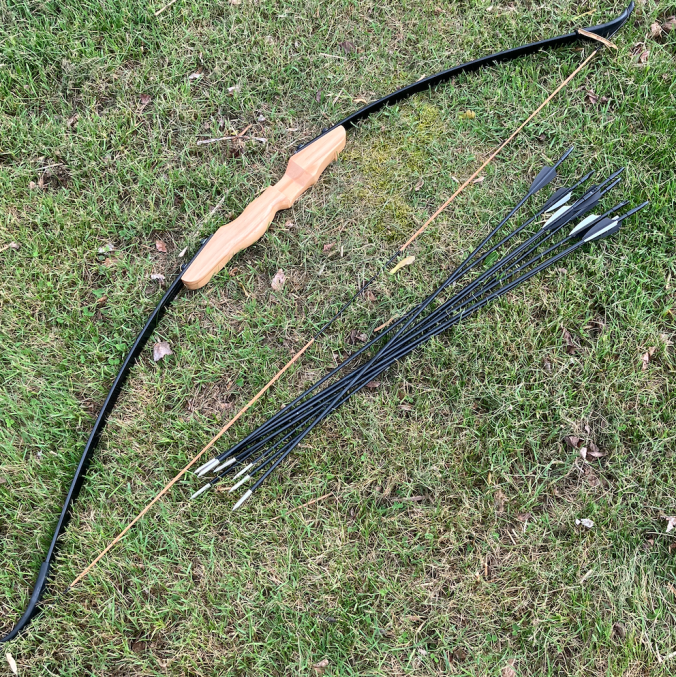
Well. Today, the bow arrived; I unboxed it and assembled it. I picked it for its simplicity, and I thought it was attractive and simple. I don’t like complex things. Complex things break. This bow, an underpowered version of what they used at Crécy, is a traditional longbow, materials excepted. I say underpowered because it has about a forty-fifty-pound draw weight, and proper warbows were over eighty. However, I guarantee you I can take a deer with today’s arrival, and under no circumstances would I want to be on its receiving end.

It is a weapon, and nothing but. It is not a toy.

It consists of two steel staves and a very comfortable central grip. The staves are bolted to the grip. Then, you mount the string using your legs and a quick flip of the string loop. Once you know how to do it, getting the string in place is easy. The string that came with this unit is a bit odd. I’ve never seen anything like it. It is many strands of thin nylon rope with a thick casing over the place where you nock the arrow. Also, the loops are coated, which certainly helps you when mounting the string. It’s an unconventional arrangement, but it works.

As an aside, I have a very old aluminium sporting longbow. I think it was my dad’s. It’s been mounted for many years with a chunk of 550 cord, and it works just fine. Today’s bowstring reminded me strongly of parachute cord—it should last forever.

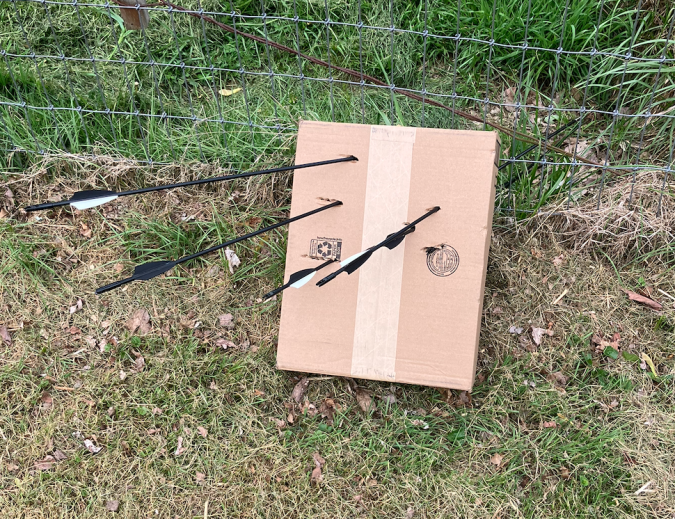
It was time to test the rig out. I took a cardboard box into the back yard, walked ten yards away (it’s been a while since I tried my hand at archery), put on my brace (you don’t want string burn on your forearm), and nocked an arrow.

I tested the draw; it felt smooth. I eased off the string and brought it to bear in one motion. As always, I concentrated on the business end of the arrow, held over, and loosed. Too high, but not bad for the first time in a decade. Plus, the bow shot flatter than I thought. I tried again.

Whap! I nailed the box off-center and started to enjoy myself. Observe.

Not exactly superb marksmanship, and my draw was erratic, but I got the job done. I moved back to twenty, and did it again with decent results. Minute-of-man, we called it in the trade. I was confident in the bow, and I liked it a lot.

Here in the States, it’s a bit of a race against the clock to pick one up like this because it’s made in China. But for my readers outside of tariff-land, you have all the time in the world.

Try it, it’s a good product and a potentially useful skill to pick up.

I have no regrets.

In other news, this was probably the first truly enjoyable thing I’ve done in a long while. There’s a lot going on with this guy, and I’ll try to do better on this page going forward.

It’s a Hard Thing

It’s a hard thing, it turns out, to get started again on a project you abandoned for good reason. Both ISOLATED and MAGIC are kicking my butt, but in different ways. A technique I’ve honed, for lack of a better word, over the years is to think about what I’m trying to do and then walk away and do something else.

This is why I keep a player sitting on my dining room table.

This month, it’s Joe, the violin you see above. Joe is a unique violin, one of a few crafted by an old pipefitter who made violins in his workshop for fun. He was a friend of a violinmaker I know over in PA. Mr. Joe Knight of Clarion, Pennsylvania, has since passed on.

I never met Mr. Knight, but I would have liked to have. I imagine his scarred old hands, battered by years in the mill, very carefully building the fiddle above, number 37 of a lifetime total of about fifty. BTW, it’s a great player. It easily matches my mediocre ability; I feel privileged to have had a chance to buy this wonderful instrument. It is made of local choice hardwoods, selected by Joe the Pipefitter.

It is a testament to a life after your chosen trade.

In his case, wrestling with monster machines deep in the guts of a steel mill. In my case, soldiering.

He built violins. I write. I do wonder if he had days when he threw up his hands and said, “This sucks.” I’d imagine so. Then, like me and others who feel as if they’re shouting into a hole dug in the forest, he returned the next day, picked up his tools, and began anew.

This is kind of where I’m at: Never quit, never surrender. This extends to all myriad hobbies and interests; keep chipping away because one day, you’ll succeed. The rock is there. It isn’t going away.

It might not be immediately obvious. Actually, it probably won’t be. Few things in life worth having fall into the category of “immediate gratification.” Whether that be my eternal struggle with those darn violins, building stuff for projects, or my prose.

Never quit, never surrender.

It’s a useful mantra for difficult things and situations—which, readers, I am in the midst of. As I sit here typing and enjoying my morning brew, I have a thousand things to do. All of them are somewhat important; each one screams for my attention. It’s a question of triage: which comes first? Some will be hard due to physical limitations, and others will be tough due to mental hangups.

But that’s OK. Nothing in life worth having is easy.

But you can’t always grind. Hence, Joe the Fiddle on my dining room table. I write or think, then pick him up and play for a minute or two. Sometimes it sounds good; other times, it sucks. Everything eventually frustrates: I take things in small doses. Then, I walk away and do something else.

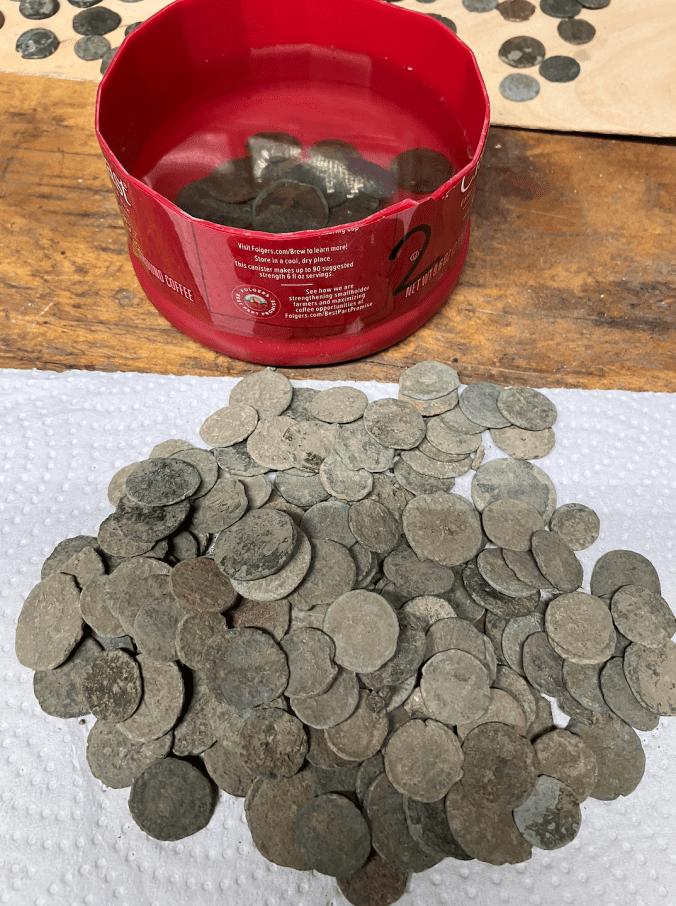
Lately, my reward after a somewhat successful day has been to clean and decipher Roman coins, which I have purchased cut rate. I would also like to thank Doc Wetsman again for this most interesting diversion.

Observe.

Admittedly, they look like hell, but under the crust are some real gems. It’s a revelation for me to see the face of a long-dead Emporer emerge from the sludge; it’s addictive and mesmerizing. Of course, I can only mess with them for a bit; like so many things, I start to stiffen up after a few minutes, and then I need to do something else.

This is the price of a little combat years and years ago.

Amazing how a few moments of your life can color the rest of your days, for better or ill. Shrugs. It is, what it is.

The rock and the hill are there; they are not going away. You will get new content as soon as I get my stuff together and produce. The next chapter of whichever project represents a boulder. Sisyphus’s real problem wasn’t getting the rock over the crest. No. It was that as soon as one boulder tipped over the hill, a new one would appear. That’s my version.

But it’s OK. Oddly enough, collecting boulders is kind of fun. Is the glass half empty, or full?

It’s your call.

—J

The Best Turkey I Ever Had

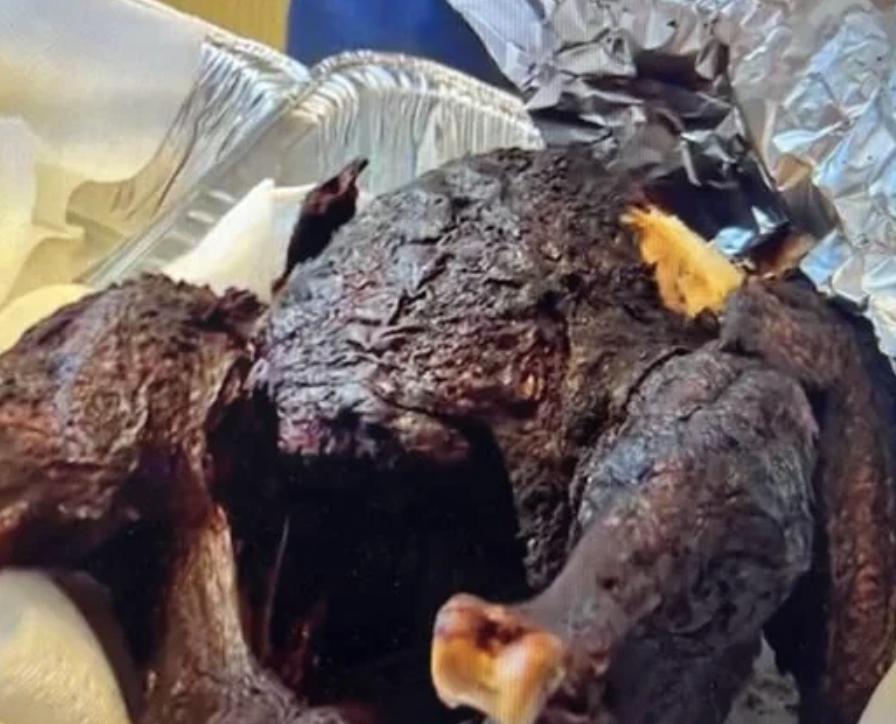
No, this isn’t the same turkey. But it strongly resembles it.

You know how to spot a bullshit story, right? It starts like this—”Well, there I was…”

This Thanksgiving Day tale begins like that. Except that it really happened, Thanksgiving Day, 2011, Camp Kilaguy, Baghlan Province, Afghanistan.

Some background. I think I’d just been promoted, and I was hurting. Most of the team was. Hacking, smoking too much, deadened. It’d been busy for a while, and we just came off a major, stupid thing out in some dive. Duststorms, cold weather, gray skies. A bright spot was that the new victims showed up, replacements from the States. We began the “right-seat ride” process, or orienting the FNGs to the area of operations.

I didn’t expect much, that Thanksgiving. But a crusty-ass NCO rode to the rescue. Sort of.

This guy, I’ll call him Toad, was a leather-faced thief and the author of a thousand tall tales. He was a veteran of the First Gulf, Iraq, and Afghanistan. Maybe other shit, I don’t know. But he had been around. Typical Air-borne 82nd dude, he was fond of mocking guys with a standard airborne badge, “Five-jump chump motherfucker. Cherry,” as he flicked his cigarette.

Toad was a gifted scrounger, which is the polite Army way of saying “thief.” On one occasion, I witnessed a spectacular act. Me and the Colonel were out on a thing, not sure how long. When we returned, we noticed a group of Joes or whoever cavorting in a hidden corner of the motor pool. What the hell was this, we wondered. The Colonel and me, still dusty and gross from the road and the field, wandered over.

There was a fucking swimming pool in the motor pool.

Army motor pools are not intended for literal pools, and to this day I have no idea where the pool came from. The Colonel said nothing, but I watched as his lips formed that dangerous grim line. We walked away, no comment made, and I went to clean my weapons like usual. The Colonel sought our Team Sergeant, the redoubtable Mike.

The pool disappeared like magic. No trace remained. I guess it was fun while it lasted, though.

That Thanksgiving, I didn’t care about anything other than going home, preferably not in a box. But Toad, the crafty, long-service NCO, had a plan to improve our day.

You see, Toad, while at times the epitome of a “leadership challenge,” could back up his bullshit, mostly. No one was better at taking care of soldiers, and he always took the mission seriously, even if nothing else—especially not petty things like Army regulations or the origin of stuff we needed, or just wanted.

Toad knew what we needed that day, and he delivered.

He appeared with a turkey, origin unknown. He had a plan to cook it using scarce, dubious and unsafe resources. You see, in Afghanistan, wood is precious. This is why for day-to-day cooking, people generally used dried sheep shit patties; this was why roadside kebab always had a tang. His plan was to use trash and ammo dunnage for cooking—the stuff that keeps munitions from rubbing together or being exposed to hard shocks; not exactly Kingsford charcoal, but it’s what Toad could get.

Toad executed. I’m not sure what I did that day, but I wasn’t involved with the dubious turkey prep. When not in the field, I had administrative duties or leadership BS. It was nonstop. A good guess would be briefings, training, or written order generation. Maybe weapons or vehicle maintenance, I don’t know anymore. However, at sunset, all of us came together in the supply shack (probably being used these days by the Taliban as a goat shed or something) to eat Toad’s spread; a well-done turkey with a chemical trash-fire tang, and T rat or purloined fixin’s, prepared as well as possible.

It was crowded, I remember. All twelve of us, maybe some replacements, I dunno, and definitely our adopted Air Force guys, the JTACs, or forward air controllers. Those guys! Nicknamed Fucks and Butter, they had gone full Colonel Kurtz and had bushy beards. However, they were real pros in the field, and had delivered for us. They belonged, and we awarded them the Army Combat Action Badge.

Even though one time I pee’d on Butter’s head. But that’s another story.

It was the best Thanksgiving turkey ever. Even though it tasted of burned toys, it was great.

A couple of weeks later, I boarded my freedom bird, never to see the Box again.

Happy Thanksgiving, readers. For all of this, I am grateful.

-Jason

Fun In Writing

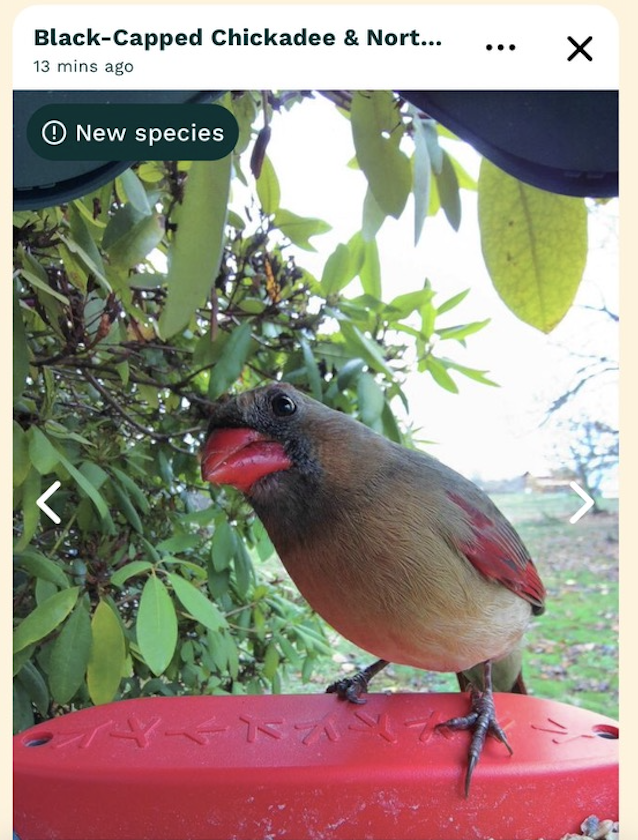
This image is apropos of exactly nothing except a source of great amusement around here, the wonderful BirdBuddy, which sends us pictures and videos of the denizens of our bird feeder. All we have to do is to supply bird feed and sunlight, and we get a series of pretty darn funny pics.

No. Today, I’d like to talk about a new writing direction I’m thinking about, and for which I busted out a short on a grey and gloomy day.

You guys know I’ve struggled lately; it’s been a real pain. But it’s OK; that’s life. I’ve taken some steps to alleviate my funk—this has helped. Yesterday, while imagining my extracurricular project, I suddenly wanted to write. The weather outside of my window seat was ghastly. It looked like a winter sunset at 1400—gray and sodden. Not the thing to lighten up one’s mood, but we went for a long walk, anyway. Movement and exercise are important. 

Upon return, I mulled over a potential future project. I had an idea. Lately, I’ve been thinking about the Roman Empire. This is partially due to Doc Wetsman’s books and “Pax,” an excellent non-fiction by Holland. In addition, thanks to my distant bud, I’ve been mulling over possibilities in fantasy and alt-history. 

I started “Pax” because I needed a little help with antiquity. This has never been a strong part of my knowledge base. I’m OK with the broad strokes of history, but I tend to focus on certain eras. Therefore, some reading was a must. I don’t adore the Roman era or think it was some ideal part of history. Actually, the times we’re living in are MUCH better than the era around the birth of Christ. 

Even deep within the “civilized” world at the time, a party of soldiers or bandits raiding a homestead for plunder and rapine was routine enough to be utterly unnoteworthy. Anybody could be enslaved for the slightest reason. Slaves and criminals were crucified. Crowds screamed in pleasure at the sight of hundreds meeting gristly ends, along with any wild animal that could be found. Entire regions were put to the sword, and no one batted an eye.

This was Rome and the Pax Romana. The “Peace of Rome” was frequently the peace of the grave, and those who idealize it are fools. 

However, it’s fascinating. Also, I guess the Roman Empire was better than squatting in some miserable mud hut and selecting an unpopular villager for the annual sacrifice to the sun. This happened every year around what we know as Christmas (The Church was GREAT about stealing ancient holy-days; see Ostara, otherwise known as Easter. Her symbol, the fertility goddess, was the rabbit.)

Like it or not, we still see the modern world through our ancestor’s eyes. Those muddy villagers who kept pigs in their huts? Yeah, that was us. The centurion who shrugged and put the slave on a cross? Both the crucifer and the crucified, us, too. The person who crouched and knapped flint by the treacherous Great Lake? Us. The courtesan in the Eternal City? Us. The long, sun-blackened, and endless pursuer of game, who could run a gazelle into exhaustion, us as well, somewhere back there. 

These are our archetypes. They inform us today, whether we like it or not. I think this is what draws people to fantasy. Times in our deep past, when the fae were real, and owls carried the spirits of the dead. We want to touch those dark and endless forests as we recline on our nice warm couches. We want to shiver in the cold, while wrapped in fell dread. We wish to chant with our cousins (who were also our mates) while passing the horn filled with holy-day mead as the Chosen roasts on the pyre. A part of us wishes to cry havoc and unleash the dogs of war. 

Unfortunately, we still have those desires in a time when war could easily mean our extinction. This creates real problems. 

We are, for the most part, divorced from the reality of mortal, daily danger. This is why this sort of fiction is so popular. It’s an escape to a time when our ancestors scoured the woods in search of anything edible, but they wouldn’t touch a fairy ring of delicious mushrooms; for the revenge of the fae would be dreadful. 

Better to starve.

With this in mind, I created a writing sample yesterday. It was a joy to write, but I won’t publish it here. It lets too many cats from the bag; but it was great fun, my first foray into fantasy, that most popular of genres. It’s just below romance—laughs, count me out, there. Not that I don’t enjoy a good love story, I do. It’s just that I cede the field to those with more talent. See Outlander and Bridgerton, and their respective, juicy successes. 

When our current reality descends into madness, bleakness, and actual horror, it’s incumbent upon those of us in the “creative class” to provide escape. Yesterday, I provided my own.

Cheers,

J   

Jeff’s Fiddle

This weekend, I attended my tribe’s powwow in Mendota, Minnesota. I discussed this at length on my paywall site. If you’re not signed in over there, maybe you want to check it out. The barrier to entry is low. But I digress.

During the activities, our tribal secretary suggested that I check out one of our vendors, a tribal member named Jeff Bardon. I did so. He runs a business called River Valley Trading Company, and he sells unique Native-related art and products. I bought some cool stuff from him, and during the course of arranging shipping, we talked a little. Somehow we got on the subject of violins, and he mentioned that he had a frustrating experience with his, a standard Amazon Cecilio MV-300 model.

Long-time readers know that I am very familiar with this exact model. In my older posts, you can find my review of those violins. The MV-300 forms the basis for the economy fiddles I sell at flea markets. The bodies are solid products, but their fitting is terrible. Bad bodies can’t be fixed, but fitting can.

I always have a few MV-300s sitting around here awaiting prep for sale. We made an agreement. He’d send me his to trade for one that I prepped. When his arrives, I’ll prep it for sale. Meanwhile, I whipped one of mine together, finished it yesterday, and shipped it. I thought I would tell my violin-interested readers about this process, it turned out pretty good.

First, I gave him the pick of the litter: a body with decent wood character on the belly. It is by no means super fancy, but for an economy fiddle it’s nice! See below.

It was stripped, of course. I usually don’t reuse factory furniture; I save that stuff for donations or super-inexpensive repairs. Here’s what the start of the process looked like.

Ok, so this isn’t the very beginning. In this pic, I’ve already installed the new pegs and end pin. But minus those parts, this is how I start. The violin clamp simplifies all the maintenance you need to do on a fiddle. It holds it steady and level as you work on it.

The pegs determined the look I wanted for this violin. I happened to receive a shipment of mahogany pegs while I was in Minnesota, so I thought I’d try them out on his violin. They were good pegs, and certainly an upgrade over factory. I’ll show you the work on the box below.

The factory nut was an abortion, as usual, so I shaped it and cut new grooves for proper spacing and string depth. I also penciled the grooves for lubrication. I shaved, fitted, trimmed, and drilled the pegs as well. These should last for years of normal use. Once the boxwork was done, I headed south, as usual.

I selected a good bridge and carved it. After I carved it, I fitted it to the plate. This is one of the most important steps of this process! A poorly fitted, low-quality bridge will adversely affect the instrument’s sound. Mind, a bridge DOES NOT have to be name-brand, but if you buy megapacks of generic bridges (I do for economy builds), you must carefully select the good ones. In this case, I thought I’d be fancy and give Jeff a nice Teller bridge.

Of course, while creating the bridge, I looked at the location of his sound post. To my surprise, the factory did OK, so I left the sound post alone. With the bridge completed, the next logical step was stringing the fiddle. It was time to make two decisions, one aesthetic and one practical.

I installed mahogany pegs, so I was inclined to use earth-tone furniture instead of traditional black. Of course, the fingerboard was painted black, but without getting into the weeds there wasn’t much I could do about that. The fingerboard was 100% serviceable, but I could help the violin in other ways. At first glance, I thought to use an economy brown furniture set I’ve used on other projects, but the more I looked at this fiddle, the more I realized that that wasn’t the best choice. I rummaged through my parts drawer, and I had the good luck to find a nice red boxwood set that complemented the pegs. I held it up to the fiddle, and I liked it.

Then, I needed to decide which strings to use. Jeff is a budding fiddler, so high-end strings wouldn’t be a good choice. I immediately thought of Red Labels, my go-to strings for students. Also, these Cecilios like Tonicas, too. However, I had another idea for this violin. Low-cost, old-school strings called Black Diamonds have a bit of a cult following with the bluegrass crowd, and I just happened to have a set lying around. I decided to use those.

Decisions made, it was time to string the instrument. See below.

This was turning out pretty good, I thought. After winding the strings, I started to tension them per SOP, slowly but surely, while watching the bridge. As expected, the Black Diamonds were “hard” without much stretch. It was time to play Jeff’s fiddle. First a few detail pics, though.

The end pin detail, with the tailpiece and chinrest I picked. I also added some fine adjusters, good Wittners, because this is a fiddle, not a concert violin. Of course, I prepped the adjusters with a tad of bearing grease, and prepped Jeff’s bows, too.

This is the box, wound and ready.

I think the red theme really suits this violin. While this is, and will remain, a student violin, it’s important that the player likes how it looks. I ran the new look across Jeff via text, and he seemed pleased. This was good enough for me. It was time to play, the moment of truth. How did it sound?

While hardly high end in terms of resonance and tone, it was journeyman good. Perfect, I think, for a student! The Black Diamonds, while inexpensive, helped with that old-time sound, and they BEAT THE CRAP out of factory strings! ALWAYS pitch those in the trash, I’m not sure why they include them, honestly. They’re terrible!

While I enjoyed working on it, it was time to re-home Jeff’s fiddle. With a final check to make sure I included everything he needs to play, I cased it and prepared it to ship. Here was my final view of Jeff’s fiddle.

I boxed it and went to the post office.

Hopefully, this will get Jeff on the road to becoming a fiddler. It’s a solid learning platform. The MV-300, once properly tweaked, is a great place to start.

Launch Day

Hey, everyone.

Today is a long-awaited event for my partner, the esteemed JB, and me. It is the day Javan War, our Cruel Stars origin novel for Lucinda Hardy, went “wide.” This is a first for me, I’m usually Kindle exclusive for some very good reasons, being a small-scale author.

However, John doesn’t have those encumbrances, so this launch is simultaneously wide or available across most platforms. Pretty cool, really.

As you may know, we’ve been working on this since 2017. Things happened, and there were delays. C’est la vie, but now it’s here. JB’s concept of a non-linear structure turned out great, but much was left on the cutting floor.

However, fear not. My paywall peeps get the cutting-floor stuff, as the book was originally written. I wanted to delay the release of this material until after the launch—well, it’s been launched!

Sooooo…more follows, soon. Plus, more ISOLATED stuff.

You can find this herehere, or anywhere—really. Even the Apple ecosystem. Just look on your iBooks app. This is the power of the Gold Hovercraft, which I was privileged to ride briefly.

Cheers,

J

Latest Novel, “Light’s End.”

Morning, all, from the pleasant late-spring weather of the Upper Ohio Valley.

2024 is shaping into an interesting year in regard to my writing adventures. First, I busted out the bridge novel in my STORYTELLER trilogy, The Storyteller’s World. Now, I’ve put the wraps on Book One of the End series—“Light’s End.” This is my take on the alien invasion trope. Because it is my take, there are no glamorous fighter pilots or a chiseled-chin President who save us.

No, none of that. My book focuses on regular people caught up in an unimaginable calamity, described in my style. It’s a mess. See below for the back-cover copy.

“An alien horde, subjects of the Queen, arrive in the Solar System without warning and launch a devastating attack on Earth, killing billions. Amid the apocalypse, a diverse group of survivors from around the globe struggles to navigate this new, hostile world. John, a father desperate to reunite with his daughter, teams up with unlikely allies. Others fight for power, seek revenge, or simply strive to survive.

In this chaotic landscape, trust is scarce and danger lurks at every turn. Meanwhile, the aliens, led by their Chief Decider, pursue a mysterious, holy mission on Earth, indifferent to human suffering. As humanity faces annihilation, the survivors must find a way to endure and perhaps, defeat and kill their extraterrestrial invaders.

Will they find safety, seek revenge, or succumb to the Queen’s deadly decree?”

The book is my longest novel to date, with about 113k words at the end-state. I think it took six months to write, and I am curious, as always, as to the reader reception.

It is available worldwide right now in two formats, ebook and audio. The paperback is done and approved, but it’s not available now. However, it should be soon for those among you who must hold dead trees (EDIT: Paperback available like ten minutes after I wrote this post).

This is just the beginning of this year. Another book, a co-authored deal that should be released next month, is waiting in the wings. This is the culmination of a seven-year effort, a book based on John Birmingham’s Cruel Stars series. I did some tinkering on this while in Australia, a very productive working trip where I capped off “Light’s End” and filled in the blanks on said co-authored novel. In addition, I came up with a premise for another alt-history series. I mean to begin in earnest on that immediately.

I have to start on that right away because I need to feed content to my crew over on my Patreon paywall page. By the way, this page is loaded with content. For three bucks a month, there’s a lot to be had. But I digress.

For now, suffice it to say that my latest has been quietly launched, and if you dig my writing, you can pick it up worldwide on the Beast.

In many ways 2024 looks to be ruinous writ large, but in terms of writing, it looks good. A paradox, I know. But at least I’ll keep you entertained while Rome burns.

Cheers,

J

The Fugue

The scene above is from Gran Torino with Clint Eastwood. Appropriate.

Hey, Everybody. You’ve noticed I’ve been a bit quiet here as of late. There are many reasons for this, chief among which is that I’m on a writing frenzy in my new alien-invasion book, “Light’s End.” It is my longest novel ever, and I must have the manuscript done by the 15th of April. Therefore, writing, and a lot of it.

I’ve decided to give a sample of what I’m up to today. A passage from this work.

An elderly man, whose wife was taken from him for no reason.

Observe.

Scrubland in Wyoming, USA.

Ralph placed a hand on his grandson’s shoulder. He spoke in a murmur.

“Stop firing, Cody. We want these shits to get in close.”

Cody looked over at him. The youth recoiled at the sight of his grandpa’s blood-streaked face.

“What the fuck…”

Ralph grinned like a gargoyle. 

“We’re not running. These men are ours.”

“There’s too many!”

Ralph chuckled. “No, there’s just enough. Stick with me, son.” He paused. “Move quiet and watch my back.”

Ralph ghosted behind a pine. He sensed Cody’s presence. Would the boy do? It didn’t matter. He shrugged and called upon the ancestors in this fight. He felt alive in a way he hadn’t felt in many years. Since Hue City, in his misspent youth, when he was with the Puking Chickens. He remembered how Sharon pulled him out of his alcoholic madness. How the elders, old warriors and people of the North, brought him back with their counsel. 

Ralph remembered it all. Today, the ancestors were close. He felt them in the walnut of his Garand, in the distant caws of crows. These men were his. They approached, and he could hear their footsteps. Why they shot at a family gathering berries, why they robbed him of his great love, he did not know.

He did not care.

He waited behind the pine tree, and he opened up his senses. Just like the old days, when he carried a gun for Uncle Sam. Or when he stalked the forests of his youth, .22 rifle in hand. It was all the same. He felt his heartbeat and the padding of his pursuers. They drew near. He waited some more, and then he acted. 

Pivoting on his right foot, he stood square along the trail. The lead dirtbag jumped and yelled. He fired into the dirt. The cowboy fired at the same moment Ralph did, except Ralph didn’t miss. His shot hit the man’s breadbasket, and the powerful .30 ball round overpenetrated and hit the next two men behind him. They dropped and writhed, howled, and gurgled. Ralph’s second shot struck the next man, and the others dived for cover, as he expected.

Ralph let out a high, keening wail and ran to the right, sliding through the brush at full speed as only a woodsman could do. The cowboys recovered and fired blindly into the mixed scrub and forest; their bullets fell behind him. Speed, he knew, would keep him alive. He made a wide loop and headed back left. As he expected, he appeared on the asshole’s flank. 

A man crouched, his eyes fixed on where he had been seconds before.

He saw Ralph too late. His face froze in horror as Ralph barreled into him, buttstock swinging out in a vicious jab. The solid, steel-shod antique walnut connected with his jaw, and his face exploded in ruin. Ralph ignored the fallen man, and he pivoted to the right along the trail. A cowboy fired at him and missed. 

Ralph didn’t. He heard a string of gunshots behind him, and he hoped that Cody had read his mind and was catching the other attackers from behind. If not, Ralph was dead. He didn’t care. At the very least, he had bought time for his women and kids. At best…

A cowboy shot at him, turned, and ran; a few of his friends made for the waiting horses. 

Ralph smiled and dropped into a textbook, kneeling supported rest. He trusted that Cody had dealt with the lead element of the cowboys. He knew they were broken. He carefully sighted on the farthest cowboy, who was almost to the horses. Ralph breathed out, concentrated on the tip of his front sight, and squeezed. 

The man toppled and plowed the dirt with his body. 

The other two tried to look, to scatter. However, they had the bad luck to be on open ground. Ralph picked them off one after the other. The powerful Garand blew chunks from his final target. He heard a few gunshots behind him, and he turned. 

Cody, his chest heaving, jogged toward him. 

“I think one got away, maybe more!”

Ralph nodded. He heard the wounded’s moans. 

“They moving fast?”

“Yeah!”

“Then we’ll track them.” He paused. “Should be easy. They’re making speed, not stealth.” He racked his bolt back and caught his second-to-last round as it ejected from the chamber. He hit the clip ejector, and the tin clip popped up with the last round inside. Ralph put the loose ammo into his pocket and then grabbed a fresh clip of eight. He loaded his rifle. The bolt slammed home with a snap. It was ready. He spoke.

“Nice work, by the way, Code.”

His grandson was pale and sweaty. He panted. Ralph talked some more.

“Job’s not done, though. We’ll make sure these wounded fucks stay put. Make sure they don’t have any guns or knives handy for when we get back.”

“Why not just kill them?”

Ralph smiled, and he felt the dried blood on his face crack and flake.

“Nah. I want them to stew while we take care of their friends.”

Cody just looked at him, his mouth open.

Ralph laughed.

***

Don’t mess with the wiry old guy, I’d say. But when you read the book, you’ll see he had good reason. This is the type of stuff I’m working on. It should turn out OK.

-JL