Rough November

Well, I just spent the last three weeks laying around sick as a dog. For the past three or four days I’ve been recovering, but it’s been a pretty slow process. No, I don’t know what I had other than to say I’ve never had a malady like this. Never. And I’ve also never been sidelined for longer than a week; I ran a fever for nearly two weeks.

This was crazy man stuff. But I’m not going to waste any more breath on it other than to say that it was bad.

Today I actually got out of the house and walked in the crisp fall air; I spent the morning cleaning up the sick room. Washed everything, swept, etc. There’s no way I was going to have another family member do that for me. On the off chance that there are some lingering germs, viruses, etc., this was a job that I needed to do myself.

So I did it.

Now everything is either tossing in the dryer on high heat, or it is freezing outside on the line.

It’s a logical morning to sit and take stock of things.

On the writing front there is nothing new at the moment; as many of you know some of my work has gone into John Birmingham’s World War 3.1 project over on his patreon.com page.

The disease pretty much sucked all of the creative oxygen out of the room; I haven’t done much.

Another distraction has been the US election. This is not a political page; I won’t go on about this at length. Suffice to say that after much turmoil the system appears to have worked as intended and the President is obliged to make room for his successor.

I’ve watched the whole spectacle from my fever-bed; my phone did a yeoman’s work keeping me entertained in between bouts of staring at the wall or sleeping.

So yeah, it’s good to finally be able to sit up and type without feeling the need to go lay down for a few minutes… which always seemed to turn into hours or half a day.

Feeling better just in time for Thanksgiving. I got sick shortly after the election; probably got infected on the weekend before we all went to vote.

Speaking of Thanksgiving, we are keeping it simple this year. But then again we’ve done so since the death of my Grandma, she was the glue that held the family together. But this year there will also be no visiting friends or close family- it’s inadvisable.

This will be a nuclear family only type of gig this year. Just the four of us. I wimped out and ordered a complete traditional meal from a local grocery chain; it might not be gourmet cooking (or Grandma’s!) but it’ll probably do.

All that good American ethnic food. Turkey and stuffing. Gravy. Cranberry. The works for 69 bucks!

For that type of money, why should we kill ourselves?

Maybe it ain’t the best Thanksgiving ever, but you know what? I don’t care.

Let me tick off what I’m happy for.

Solid family. Good friends. Roof over my head. A full belly. Reliable cars.

The list goes on. You know what? When I started compiling this list, I realized that I’m a pretty lucky guy surrounded by pretty lucky people. Yeah, it’s super easy this year to be pissed off at everything, but why be that way?

If you are reading this, you are already a step ahead of the game.

The other day I had a tele-meeting with my TBI (Traumatic Brain Injury) group up at the VA, and we were talking some stuff over. All of us are combat veterans. Someone brought up how the villagers in Afghanistan would perceive Corona.

It didn’t take long for us to come to the conclusion that the pandemic probably doesn’t mean much to them. When you are worried that the Taliban will come to take your sons in the night, or that your daughters will be kidnapped by the neighboring village boys while doing their farm work, a little disease doesn’t mean a whole lot. When you can lose a child in an instant to cruel and capricious violence, not much else holds the power to frighten.

The conversation was helpful; although I was still weak and sweaty it made me think of the basics.

Life. Liberty. Cleanliness. Reliable food supply.

So yeah, Happy Thanksgiving, indeed.

May we be thankful and not pissed off, this rough November is nearly gone.

Good.

Mr. Birmingham poses a question…

Here I go, off onto another wild goose chase occasioned by a simple question posed on another website, John Birmingham’s cheeseburger gothic.substack.com.

He was doing a mini-review of a Netflix series called “The Liberator.”

Here was his question:

He was “exploring why men would fight for a country that wouldn’t extend them the basic courtesies, let alone the same legal rights as their white officers and squad mates.”

It occurred to me that I might have some extra insight into this question, having grown up somewhat mixed, and definitely military.

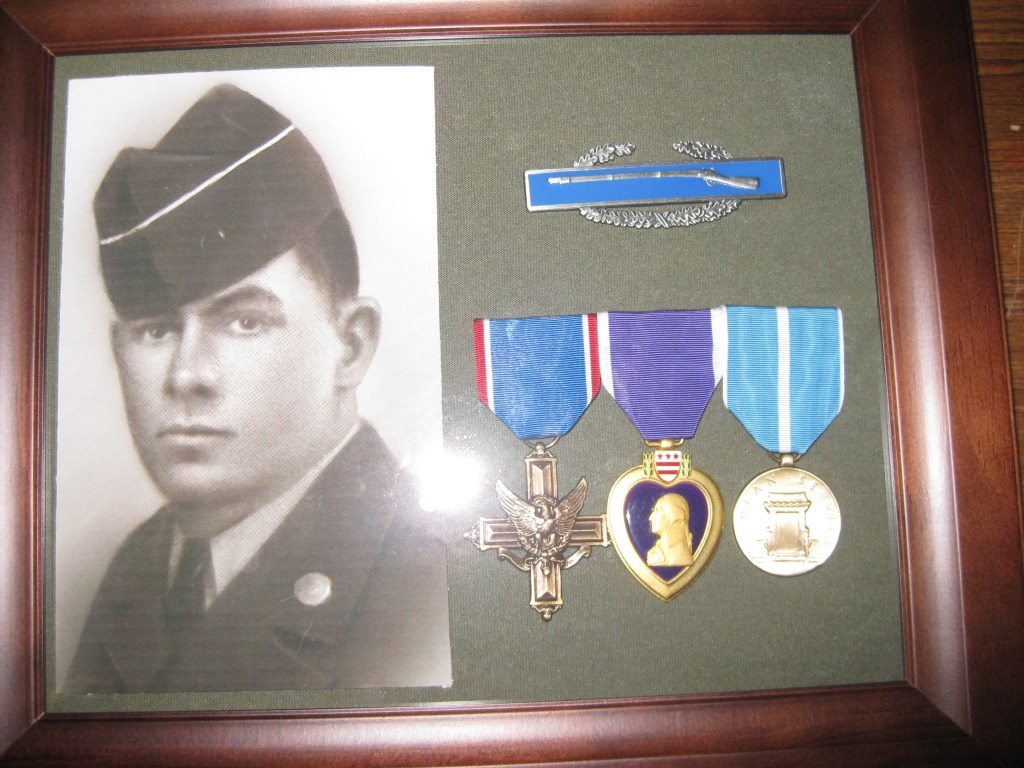
The photo above is all that remains of my uncle Dick, who was killed in Korea a few weeks before his eighteenth birthday.

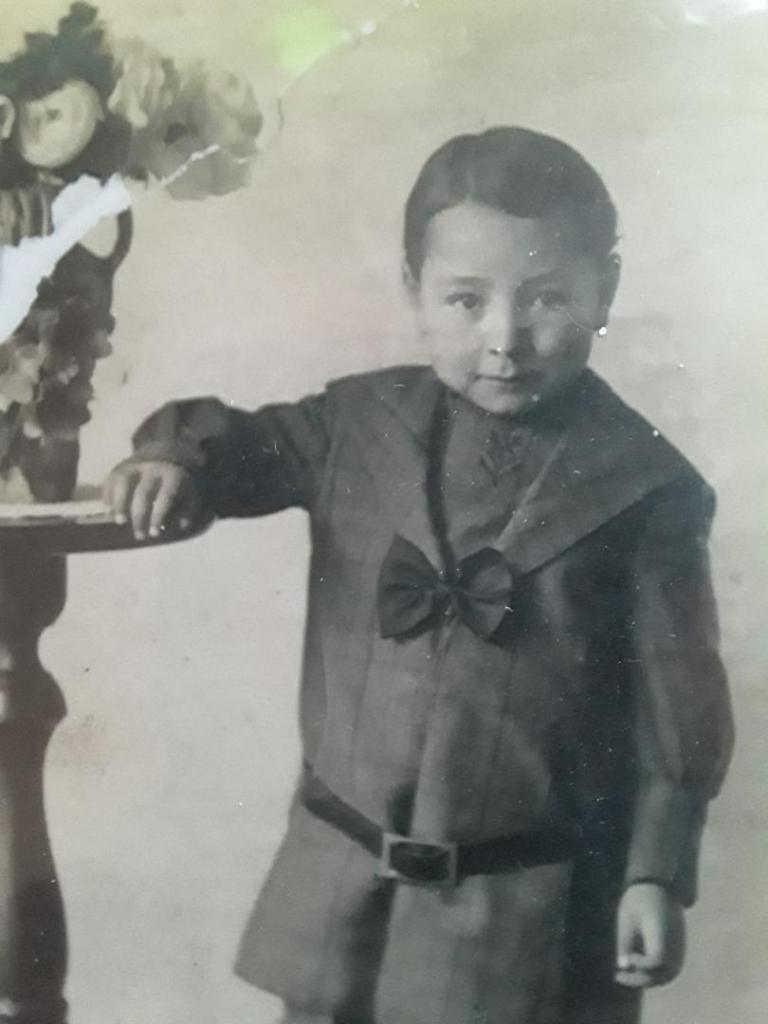
The woman below was his Grandma.

She was born on a reservation in the 1870’s in Minnesota, shortly after the greatest one-day execution in US history, when 38 men from her tribe were hung for rebellion.

Surely she heard something about this growing up. How could you not? You would think that she would never have a single thing to do with the US Army or government; but this was not so.

At the tail-end of the Indian Wars, along came a blue-coated soldier. The details are vague, but he and Great-Grandma got along fairly well and when he finally got out of the Army they had a son.

The Indian Census of 1910 was coming, and Oatszela, Matilda, didn’t want her son to be officially marked down as a “native.”

So they moved. Back to Ohio where her ex-soldier man came from, to a place where no-one would recognize them.

Of course, you can tell all of the stories you want, but there are some things you just can’t hide. Such as an imperfectly white shade of skin. “Matilda” could squawk all she wanted to about being “French,” but did anyone believe her?

No. Her kids tried the same game, but it didn’t matter. My Grandpa got in trouble with the law (his first offense? He stabbed a fellow with a pitchfork while attempting to steal raccoon skins.) and stayed that way for a while. Eventually he ended up in a Wild West show as a horse handler.

Up until the Second World War, it would be fair to say that my Grandpa had a pretty tough time- yeah, it would be easy to blame all of it bigots and jerks but part of it was some pretty poor decision making on his part, too.

But the Army didn’t care that he was a jail-bird. Not during the war. He and his brother answered the call. His brother Russell was an infantry NCO and a hard-bitten man; his war ended at the doorstep to Japan. Luzon, 1945.

My Grandpa? He started as a private and finished that way. The A-bomb saved him from Operation Downfall, 1945.

What I’d like to point out is that both men were willing despite their backgrounds. Neither cared about the decidedly unfavorable aspects that the US Army had played in their ancestor’s lives.

When the time came, my Grandpa allowed the false enlistment of his oldest son, Dick, who left for service with the 3rd Infantry at the age of 15 (!).

Grandpa isn’t around to ask, but I have the idea that allowing his son to follow the warrior’s path was an acceptable solution for a difficult relationship.

Dick’s luck ran out in Korea. He never came home.

The years went by, the stories were told and re-told. Some left for Vietnam, the Gulf, Africa, Europe, Asia, to all corners of the globe. Where America stood, we went. Where America fought, we fought.

Hearing my elders talk as a kid I had the idea that yeah, we had some hard times; prosperity didn’t truly come until around when I was born, the 1970’s.

No silver spoons here; just dozens of flat, brass, complimentary VA markers.

So let me return to the original question- why? Why would you do it? Why would you risk your life in someone else’s war?

First, let me say that none of us ever deserved the title “sucker.” I don’t think a damn one of us was fooled into service. I think it is a real thing, from time out of mind, that when the tribe said “you must fight,” that we fought. There’s not really more to it than that.

Second, my family always had a strong oral tradition, a real sense of family and an unbroken line of ancestors, many of whom were soldiers. Long-time readers may have noticed that I speak of Uncle Dick quite a lot. There’s a reason for that! His death went off like an A-Bomb in the family; he was mentioned quite a lot when I was a boy.

A secret, and this will come off a bit odd. As I fought through those windy, craggy valleys I always had a feeling I was watched. That my actions were judged. By whom? A long line of ancestors, starting with Dick.

Crazy? Illogical? A construct of a mind under extreme stress? Yes.

But pretty damn real, nonetheless.

Finally, I guess the racism, the bigotry, just didn’t mean all that much to my family in the end. That it was there was plain to all. That the US isn’t a perfect country would be <zero> surprise to any of us.

Maybe the reason we picked up the sword, tomahawk, assault rifle, etc. was as old as time: our (place relevant name here) tribe was threatened by outsiders; we offered our lives in our children’s defense.

Not because we were suckers, and not because we were saints, either.

Why? Because it was the right thing to do.

Dog DNA Test, a review.

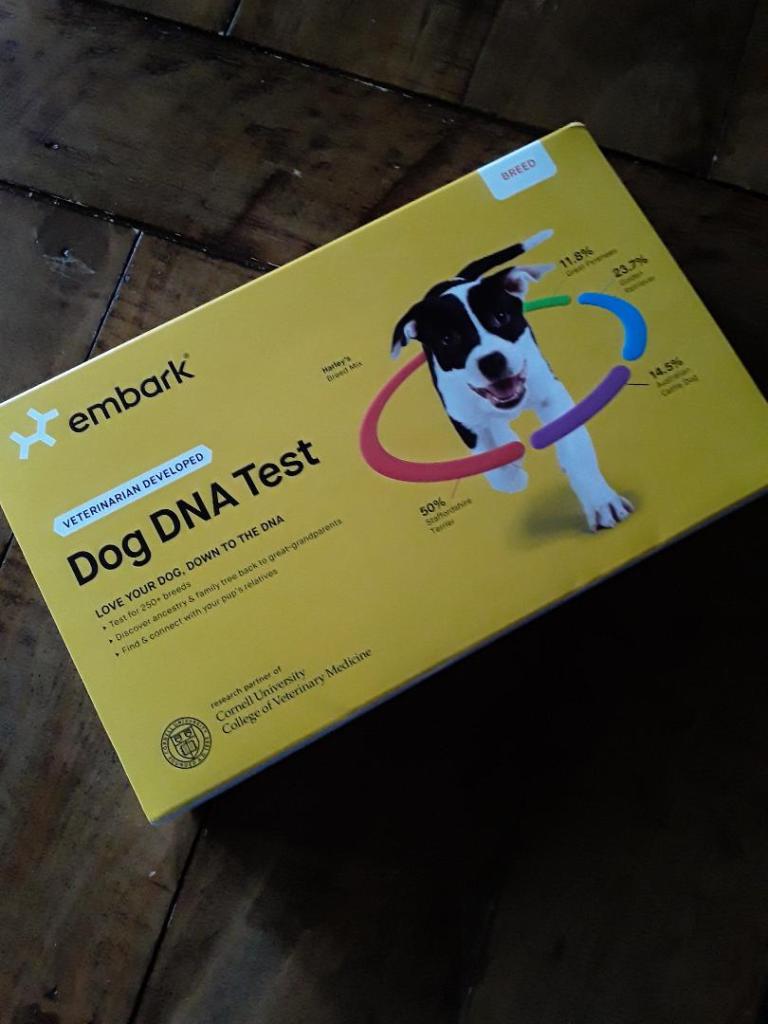
OK, Maybe you all remember my write-up about Amazon Prime Day. It may have escaped you, but somewhere in the list of things important and frivolous that I bought that day was a dog DNA testing kit.

If you are interested, you can buy one too.

I would definitely list this as a frivolous purchase. However, all of life can’t simply be necessity; this would make for a pretty dull existence.

So let’s get down to the brass tacks. Why am I writing today. Pretty easy. I’ve gone through the entire dog DNA testing process, and I am ready to display the results. This was particularly interesting as I could compare it to 23andMe, the human DNA testing service.

The first thing you do after receiving your kit is to collect the sample.

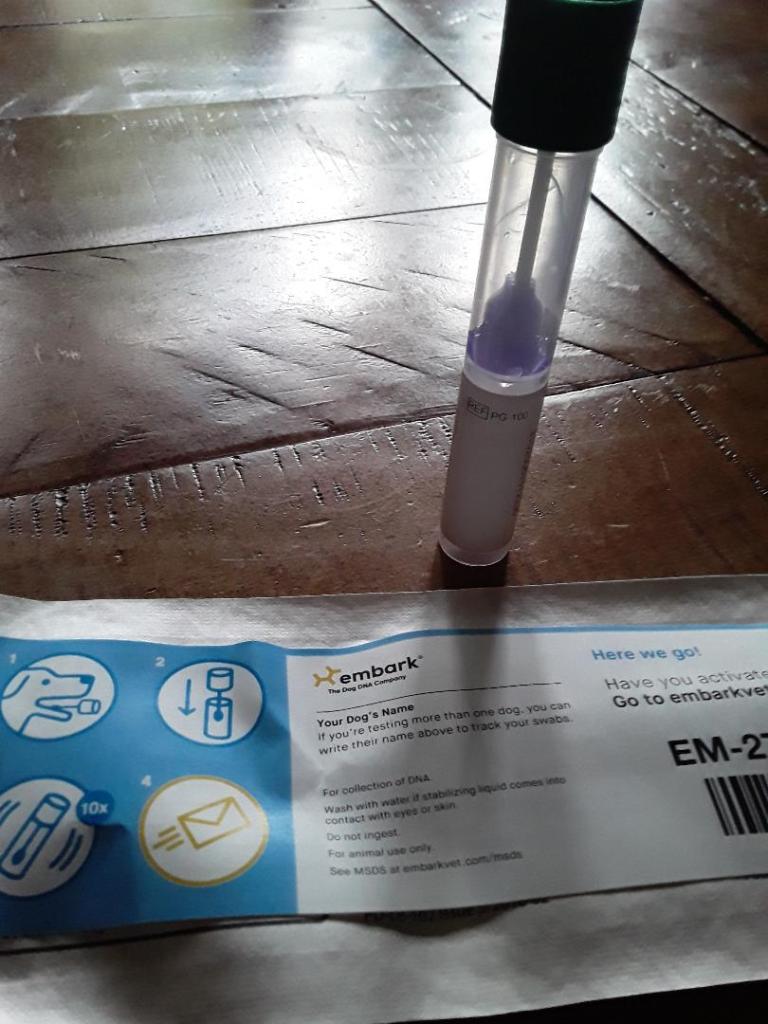
See the swab above? This is after the sample has been taken. To get the sample, you take the swab and jam it into the saliva pouches in your dog’s cheeks. Some dogs react better to this than others!

Dixie wasn’t pleased.

She got over it, though. After the sample has been taken, you stick it into the provided tube and mix it with the preservative fluid in there. This differs with the 23andMe sample process a tad- probably because it would be difficult to get a dog to neatly spit into a tube.

BTW- same as with 23andMe no eating for an hour or so before sampling.

After that’s done, put the sample in the postage-paid envelope. Somewhere around this time be sure to register the sample on the Embark website, then put the sample in the mail and wait.

In my case it took about two weeks. Not long at all.

Here is what I found out.

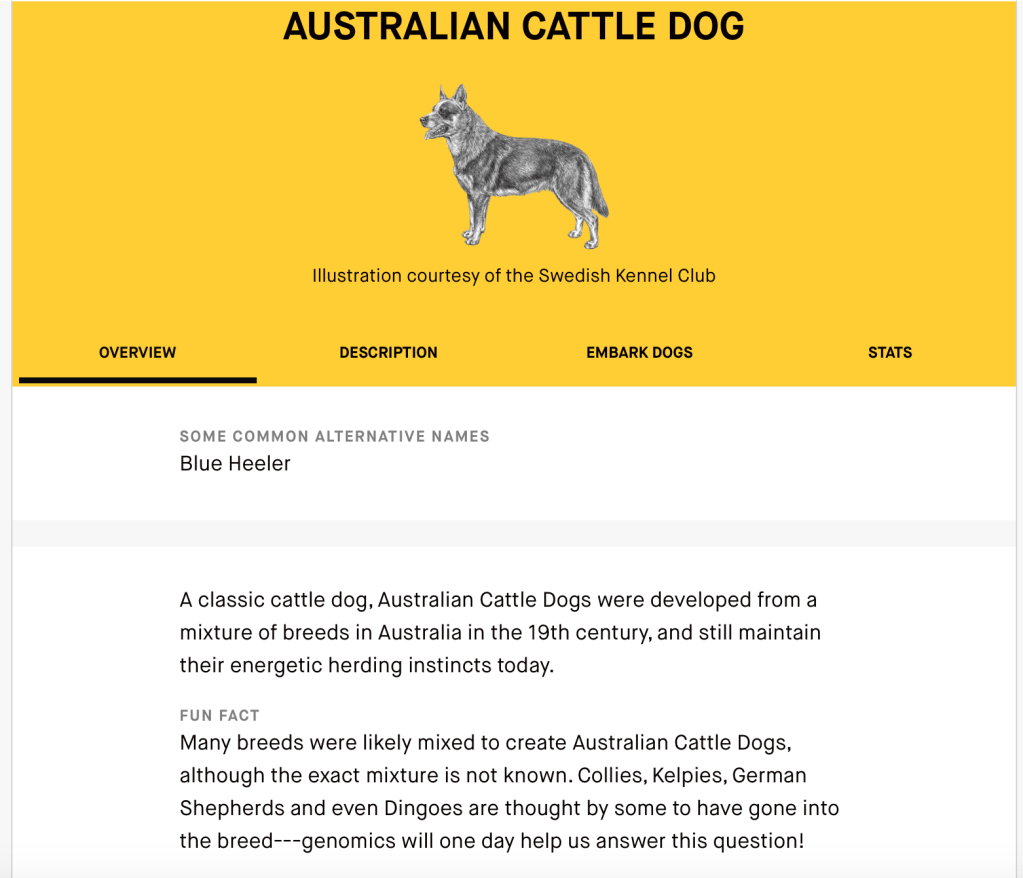
It turns out that Dixie really is 100% Aussie Cattle Dog- of course, by definition that breed is super mixed, anyway. So purebred Australian mutt? Guess so. It was a surprise that she was purebred- I always had the idea that where we got her from was pretty dodgy.

Guess they were legit, though.

Nice that they gave percentages- although Dixie’s was pure and mine was not. Pretty fascinating stuff.

There was more, though.

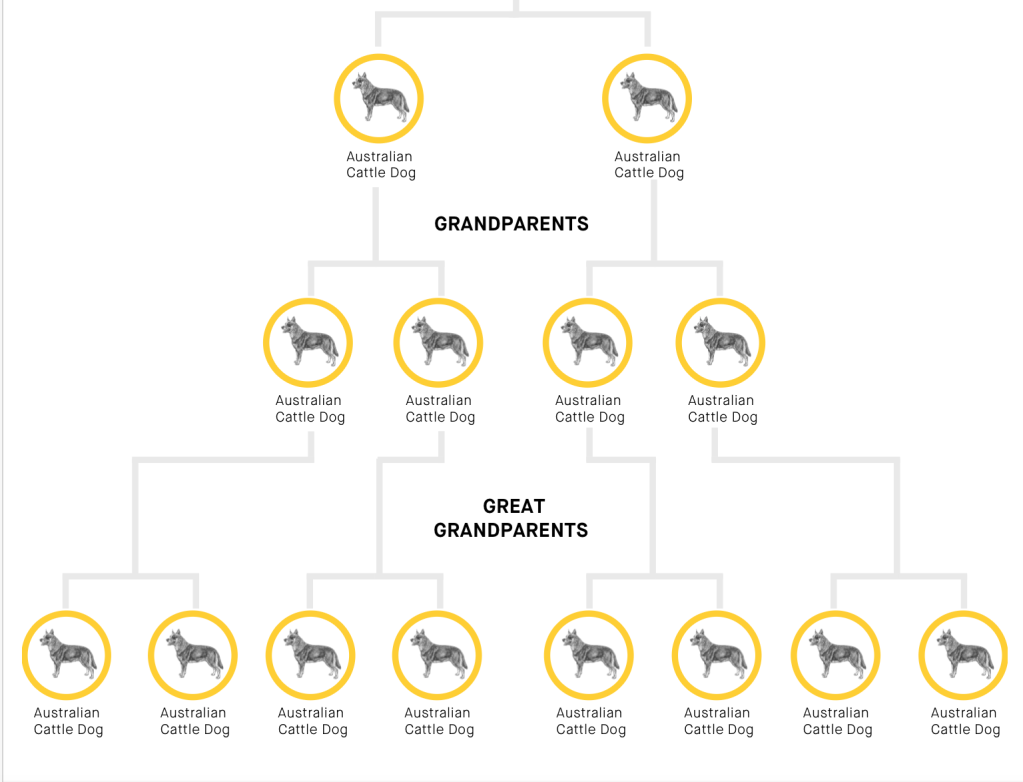
There was a family tree.

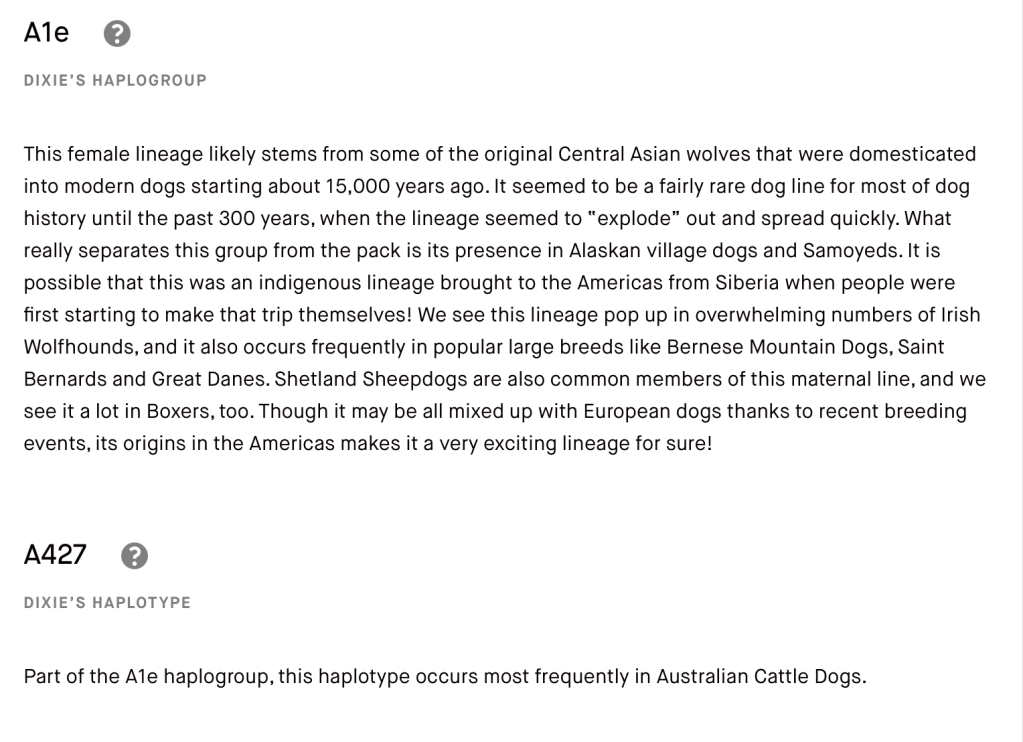
Then there was a chart showing worldwide where her genes came from. This was accompanied by a description of where her genetic markers were often found, which I thought was interesting in its own right.

23andMe has something similar; for example, my maternal haplogroup was passed down by the Saxons. Dixie got something like that, but for dogs. Pretty cool.

And then another feature similar to 23andMe, but a LOT less fraught.

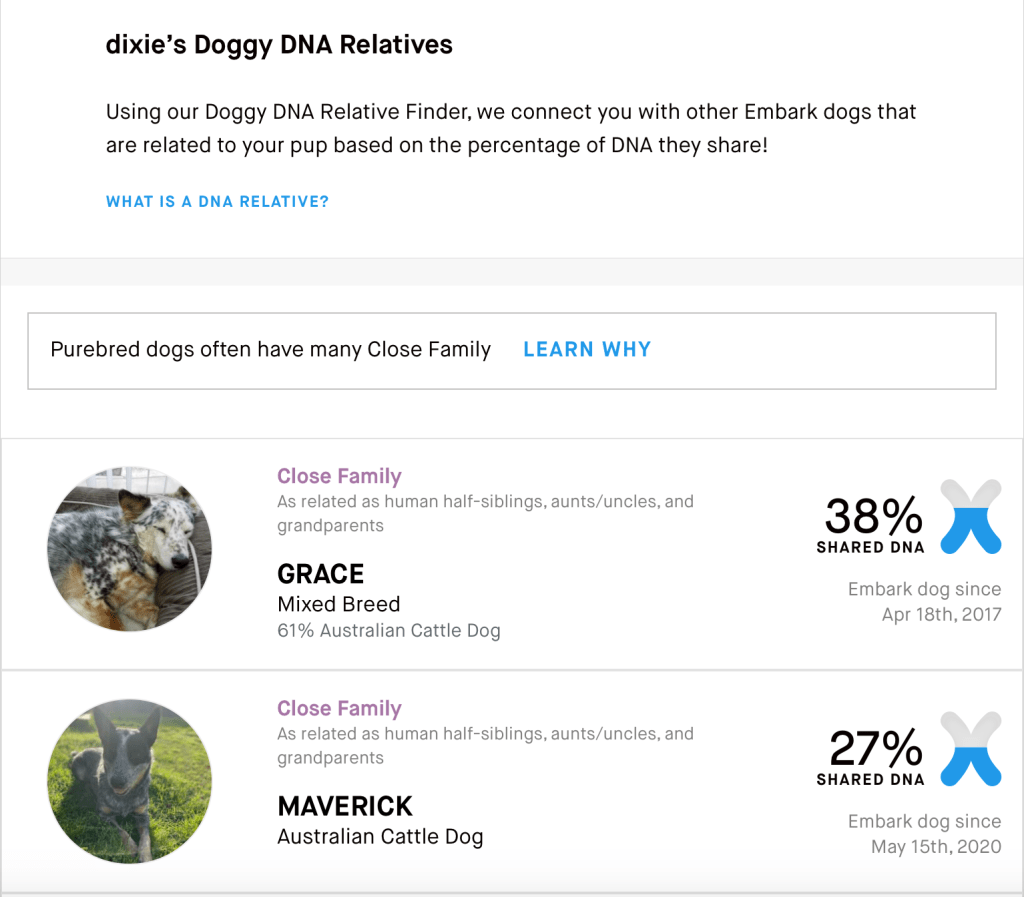
Dixie’s relatives!

Pretty cool, and as I said a lot less controversial than the human version. Mine ended up snagging me in a minor family dispute, even though that too was a learning experience.

This was a window into who Dixie’s “family” was, and other dogs that shared her traits.

So that was about it. Was it essential? Did it need to be done?

NO.

Was it cool and fun?

YES.

So the choice is really yours, readers, as to whether you want to throw some money away. Personally I would recommend to wait until Black Friday, Prime Day, etc., so you get some money kicked off. But then hit the “buy now” button and give it a whirl.

Geeky fun, right up my alley!

The Whitetail

The North American White-tailed deer is an old friend of mine. They are a common sight around these parts, they are frequently harvested for meat. Unfortunately, many of them die in traffic accidents as well. Over the years I have hit five.

There’s a reason I’m talking about this today.

The mix of Whitetail and advanced technology.

Guess I have to start at the beginning.

We all know that 2020 is a really bad year. Everyone has taken a hit, whether from health concerns or the collateral economic or social damage. Well, an industry that has been beaten up is sales of all types.

The car industry is no exception to this rule. They want people to buy cars, so at the moment many manufacturers are offering some amazing financing deals- Subaru is one of them.

Depending on a few factors, it is possible right now to get a new car for 0% financing over sixty months. In layman’s terms, this represents thousands of dollars. Also, the 2020 models are hanging around like a beached fail-whale, the dealers are desperate to ditch them.

If you can do it, this makes for a buyer’s market.

But I digress. What does this have to do with technology or for Pete’s sake the whitetail deer.

OK, our old car was due for a little expensive TLC. Nothing major, but still. I was at the Subaru garage, and I found out about these deals. I did some thinking. Hmm, dump a ton of cabbage on a high-mile vehicle that was out of warranty, or maybe trade it in.

Grabbed up a sales lady after checking Kelley Blue Book on my phone. I knew what my vehicle was worth, bottom line. A casual conversation followed; she made me an offer and we crunched the numbers.

My mouth dropped a little. They gave me excellent trade-in, and the interest rate and finance terms made it so that we got a better, brand-new vehicle for LESS per month.

It was a no-brainer.

This is how we got a new Subaru Outback.

I say what kind of vehicle it was for a reason.

The mind-blowing technology.

The car is not mine, so I didn’t drive it home. The next morning at about 0545 I decided to take it for a test drive. I knew this would be a different experience, but I wasn’t really prepared for how different.

Holy cow. When I opened the door my eyes fell upon an enormous center console that looked like a giant iPhone, and acted accordingly.

Menu this, setting that, precise temp controls. Every last bit of the driving experience could be customized, from the volume of the traffic warnings to the temperature of the flipping’ seats, for heaven’s sake.

Whoa. After convincing myself I hadn’t hit a self-destruct button somewhere, I turned the old-fashioned key (a feature I like). The Boxer engine growled to a start, I put the beast into reverse and looked at the night-vision backup cam.

Seriously? Yeah.

I backed onto our quiet rural road, put it into drive and headed on my test drive.

More technology- this must be mentioned. The Subaru lets you know when you cross the yellow line; there is a function that pulls your vehicle back onto the road. It isn’t gentle. Even when expecting it, it startled me. Also, there is an intelligent cruise control that maintains a precise three vehicle separation with the car in front of you; this function is enormously helpful when driving on a two-lane highway and you are stuck behind a drunk who keeps accelerating and slowing.

This is borderline auto-pilot stuff.

So into the inky darkness I drove; I went through a local twisty hollow to judge how the vehicle cornered, etc.

I ended up testing a feature I knew of, but didn’t appreciate.

Not fully.

My odometer read 114, the wonderful smell of new car tickled my nose. What a luxury, to drive in a factory fresh-vehicle. The white-blue headlights did a fine job of illuminating the darkness.

They lit a blur from the right.

Everything that happened next was like the taffy-speed of combat. Time stretched and everything went s-l-o-w.

In one second, probably less, I heard a strange machine hum. I noticed the Subaru rapidly decelerating. Like a photo strobe a large, beautiful Whitetail buck, probably an eight-pointer, leapt in front of the car and ran off into the woods to the left.

My foot hit the brake at the same moment that the car came to a complete stop. It didn’t even skid.

Holy. Shit.

I nearly wiped out our brand-new wagon on a deer.

There is no doubt that the auto-brake function prevented the collision. It saved the deer and left the Outback unscathed.

Things happened faster than human reaction times; I was wide awake and alert. There was no way I could have reacted faster than what I did.

The deer was long gone. I let out a breath and accelerated away.

Saved by technology.

Again.

Putting back the pieces

I’m having an odd day in an odd year. Not really sure what direction this discussion will take, but what the hell. Hold onto my beer and watch this…

It all started with a beautiful cover of a Hendrix song.

Since I came home, music has been tough for me. Not sure why, it just makes me a bit sensitive (for lack of a better word). So I ration my listening fairly carefully and I turn it off if it gets to be too much.

Today was one of those days. I could barely stand to hear the soulfully played song.

No idea why this is, I’ve never brought it up with the VA people. I have only noticed this lack of control since Afghanistan, though.

I could go on at boring length about some of the stuff that plays in my head, but I won’t. Anyone can wikipedia some of the results of combat exposure and blast trauma, so if you feel like making yourself smart about this stuff, go right ahead. I won’t stop you.

I dunno, a lot of this thinking was brought about by the weather and the re-discovery of some old images hidden deep within the files of my old computer; I backed up the old MacBook when I busted out the new machine (Thanks, Prime Day!). Lo and behold I came across a couple of Power Points my old boss had me write.

I thought they were corrupted beyond any use, gone forever.

It turns out they were just outdated and inaccessible with the junky old software.

With some degree of trepidation, I opened the file called “Explosive Hazards of “x” Province, Afghanistan, October 2011.”

Good God, it was riddled with images I took and catalogued some nine years ago. Stuff I thought I had forgotten, like the blast crater below.

Just a dumb hole in the ground, you say. Yeah, it is that.

But there’s a story there. You see, I watched that hole being made. I watched as an Afghan Police truck passed over that exact spot. The IED with my name on it, but not that day, exploded violently.

The bomb was planted along a road I travelled daily, either on foot or riding as shown below.

Riding as the gunner on an 1151 Humvee.

Good God I shook like a leaf as we rode through that crater shortly thereafter. I nearly pissed myself as I felt the truck lurch while passing through the hole. That bomb. That Improvised Explosive Device. It sought to tear the life from me, to blast me and my friends to rags and red filth.

So yeah, maybe I should have never opened that file.

But that’s the hell of it. These days nothing electronic ever truly dies. Long after I have passed someone cruising the web or whatever will be able to search for images of the Afghan War, and there I will be, in living color. Maybe even rendered in a 3D hologram or something.

So the war will never truly die with us, its combatants.

It will be preserved, like a fly in amber.

I have my doubts as to whether this is a good thing. No, you know what? It’s not. But it doesn’t matter, the cat is out of the bag for good. Digital immortality is upon us, for better or worse.

For an eternity I will ride on top of my machine in my gunner’s harness, my right hand on my trusty PK. For uncountable years I will wait on the explosion.

This. As I sit behind this computer typing, my teeth chatter. I remember.

There is no forgetting. Likewise forgiveness. Understanding, the same.

All that is left is to endure.

A Prime Day

I’m not sure if I’ve ever specifically expressed this, but we live in an amazing world during exceptional times. A lot of stuff is good. Some of it is bad.

Today I’d like to mostly discuss good stuff. You can go somewhere else for politics, etc.

OK, so it’s kind of odd here in my house. Many large ticket items can be dated from various deployments.

Well, almost all of our electronics dated from the final Afghan trip, 2011. Do the math, that stuff was getting long in the tooth. For example, the laptop I’m typing on. The bluetooth has given out, several of the keys are illegible and some of the software is glitchy.

If I haven’t written five hundred thousand words on this MacBook, I haven’t written one. It is an amazing machine.

A big reason I didn’t replace it sooner was because of Apple’s dumb butterfly keys. They were notoriously unreliable. Hey, Apple! I buy Apples because they are reliable, not because they are cutting edge or cool. So for years I held off until they fixed the problem with the “new” Magic Keyboard. Ha. All this is is a refinement on the tried and true scissor keys.

But I digress.

Lemme get to the core of this post.

Amazon Prime Day.

They blew my doors off with the deals. Seriously. A lot of people don’t care for Jeff Bezos or the Beast. My response is that he saw an opportunity and took it. If he wouldn’t have, someone else would have and people would be cussing whomever instead.

In regard to the mom-and-pop stores, they are gone. In my little village the main street used to by filled with small shops. Empty storefronts or gap-toothed holes remain where lives used to be.

There’s no going back; the changes are coming hard and fast.

In fact, there is a noticeable acceleration. Within my lifetime we have gone from rotary dial phones to cheap crappy Walmart phones that could literally build an atom bomb.

Which brings me full circle to where I want to go with this today.

For the full price of one laptop I got the laptop as well as a pile of other stuff to replace the obsolete/malfunctioning 2011 purchases.

So in practical terms I got electronics that are far more capable than the old ones for HALF the 2011 price.

For example. We bought a replacement sitting room TV for a ridiculous price. I won’t say how much, but it was stupid.

The TV is a full foot (30.4cm) larger than the old one, was much easier to set up, is far more capable, and the colors are intense, cinematic.

And it cost 60% less than the old TV in 2011 dollars.

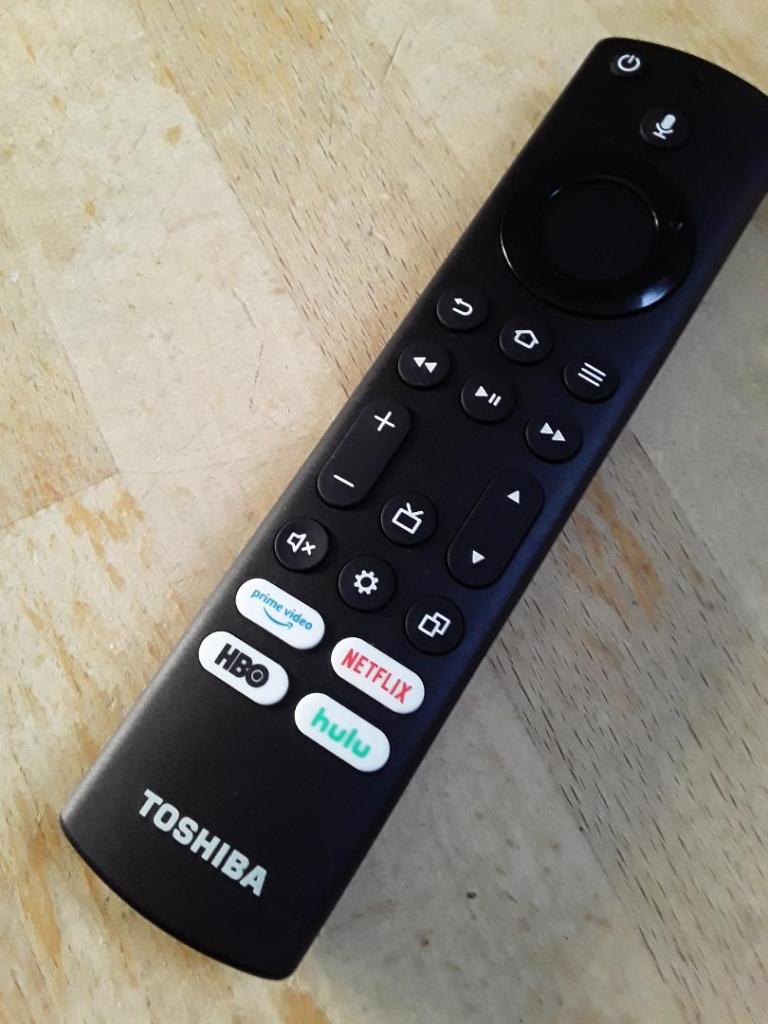
I’m still shaking my head. See the remote above. If I want to watch (name the app), I push a button. Or (and I wasn’t aware of this when I bought the TV) I can push a button and have Alexa find me whatever.

I’ll bet a first grader could set up this TV. Ten or twenty years ago this would have been a mighty struggle for 1/100th the capability; I remember well.

My old TV is outclassed in every respect by this unit. It is simply amazing.

And that is but one item.

But look, this brings me back to the point of this post. We live in a world filled with amazing stuff; many of us exist at a level of comfort which would have been foreign to our grandparents. The world has so much potential. Seriously; the TV is an infinitesimal speck of the whole.

So why do many of us want to screw it up? Are people so bored or stupid that they want to tear down what our ancestors have built?

Stop it.

Leave your guns at home.

When the time comes, exercise your right as a citizen to vote.

This is a democracy. Compromise and imperfect solutions are part of the experience.

This is a peaceful and beautiful land; the vast majority of the residents have never known war or hardship.

Let’s keep it that way; let “Call of Duty” be the closest that many come to the sound of the guns; or a rainy camping trip be the worst misery that the vast majority see.

Look at your humble TV remote; you are holding the product of a thousand generation’s knowledge and wealth.

Me, personally? I am floored by this.

So if you feel like it, let today be the day that you take some joy out of simple things.

Let life be long. Live and let live.

And now I have a Netflix button and Alexa.

Life is good.

The Compass

Another folksy, woodsy article. Why? Because I felt like passing along some arcane knowledge.

Alright, it’s been my experience that people are afraid of the common woodsman’s tool, the compass. I don’t know why. So today I want to do a quick and dirty bit about common sense compass use.

Look, it’s kind of a big deal to be able to figure out where you are and how to get to where you want to go. I know, cell phones have an app for this, right? And what about GPS?

Too much technology, and always have a backup. I enjoy “Bitchin’ Betty” on an iPhone just as much as anyone, and it’s nice to have a precise ten-digit grid when you are utterly lost. But who says you’ll always have that stuff? No one, really. So learn a little about a compass.

First, a few basics. I’ll point them out.

You should always be able to find the cardinal directions by simply observing the sun. The sun rises in the east, and sets in the west. In the northern hemisphere, it tracks across the southern sky. South of the equator, the opposite.

What does this mean. Here is an example.

In Virginia, you face the rising, morning sun. You are facing east. Your left arm points approximately north, your right arm points south. Your back is to the west.

Just like that, you know your cardinal directions.

At night, in the northern hemisphere, find Orion. South. Look the opposite direction for the Big Dipper. Roughly north. Polaris, or the north star, is close by.

How useful is this stuff? It can be a life saver. For example, generations of runaway slaves navigated from the Deep South to the North using nothing but the above: a journey of a thousand miles. Talk about courage and resourcefulness, along with a pinch of fieldcraft.

Alright, now let’s up our game a little.

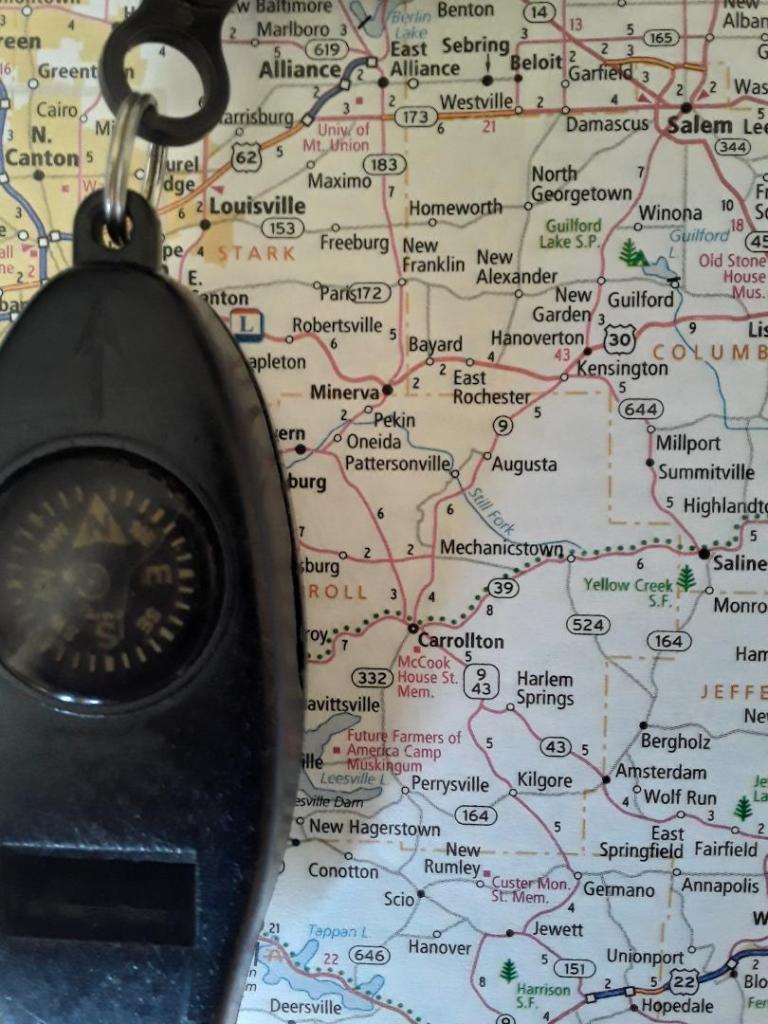
We have a compass and a map. See image below.

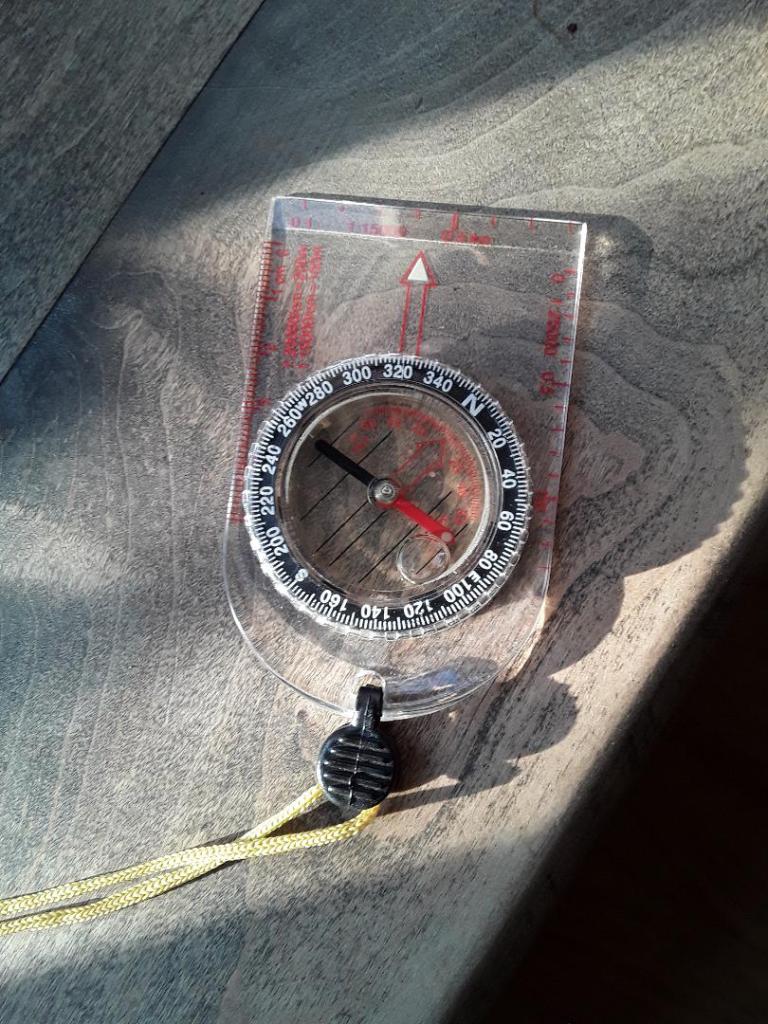
Above is a cheap, crude compass and a common road map. You can see the scale bar and the “north seeking arrow.” Note that the north arrow is roughly aligned with the compass. This is important.

Why. Because now you and the map are pointed in the same direction. Your body faces north, left is west, east is right, and behind you is south.

The pictured compass is crude and cheap. It is also surprisingly accurate, and is probably better than what the Spaniards used to navigate the globe. You can get from one town to another with such a device, look at the map. If you need to walk southwest to get there, turn your body until the compass, held flat, is pointing southwest. Look up. Find something in that direction. Walk towards it. When you get there, take another “sighting,” and continue walking. Repeat over and over until you get where you’re going.

This is where I must mention that I’m leaving a lot out.

For example, there is a thing called “magnetic declination” that throws off a compasses’ accuracy.

Here’s my take on that. If it’s less than ten degrees, and you are traveling short “legs,” don’t worry about it.

If it’s over ten degrees where you are (Google it), then read up on how to compensate for it. Not really hard. For example, here in Ohio it is 8 west. This means that for a true reading you need to add 8 degrees to what your compass says for accuracy. For east declinations, you subtract.

Also, it is helpful to know how far you must travel and approximately how far you have covered.

How do you know how far to go?

See image above. All maps have a “scale bar” that allows you to plot approximately the distance on a map. Mind you, this is “as the crow flies” distance, and not what you will actually travel because of terrain and obstacles.

Maybe go down to a football pitch and measure off your “pace count.” This is easy to do. Start at one end, step off taking normal steps. Count every time your left foot hits the ground. My walking pace count is 62/100M.

And like everything else, this has a caveat, too. Your pace count changes if you run, go uphill, etc. So just do like I do and keep it simple; use the walking count on average.

An example. Using the scale bar on the map, you know you have to walk southwest about five miles. Convert to kilometers right away, or you are in hell. So 1 mile= 1.5km. 5 mile=7.5 km. 620 paces per km. Start walking. After an hour and a half, you should be pretty close unless you had to swim a river or something else stupid (been there, done that).

A practical example with the cheap compass.

Alright, you have oriented your map to the north, you and your map are pointed in the cardinal directions. You want to move from Summitville to Augusta. Using your handy scale bar and guesstimating, you see it’s about eight miles away cross-country. Looking at the compass, you can tell you need to go almost due west. Close your map, turn until your compass and your body are facing west, and start to move.

Make sure that you periodically check that you are in fact moving west. When you hit a road about 12km later, look for signs. If it is Route 9, good. You will be fairly close to Augusta.

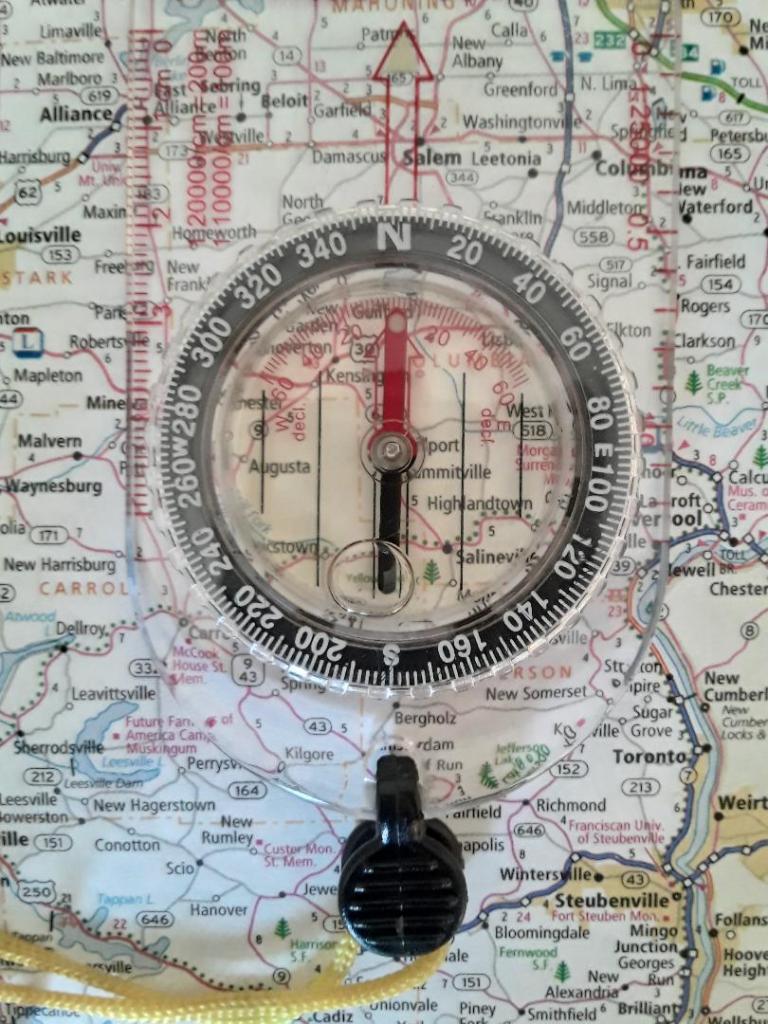
If you spend just a few dollars more, you are capable of much more precision. The compass above has a ton of good features, but not so many that it overwhelms. Also, note that it is partially luminescent. Handy if you need to move at night.

Once again, we want to move from Summitville to Augusta. Using the scale bar and the ruler, we can do a better estimate of our traveling distance. Also, instead of an approximate heading, we can nail this one down to degrees. See how the compass is centered over Summitville? Look right and you will see Augusta. 268 degrees, map heading.

You could go ahead and add your 8 degrees here for the declination, which would give you an adjusted true heading of 276. This would be accurate and would potentially land you in the center of Augusta.

But I said don’t bother with that. So move out at 270ish degrees, you’ll be close enough for rough work.

After all, we aren’t calling in artillery.

And buddy, I sure am glad!

There you go, rough and dirty. This is how to use a compass. Just make sure it’s roughly flat when you take a sighting and check your heading early and often.

Piece of cake.

Now go spend your five bucks and put the compass away somewhere. Forget about it. And when your car is broke down by the road, cell reception is lousy, and you need to get to the next town, you’ll remember.

There’s a compass in my glovebox, and I know how to use it.

Cast Iron Recovery

Cast iron pans are amazing to cook with. Since I was a small child, I’ve enjoyed who knows how much food, healthy and otherwise, that was prepared on black, oily cookware of indeterminate age.

The pans are pretty much immortal if maintained properly. We use cast iron almost daily around here, and the pans are over a hundred years old.

Why am I talking about this today. Well, something I would like to do this year is to discuss the use of the produce from our vegetable garden; I would like to practice my campfire cooking. It’s been a while. I thought about it and I didn’t want to use our kitchen pans for this. Then I remembered that in a hidden corner in the basement there are a whole stack of cast iron skillets.

I think my mom picked them up at a garage sale or something. I’m not sure. Took a look at what was there and I decided upon a large, deep and heavy No. 8 skillet. It seemed perfect for campfire cooking.

But there was some work to be done.

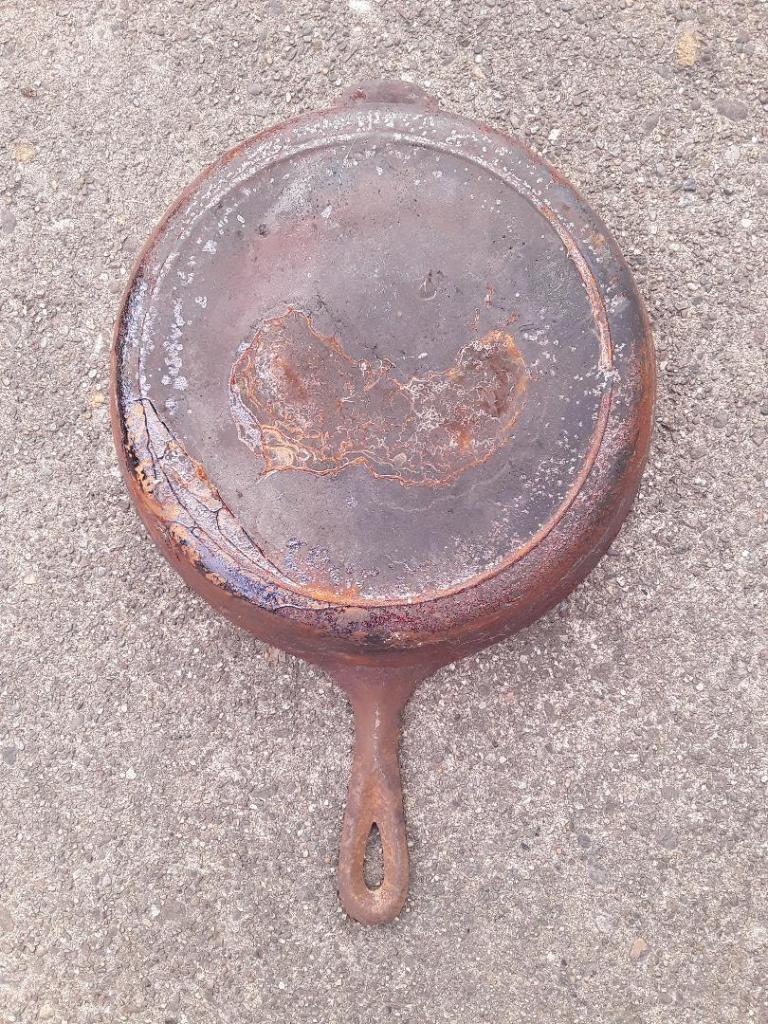
See below.

What a piece of junk, many would say. Some would shake their heads and plant daisies in this fine piece of cookware. Not I. I’ve done a lot of metalwork, and I could see past the rust. This was one solid pan with tons of potential. I cracked open the newly cleaned and ready garage and went to work.

What you see above is called an angle grinder with a wire-wheel attachment. This is the quick way to deal with crusty, ancient rust.

A note of caution: These tools, while useful, are potentially dangerous. The wires can and will let go as you clean a surface. You can and will be struck by the sharp wires. Wear eye protection, gloves, and a long-sleeved shirt. Also, the grinder is powerful. Hold on tight! Finally, the grinder can cause sparks. No flammable materials nearby.

If the thought of using an angle grinder now freaks you out, you can also do this with a wire brush and steel wool. It will just take forever, that’s all.

With an easy half-hour of work with the wire wheel, this is what I had.

Looks much better, right? Well, it is. However, it is not yet ready to fry stuff up. As-is, this pan will rust again in a heartbeat. What it needs now is “seasoning.”

This isn’t hard. Lemme explain.

First, wash off the pan with boiling hot water to remove rust dust and other debris. Once you’ve done that, wipe it dry with paper towels. The pan will be a dull gray, and it will be dry.

Now you need shortening or vegetable oil. Either will work. DO NOT use non-food oils. Very, very bad idea. Edible oils only. Wipe the pan down with a generous coat of oil. Place it upon the cookie sheet that you have prepared with tinfoil. It should look like this:

Another note. Maybe it’s best if your family isn’t home for the next step. It stinks more than I remembered!

Set oven to 375F, (190C) set timer for 45 minutes. Once oven has pre-heated, stick the pan in. After about fifteen minutes it will start to really stink like something is baking. Do not be alarmed, but maybe do turn on the range fan and open a window. Wait.

Once the time has past, the pan is done. Note that it is now a shiny black color, instead of a dull gray. This is good, and desirable. The pan will smoke a little when you first open the oven. Let it cool down. Once it is cool, wash again with hot water and wipe it down with paper towels or a clean rag. Never use dish soap on cast iron, this will cause it to “lose season” and rust.

Now the moment of truth had arrived. Time to cook!

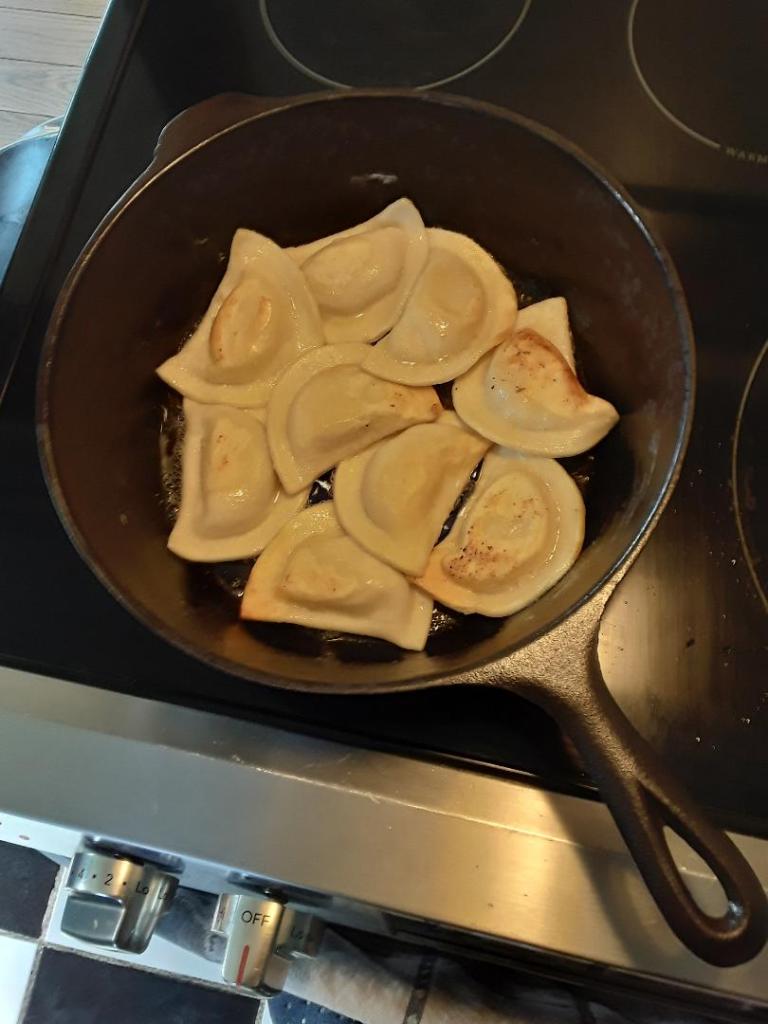
I chose to make pierogies, a regional favorite, as this aged pan’s first meal in decades.

As you can see on the first image, it did more than fine. Pierogies, loaded with potato and sharp cheddar, browned up nicely on the elderly iron.

I served them up to my kids. Success!

Not bad for a morning’s work.

If you come across a cast iron pan in need of some lovin’, don’t be scared. As long as it isn’t cracked, pick it up and recycle it.

It will be just as good as, or better, than new. Probably cheaper, too.

Put that old iron back to work!

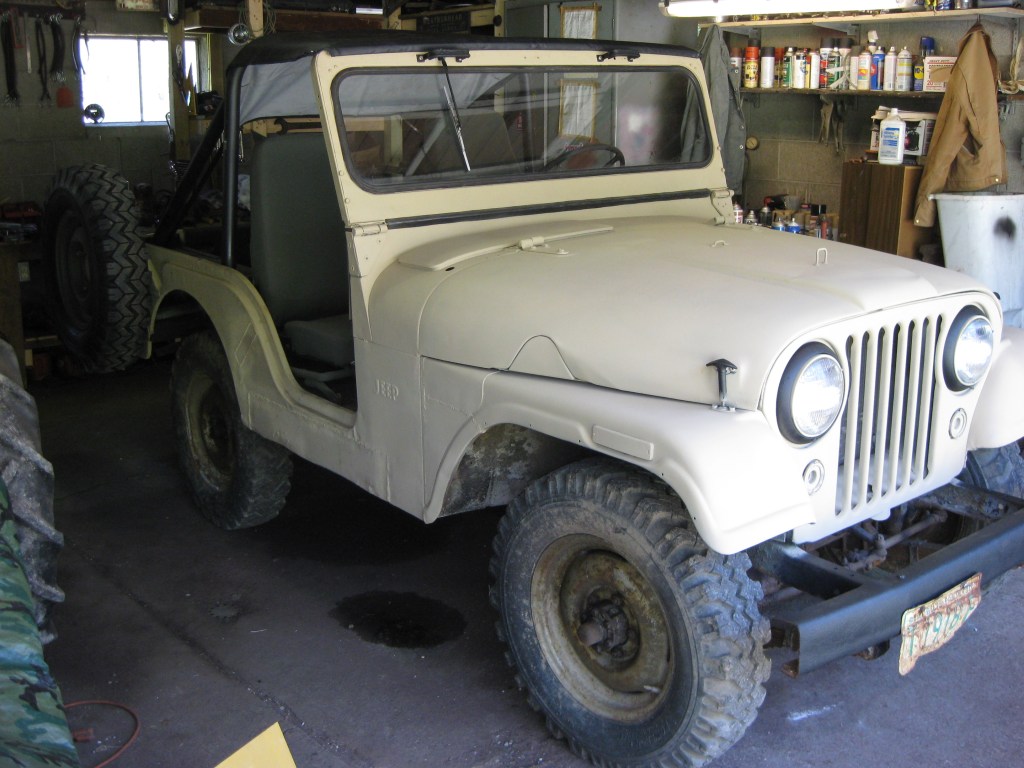
The Jeep

The vehicle in question is pictured above, a few weeks before MkI of the restoration was completed. It’s not the best picture, but you get the idea.

It’s a real 1955 Willys CJ-5, a direct descendent of the Jeep of WW2 fame.

Why am I talking about this today.

Because at long last the Willys is headed to the shop for the MkII restoration.

You see, the MkI version was damaged by some fairly extreme trail riding with an old friend; the engine did not survive the experience. Because the old Buick V6 was obsolete it could not be economically repaired. So I had to install a Chevy engine. To install the Chevy engine, the Jeep had to be converted to a hydraulic clutch. And BTW, it needed a new exhaust.

The list went on.

To make a long, sad story short, I burned out on the Jeep. I literally locked the garage and walked away. I knew that I had reached the edge of my competency, and funds were tight so I couldn’t pay for the repair.

I went back in the house and started to write. I published one book, then a whole trilogy. In the meanwhile, the CJ-5 slept. My garage was a cobweb strewn mini-museum.

It always bothered me, that fun little Jeep.

Then one day my former commander and friend came down to the house to check up on his troop.

We went out to the garage to look at the Jeep. You see, my journey with the CJ-5 was his fault.

How?

Well, for that we need to step back in time. To Afghanistan. To the valley.

He and I were standing there talking. Smoking or something. He mentioned that he had once had a Jeep but he never got around to fixing it, so he sold it. He told me of buzzing around the desert with the Kuwaiti Army in their Jeeps before the War kicked off. It was a pleasant memory for him.

Then some jerk shot at us.

A couple of years later, and I was going through the hell that is the Army Medical Board. I was under medical supervision and I lost my driver’s license. It was rough. The Colonel called, he asked if I knew where an old Jeep was. I said I didn’t know, but I could find out.

I located two. He came down and inspected them, they were too far gone for his tastes. But I looked at them and realized I could combine them into one good vehicle. After the Colonel left, I called the seller and proposed a trade.

A hunting rifle for the two Jeeps, a 1958 and a ’55.

They said yes. A few days later and I had both vehicles parked in my driveway. The fun began. Within one hundred days I had one complete and functional Jeep. Then I trashed it and the sad part of the tale began.

Fast forward to now, readers.

Now the time has come for the Jeep to get back on the road.

It’s the Colonel’s fault, again.

The Jeep isn’t getting back on the road because I’ve suddenly struck it rich. That is not the case. No, it’s because the Colonel visited and he came up with a plan.

It seems he finally wants a functional Jeep back in his life, but he doesn’t want to pay a fortune. Neither do I. So he says to me, “Hey, let’s go co-owner on this thing, get it to a shop and get it fixed.”

As we looked over the forlorn abandoned project, this struck me as a great idea. Upon further reflection, it was the only idea. Otherwise the old wagon would never get back on the road.

So it’s a win-win. The Colonel gets his Jeep and a place to store it (he lives in the city and room is tight), I get to see my project completed.

The restorers are coming this week with a flatbed. After some unknown period of time, the Jeep will come back fully functional.

The old ’55 model. Born of war in a couple of respects, serving in retirement and peace.

I’m cleaning the cobwebs from my garage; this is exciting stuff.

Kind of like this fall’s writing. The wait has been long, but worth it.

On Teamwork

I guess before I wrote about leadership in an earlier post I should have written about teamwork. Because if you aren’t a good team player, you will be a bad leader. Just my two cents.

Ike would agree. That’s why I posted his picture.

No man in history, with the exception of Marshal Zhukov, ever controlled a mightier military force. Surely General Eisenhower could have called his own shots, done what he wanted, right?

Actually, no. To study Ike’s history is to look at a long chain of compromises and coalition and team building exercises.

Put simply, General Eisenhower was a supreme team player and eventually a mighty commander. But on many occasions it almost ended badly. Look, I’m not going to talk about Eisenhower at length; I cite his example because it’s a good one.

A phrase from Army OCS. “Never ‘get married’ to your plan, because it isn’t your plan. It is the commander’s.”

What does that mean?

OK- this is very important to the discussion. Everyone has a boss. Even Eisenhower had a boss- Churchill and Roosevelt. Eisenhower may have been responsible for the development of Operation Overlord (the invasion of Europe 1944), but his bosses owned the plan. They could, and did, attempt to modify the plan. Churchill was particularly bad about this, and Eisenhower clashed with him.

Eisenhower knew, however, that his civilian bosses were responsible for strategy and political considerations, and that if they offered changes to Overlord that he could not tolerate, he could remove himself from the team.

This is teamwork, too. Letting the person in charge know they are about to screw up. Eisenhower mastered politeness and discretion, but he would bring his point across, especially when dealing with sensitive subordinates such as Charles de Gaulle, among others.

Eisenhower’s extensive staff developed Overlord, and Eisenhower himself reviewed it and approved the Operations Order (mil speak for plan). But Overlord itself belonged to the politicians, and they would have answered to the people of their countries for its failure.

Eisenhower would have gotten the sack too, of course. That’s part of being a leader and team player as well.

But he knew that his failure would be paid by thousands of his dead washing onto France’s shores.

Leaders and team players are accountable. Where there is no accountability, there is no team. When you let your end drop, everyone else pays as well.

Real leaders look their people in the eye and say, “This is on me, and I need your help to make our plan work.” The leader needs to invest his or her people in the job at hand; they need to place a value and a face on what is going to happen.

Teams work best in small groups; the military has long known this.

What do I mean.

OK, let’s think about our ancestors. They had fleas and were nomadic, they were capable of enormous work performed in bursts, and everyone was related somehow within the average group of thirty to fifty.

About platoon size, actually.

And within the group there were families and friends. Groups of about ten.

Squad size.

Within the family were couples and surviving children, there were two or so dominant voices.

Fire teams.

It is at the fire team level that people are the most comfortable. This is no accident. It’s how our deep social structures operate. So let’s translate this into teamwork.

I’ve been told that no-one should ever really be in charge of more than three to five people.

I believe this to be true. Teams need direction; they also need delegation. A leader who tries to control every member of his team controls NOTHING!

Trust your people! If you have done the right thing as a leader, your team will do the right thing, too. Everyone goes into something with a good attitude, usually. The leader and the team need to find what motivates each person and get them to do that thing that they are good at, that they enjoy.

Do you really think that our 2000x ancestor Og the Magnificent was particularly skilled at cave paintings? Probably not. But Og identified a need for drawings of aurochs with massive genitalia, so Og figured out who had the keenest eyesight and the ability to make the desired mural. No more than three people were involved; Og did not need to control every step of the process.

Og was an ur-leader. Even though there was no word for leadership or teamwork at the time, our ancestors figured it out and passed the basics down to us.

A team:

  1. is small
  2. is cohesive
  3. uses delegation
  4. understands the job at hand
  5. knows who is boss
  6. is trained or trainable
  7. is self-aware
  8. uses good-natured competition
  9. has a clear goal
  10. attacks bite-sized problems
  11. finishes the work
  12. values quality, takes pride and ownership.

These are the very basics, and I’m sure I’ve forgotten some stuff.

But I think you all get the idea.

A leader must FIRST be a successful follower, a team player. People will follow such leaders into the worst sorts of hell and emerge out the other side successful.

“Don’t get married to your plan. It’s not yours.”

No, the plan belongs to the team!