A decade for delivery

It takes way too long to build a ship.

Why do I say this.

The USS Robert E. Peary, a Liberty ship, was built in four days, fifteen hours, and twenty-nine minutes. This was the record set for the construction of a Liberty class vessel in World War Two. Yes, it was an outlier. However, the average time for construction was about thirty days. This is a blistering rate of construction.

In contrast, the construction of the USS Gerald R. Ford, the USN’s newest carrier, spanned from 2005-2022 from start to fully operational status. This seems to be an apple-to-orange comparison. Fine. The USS Yorktown, a carrier that was commissioned in 1943, served for over thirty years. It took sixteen months to build.

Sixteen months versus well over a decade.

This lays bare a chief weakness of the Western democracies. We have forgotten how to produce weapons and ordnance to scale for a peer-on-peer conflict.

One missile, albeit an expensive and sophisticated one, will send the thirteen billion dollar Gerald R. Ford to the bottom of the sea.

Our enemies know this. They also know that we no longer possess the basic manufacturing capabilities that we had in the Second World War, because we sent that overseas a long time ago, in many cases directly to unfriendly countries. We labored under the delusion that our peaceful and interconnected world would always exist, that our extended supply chains didn’t matter, and that we could bask in the sun of readily available cheap stuff made by people far away in places we couldn’t pronounce.

Well, a lot of things these days are showing us what a foolish presumption that was.

First, there was COVID, which shut the world down for a while, killed millions, and continues to cast its shadow across our supply chains. This is one reason that it’s hard to buy a car at a decent price these days. Second, someone decided that it would be a great idea to restore the Soviet Union by rolling tanks into Ukraine. This set off alarm bells throughout Europe, which in terms of defense had fallen asleep at the switch around 1992 or so. Finally, it became clear to all that the world’s factory, China, was not going to transition as imagined to a benign semi-democratic and friendly economic superpower.

No, Chairman Xi put a stop to that. Witness his latest move, publicly humiliating and purging a potential rival at this latest conclave of the Chinese Communist Party. No, make no mistake Xi is in charge, and under his watch, the Party has regained its primacy in China. Leninist principles will be adhered to.

Vladimir Lenin, remember him? The hoary old ghost we all thought had finally been laid to rest? Nope. Not so much. The hammer and sickle rule billions.

The purging of Hu was worthy of Stalin. All that was lacking was a show trial. But who knows, maybe we’ll get to see that, too.

I say all of this to remind my readers that there is no replacement for hard power. Soft power is fine, but if you can’t back it up with hard, you are pissing in the wind when confronted by men such as Putin and Xi. “How many divisions has the Pope,” asked Stalin, in a succinct summation of the limits of soft power.

This is why I’m distressed at the current state of our logistics, let alone our politics.

A brief aside about politics. Isolationism was thoroughly discredited for generations for a reason. We learned the hard way that wars elsewhere have a dangerous tendency to reach our shores and that alliances are crucial to maintaining global peace. It’s not for nothing that certain alternate histories portray a Nazi victory in World War Two. It is not hyperbole that if the US would have stayed out of World War Two, at least in the beginning, the German war machine would have eventually dropped a nuke on Washington. Does anyone doubt that Hitler would have shown any restraint in that regard? This drives me crazy. It took all of the combined Allied might to subdue fascism in that war, and to contain Communism thereafter, and how quickly we forget. Eighty years of relative peace, paid for by the blood of our grandparents, largely forgotten. But I digress.

What I really want to talk about is logistics.

The ten-year carrier. A company that can only make a few thousand Javelins per year. The limited capacity of the Lake City plant to make artillery rounds. The chip shortage, which affects each and every “smart” munition in our arsenal. And by the way, most of our chips are made in Taiwan. Do you think that the benevolent Chairman Xi doesn’t know that? Our inadequate shipbuilding capacity. The list goes on.

Some politicians speak of how we need to stop supplying Ukraine with munitions because we are drawing down the US Army’s stocks. This is an enormous fallacy for a number of reasons.

First, Ukraine is fighting to hold back the Russian army from an unprovoked invasion. They need help. But this isn’t charity on our part. Does anyone doubt at this point that Putin would have used an occupied Ukraine to threaten further expansion into Europe? The man has shown his cards. Soviet-style terror amongst the general population. Re-introduction of the internal passport system and the levée en masse. Using energy as blackmail. Blockading food deliveries to the third world. Sabotage on Europe’s vulnerable infrastructure. The list goes on. Ukraine’s problem is our problem collectively. Didn’t we learn a damn thing from the 1920s and thirties?

Second, the Ukrainian war has done us a favor by clearly illustrating that our munitions procurement system is broken and sclerotic. OK, fine, the Ukrainians are drawing down our stocks and the US Army might run out of Javelins. Doesn’t this tell anyone that it would not be different if we were fighting a war? Wouldn’t we be subject to the same limitations? This gives us a chance to fix the system before we fire a round- the Ukrainians are doing us a favor and spotlighting this issue before it bites us in the ass.

Finally, the Ukrainian war has shown us how vulnerable our major weapons systems are to attack by sophisticated and relatively cheap munitions. Look at how the Ukrainians took down a capital ship, the Moskva. Look at all the blown tanks and fighting vehicles scattered across that blood-soaked land. Look at the many, many strikes to critical infrastructure. Look at the blown pipelines into Europe. This is a preview of what a major war looks like in the modern age. If our leaders can’t look at the example of Ukraine and draw appropriate defensive conclusions, then we are governed by fools on the left and the right.

But what do I know, really. I’m just a pensioned-off company-grade officer.

My only hope is that someone in a position of influence is thinking along these same lines and that we need to take a very hard look at the underpinnings of the arsenal of democracy, which we have allowed to atrophy. Actually, “atrophy” is far too kind.

In an act of criminal negligence, we have sold the old arsenal to our enemies. We have sub-contracted to those who wish to destroy us and our way of life.

Josef Stalin was, in the end, correct.

When it comes time to hang the capitalists, they will sell us the rope.”

Burning bridges

Image courtesy Vera Katkova.

The Ukrainian war is starting to really hurt the Russian government. This is a self-inflicted wound, there was no reason whatsoever for Vladimir Putin to roll the panzers on his neighbor. But he did, and here we are, in the midst of a slow-rolling replay of the 1962 Cuban Missile Crisis.

Actually, I would go so far as to say this one is worse. Why. Allow me to explain.

Khruschev was a rational actor with real experience of war at its worst. Kennedy was also a man with combat experience. Both were participants in World War Two, and both men knew on a visceral level how everything we had built could be vaporized with a single miscalculation.

Putin has delusions of grandeur and Biden is president because it was his turn. This is not the leadership team I would have wanted at the helm of this crisis.

However, you don’t go to war with the army and leadership you want, you go with what you have.

So, now we have a threatened and possibly unstable KGB agent with thousands of nuclear weapons at his disposal, leading Russia. The man leading the United States rose to the top because everyone else disqualified themselves. He was the last man standing.

On these two men rests the fate of our world. Literally. Not exactly the stuff of pleasant dreams.

This is why I have been fairly quiet as of late. But now I think it’s time to write about this.

Vladimir Putin has burned all the bridges upon which his country depends to further his dreams of fire and glory. Economically Russia is totally screwed, their chief exports were hydrocarbons and weapons.

Europe was the primary recipient of Russian oil and gas. Any idiot can now see why dependence on Russia for energy was a bad idea. The Europeans are praying for a soft winter, and I don’t blame them. The acceleration of green resources will take the time they don’t have, and people are going to get cold without cheap Russian gas. The mysterious sabotage of the Nordstream pipeline hasn’t helped, and OPEC isn’t riding to the rescue. Just the opposite is true.

In the short term, the Europeans are going to pay through the nose for energy this winter. In the long term, the OPEC lands are shooting themselves in the foot. No one likes blackmail or watching their mother-in-law freeze in her flat. People remember.

In terms of weapons exports, what country will want to buy Russian arms when those have been comprehensively proven to be vastly inferior to western systems? Russian weapons are not only inferior, but they are also a tremendous waste of money. Who wants to buy tanks that are so readily converted into scrap metal littering the countryside? Who wants artillery that is only a slight improvement upon systems from WW2? Who wants planes that don’t dare to fly over hostile territory because they’ll be shot down readily and immediately?

Putin. He created this terrible situation, and in the short term he might do something desperate.

In the long term, he has thoroughly poisoned the water of his country.

Of course, any bad situation can always get worse.

One has to remember that life is a series of choices. Zeroes and ones. Putin made the choice to invade Ukraine. The Ukrainians made the choice to resist. As a result of these choices, our world is being pushed to the brink of a terrible conflict, one in which a possible use of nuclear weapons can be realistically foreseen.

What, was our lazy and happy world simply not good enough? A disappeared nirvana where the news cycle was driven by inflated outrage and not-stories involving the Kardashians?

No. Instead, we get disease, famine, and death, all rolled up into a lovely hate cigar that we are forced to light up and inhale. What is with these historical monsters who dream of imagined utopias based upon fire and glory? How do we keep getting saddled with these losers? A failed seminarian. A disgruntled corporal. And now, a pissed off secret policeman.

Fantastic.

And here in the US, I don’t see a Lincoln or FDR anywhere in sight.

Cometh the hour, cometh the man, so it is said.

Well, right now I’m not seeing it. At least not over here. The Ukrainians totally lucked out with Zelensky, who obviously inherited something from his grandpa, a Soviet infantry officer. The Finns have a good one, too, with Sanna Marin.

Ahh. This is why it’s taken me so long to write this. I’m having a lot of trouble seeing a good way out of this situation.

More power to the Ukrainians, who are fighting for their homes. Paradoxically, their success with weapons stamped “Made in the USA” makes the conflict more dangerous and likely to metastasize.

I guess the important thing to realize is where this all started. It wasn’t with NATO, which until very recently was rather content to sit and slumber, to atrophy. It wasn’t “the West,” which was happy to send billions of Euros and dollars to Russia in exchange for methane, raising the living standards for all in that perpetually tormented land. No, this all started in the fevered imaginings of a man who began his career in the torture cellars of East Germany.

This crisis began with him, a man nurtured on the most poisoned fruit possible, the institutional memory of the NKVD/KGB. It may not end with him, for he may be replaced by someone crazier.

Zeroes and ones. Choices. It all comes down to that.

What will Putin choose now that he has burned his bridges? Will he unleash nuclear fire?

If he does, this will be a first. In what sense, you may ask. Didn’t the Americans destroy Hiroshima and Nagasaki in 1945?

Yes, we did. We destroyed those cities to end a terrible war.

If Putin uses nuclear weapons in Ukraine, he will start one.

There’s a difference.

A fun project

Hey, everyone.

Something a little different today. I know a young lady named Arika, and it seems her class has a fun project.

They are trying to get postcards from all over the world. Could I ask you to consider helping a 5th Grade class out?

It doesn’t take much. Simply address the postcard from your area to “Arika Polen’s Class,” then pen a sentence or two about where you live. Stick a stamp on it, and then send it to the following address:

Miss Falls 5th Grade Class,

1004 Third Street

Brilliant, Ohio, 43913

USA

That’s all! I’m curious what cards come in- I know from my stats page that a lot of different countries are represented in my viewership.

Chip in. It’ll be fun!

A mountain to climb, again

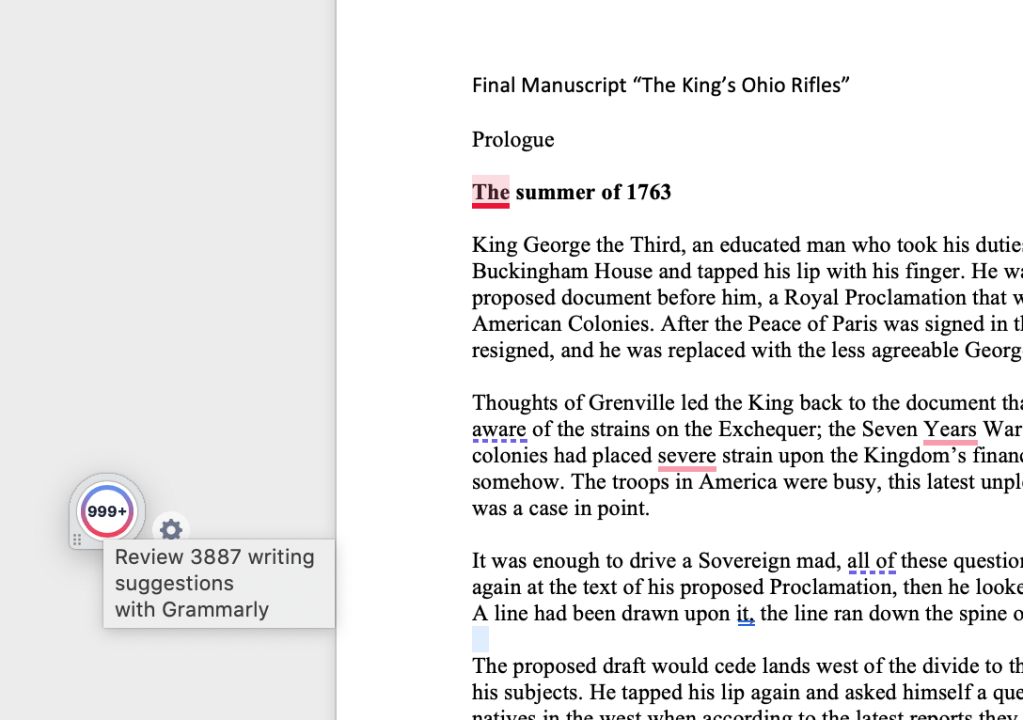
Note the window to the side, the Grammarly prompt with the number of edits for me to review on my rough draft manuscript of “The King’s Ohio Rifles,” book one of the upcoming Ohio Rifles trilogy. This is my foray into alternate history, and I would like to have it released on Amazon NLT 15NOV22.

3,887 edits is a lot of edits. True, most of them are dumb stuff like comma placement. But for a lot of them, you really have to think. In some cases you have to ignore the AI, and that’s where it gets tricky. You do so at your peril, but in dialogue especially it is often necessary.

Well, Grammarly did one hell of a job with my last MS, and I don’t expect this to be any different. The program only made one howler, and it was my fault. It changed “herd” into “heard” and a sharp-eyed reader pointed this out to me. I must have clicked the “change” box without thinking about it, and it bit me.

So far, though, that’s been the only mistake that people have pointed out. Grammarly rocks.

Note the 3,887 block once more. This is a MS that has been beta-read by a few very good readers, and I’ve made a ton of changes to the original copy in Dropbox. And still, nearly FOUR THOUSAND edits to perform! This number is not a mistake, the AI is right about approximately 95% of them.

This will take me about a week of solid effort to do. However, this step is utterly necessary.

It’s simply a question of getting it done.

I have a series of time hacks and NLT dates by which certain steps must take place. A completed cover, an edited MS, a dunk into Vellum at the end, etc.

All of this is to provide you, my readers, with suitable entertainment.

I currently have four complete and unreleased novels in the stack, so I’ll be going through this process a lot over the coming year.

Keep an eye out! If you are new to this page, click here for my published works.

Old Twist

Good morning, readers in various lands and time zones!

Today a little about one of my most successful projects ever, Old Twist the mountain fiddle.

For a little background and to see where this fiddle started from, see my earlier posts “The Mountain Fiddle” and “The Coffin Case.”

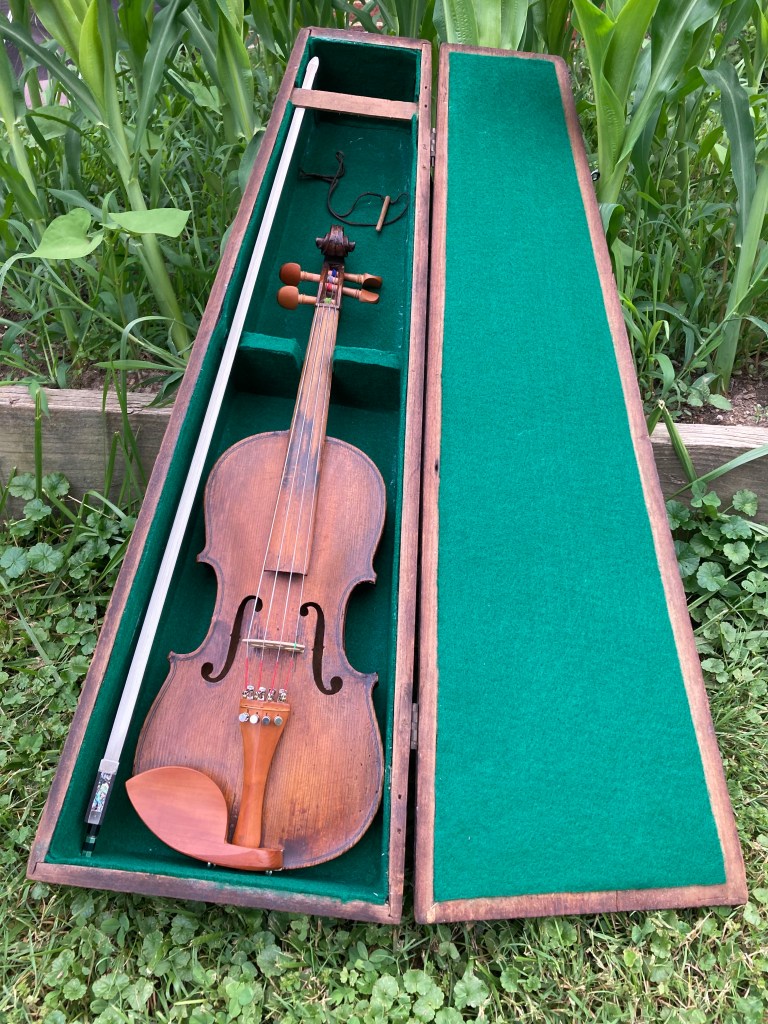
A quick recap. Several months ago, I found the violin and case illustrated above at a flea market. It was in sorry shape and needed a ton of TLC. When I bought it for forty dollars, I figured I didn’t have much to lose. Well, this violin became quite the quest. First, everything needed cleaning. Then the assembly and required refurbishing. There was a quick stop by my luthier, followed by adjustments and settling-in (the violin probably hadn’t been played since the fifties).

By mid-summer, it was finally ready to be used on a regular basis.

Note the oddly twisted scroll and strangely angled pegs. This is why this violin is named “Old Twist.” Also, it is not quite full-sized. It isn’t a three-quarter, either. It’s in a league of its own. But I digress.

I love this darn violin. It has a rich, dark sound that is perfect for mountain music and is my most comfortable violin to play. When I settle this fiddle against my cheek, it feels like I’m relaxing on the couch. Yes, it is an odd comparison, but it’s the best metaphor I can think of. This fiddle just feels right. Composed. Worn. Easy.

My instructor pointed out that Old Twist had probably been played in the past without a chinrest, and the fiddler would feel the music through their cheek. I believe it. Several people played the hell out of this violin for a century or so, and it shows. In my admittedly limited experience, I’ve never, ever seen a violin with this degree of wear.

But that’s the wonder of an old fiddle. Its age is immaterial as long as it is properly maintained and stored.

For the millionth time, I wish I had this violin’s story. Who played it, and what songs. Judging from where I bought it, I’d say the violin was manufactured and used in the Tri-State area (OH, PA, WV), more specifically in the upper Ohio River Valley. It’s a real Appalachian fiddle with a history. Just a shame I can only guess at it.

Was it played in a church? The county fair? On someone’s porch? A village band? Bonfires and wild parties, with the firewater jug passed hand to hand? I’ll never know, and this adds to my interest in this oddly constructed instrument.

All I can do is attempt to do it justice by playing the old songs as well as I can. Give it a good home. Extend its life as far as it will go.

My best guess on its age is 1800-1850, and it wasn’t factory-made. After that period, violins were readily available through mail order (Sears and Roebuck, etc.) and a village carpenter wouldn’t have bothered, as the mail order fiddles were three dollars. He wouldn’t have been able to make any money.

So, there you have it. Old Twist, the ancient mystery fiddle. It still astounds me that something so old and worn works as well as new with just a little work. This is not a concert violin by any means, but it is perfect for the sort music I like to play.

Hands down, the best forty dollars I have ever spent.

The Intro to my Universes, 99 cents.

Hey, all.

As you may know, I’m between projects at the moment and I’ve been tossing some ideas around. One thing I’ve thought about is book pricing and readership. My reader base is important to me, so one idea, in particular, occurred to me.

I decided to permanently lower the price of “In the Valley,” the first book of my original trilogy, to USD 99 cents. This lowers the barrier to people who may be interested in my books, but can’t get over the standard 2.99 USD speed bump.

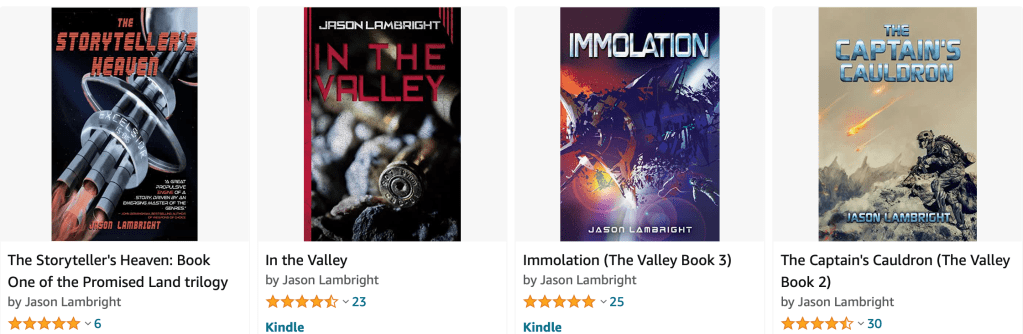
Well, this morning I instituted the change. The going rate for Valley has been changed worldwide, and hopefully it pulls people along into my original universe, and then to my latest release “The Storyteller’s Heaven.”

A few words about “In the Valley.”

First, it was my initial novel, and I think it shows. There are problems with its structure, and I dislike the cover. It has the look of crime fiction, not military sci-fi, which is what it actually is.

Second, Valley was a pretty raw book in terms of content. How it came into being was that someone, perhaps my shrink, told me I needed to write a book. At the time I was going through the US Army Medical Board and I was bored out of my skull, as well as being really, really sick of being poked and prodded by the docs. So I sat and wrote my tale, using science fiction as a touchstone.

Finally, Valley wasn’t meant to be a trilogy; that just happened. Although I intended it to be a one-off and catharsis, I did leave a hook at the end in case I wanted to continue the tale of my protagonist, Paul Thompson. When the process was completed, and the book was published, I walked away from it for a while. I never seriously considered myself to be an author.

So, I did nothing. I had no website, no FB page, nothing. Just a random book hanging out on Amazon. I maybe sold seventy copies or so, at best. And then, something strange happened.

Out of the blue, a gentleman contacted me from Wisconsin and asked a simple question.

“When is the next book coming out?”

I was retired from the Army by then, and I was touched by his interest. I began to seriously consider the next work, and this time I made a study of what worked, and what didn’t. Also, in this period I made contact with the author John Birmingham, and I read his book “How to Be a Writer.” As a consequence, I decided to take the whole writer thing a bit more seriously.

I started this website, among other things. I also planned and produced the second book in the original trilogy, “The Captain’s Cauldron.” Yes, I planned the second book, and I think it shows. I was still dissatisfied with the cover, however, but it was better than “Valley.” It sold pretty well, so I moved on to the capstone for the trilogy, “Immolation.” IMO this was the best book of the three, and I actually liked its cover.

I’ve moved on since, of course. Yes, there was a five-year publishing gap, but I was not idle during this time. I did a lot of short stories and wrote a couple of unpublished series. Part of the problem was that I had gone separate ways from my original publisher, and I couldn’t crack the code of indie publishing on a budget.

Finally, with a big assist from JB, I produced my first true indie. “The Storyteller’s Heaven,” the first book in the “Promised Land” trilogy, is the result. Oddly enough, it is the most recent thing I’ve written, the two other series, one a series of disaster novellas, and the other an alternate history, remain unpublished.

Unpublished for now. Of course, I have put out “The King’s Ohio Rifles,” the first book in the Ohio Rifles alternate history trilogy, over on patreon.com/jasonlambright. It is in rough draft serial form because that’s how I do things over on Patreon. However, I plan on releasing the ebook in November 2022 on Amazon.

Long story short, “In the Valley” is now available worldwide for 99 USD cents, and it’s going to stay that way.

The writing continues.

76,730

The screenshot above signifies happiness.

It is a file full of completed rough draft chapters of my latest book, the second of “The Promised Land” series, the follow-on to “The Storyteller’s Heaven.”

The manuscript is done, God be praised. It took an unprecedented thirteen months of labor and thought, at times I believed I would never get it finished. But here we are, and here I am, with a capped-off RD MS of 76,730 words.

I completed it this morning at 0603 hours, US EST. When I typed the last words, it felt like bliss. Pure heaven, to have this monster in the bag.

I’m looking at having this latest novel completed and launched by the middle of March.

The work doesn’t end, it just takes different forms.

Alien Invasion

Image courtesy NASA

Yeah, that image above is ‘Oumuamua, a mysterious interstellar object seen a few years back.

Pretty cool.

It only relates tangentially to my newest idea, a series about an alien invasion. Guys, it came to me yesterday during a long, boring drive in the middle of nowhere.

This is frequently how ideas come to me. My mind in neutral, cruising along. I tell myself stories as I drive. Sometimes they are stupid. Sometimes crazy. Usually implausible. But always entertaining, at least to me for a short while. Maybe I get these stories because I can’t stand to listen to the radio and my mind fills in the gaps.

Whatever. All I know is that the creative engine is cranking while I drive along. Yesterday was one of those days.

Suddenly, I had the premise for a pretty cool book, and I bounced the title off of my passenger. She and I tossed it back and forth, and I had a working title by the time I reached my destination.

No, I won’t reveal it. I won’t even reveal it over on my paywall page for my hard-core fans. Not yet, anyway.

This idea is so new it’s glistening like a newborn foal.

But it’s one of those concepts that simply must happen. I’ve seen a fair bit of enthusiasm over on Patreon, and I’ve decided that this is going to be my latest series.

Everyone loves an alien invasion, and I am no different.

This is going to happen, amongst all my other projects.

Count on it.

The Cheap Seats

Hey, everybody.

I wanted to let you know that two books of mine are discounted right now on Amazon, and they will remain so until Saturday the 20th of August, 2022, at midnight PST. Later today and tomorrow another two books will drop to 99 cents as well.

That’s right. My latest release, The Storyteller’s Heaven, is set to .99 USD cents. The original book of my first trilogy, In the Valley, is set to 0.00. Also, for a limited time, The Captain’s Cauldron and Immolation will be set to 99 cents as well, although the price on those won’t change until 0800 PST on the 16th (Captain’s Cauldron) and 0800 PST on the 17th (Immolation). Don’t ask me why these are staggered, I’m sure Amazon had its reasons.

This means that for less than the full-whack price of The Storyteller’s Heaven, you can get all four of my books this week. It’s a pretty good deal.

By all means, go over and score some copies on Amazon.

This deal was meant to reward you, my fans and readers.

Check it out!

Rights of Use by Shannon Eichorn, a review.

BLUF: A fast-paced and entertaining sci-fi read.

This past weekend, I met an intelligent and articulate author, Shannon Eichorn, at the Confluence convention in Pittsburgh, PA. She had released a debut novel “Rights of Use,” which involved alien abductions, a secret and underfunded Air Force unit, and alien/human symbiotic relationships. I’ll say right up front that the alien abduction sub-genre usually isn’t my thing, but something about her premise intrigued me. 

My reading preferences are eclectic, and it’s difficult to say which books I’ll select for my library. I chose this author’s book for a reason I can’t put a finger on. Maybe it was the whole underfunded Air Force unit thing; I can easily picture the scenario she described. One scene early on in the novel sold me on her work and kept me flipping pages.

I don’t think I’m putting any spoilers out there by describing the atmosphere at the remote Air Force base where a distraught father and politician landed to be read-in to the project. 

The oh-so-secret base was in the middle of nowhere, as one would expect, but it was a picture of disrepair and neglect. It was a dead-end for careers, complete with a seedy dayroom filled with taped-together furniture, cheesy decorations, and Hollywood posters depicting aliens. 

Anyone who has worked for Uncle Sam would recognize such a space. Lack of funding, penny-pinching, and careless use by government employees permeated her description. I thought it was authentic to a tee, and curiously enough, the dayroom setting in this “secret and powerful” base shot me ahead into the narrative.

The only things missing in her description were the scent of Pine-Sol, a bored enlisted trooper watching some crappy movie on an old TV, and a pot of vile coffee brewing in a stinky corner.

I thought this scene was wonderful. 

It took me a little while to get into her world-building; at first, there was some confusion. It was OK, though, because she resolved my questions as I plowed through the narrative. This is as it should be.

Something I noticed as I read was that I kept skipping over words to SEE WHAT HAPPENS NEXT. This is always a good sign for me; the author has engaged me in the given work.

Another thing I’d like to point out.

Ms. Eichorn’s debut novel is a far better effort than my own. Why do I say this?

Well, I regard “In the Valley” as a flawed work in a few regards. One of its problems is a simple lack of planning, and “Rights of Use” does not suffer from this. There is a clear structure, character development, midpoint, and acceleration to the finish. “In the Valley,” as many of you are aware, lacked some of these critical story beats. 

My first book was a study in “hold onto my beer and watch this,” it was written on a whim while I proceeded through the US Army Medical Board. Later books in the series had an outline and a structure, but the damage was done with Number One. Readers who made it through “In the Valley” to continue to the rest of the series have my appreciation and respect. Debut novels are NOT easy.

This author’s book shows the signs of careful planning and execution, which I appreciate. 

I have some minor quibbles, but they are just that, minor. At first, her “alien” words took some getting used to, but this is a standard tactic in sci-fi novels, and she didn’t overdo it. Some of the military bits weren’t entirely as I would have written them, but hey, my background and hers are wildly different. Also, a few sections required a bit of suspension of disbelief, but this is also standard sci-fi. If everything has to be hyper-realistic, I suggest you read a different book.

Me? I was content to sit back and enjoy an entertaining yarn, well-told.

Also, it turned out that some of the too-lucky escapes and surprising discoveries were… by design. I will say nothing further, as I don’t do spoilers.

If you are interested in Shannon Eichorn’s debut novel, I’d say it’s definitely worth a read. This goes doubly so with a first book and series kick-off. Very impressive.

I give it a solid four and a half stars.

Recommend.